Category: Uncategorized
Be True
There’s one certainty in writing, or in doing anything creative for that matter – not everyone is going to like your stuff. In fact, there’s always going to be people who hate what you do. It’s just not their thing, they’re not going to like it no matter how you go about it. You can’t expect everyone to be supportive or positive about your work, because it won’t happen. Same as you, people like some things, don’t like others, that’s going to be the case with editors, publishers, judges – sometimes your stuff just won’t be their thing. You can’t take it personal.
The best way to combat this is to know who you are and what you want. I was listening to a podcast by artist David Choe once, where he was talking about his life and how he became an artist. Choe was basically a juvenile delinquent, vandalising whatever he could. He talked about how he grew up doing stupid drawings of G.I. Joe figures and his early drawings that you can find online are just that, scribbles no better than anything you could do (Choe notes this himself in one of his books). But he stuck with it, and over time he developed his own personal style. His work (in my opinion) is amazing, but as impressive is his persistence and dedication to his art. It wasn’t created for anyone else, it wasn’t designed with a commercial strategy in mind – Choe has said his options were become an artist or end up in prison (he ended up doing both, but that’s another story).
What David Choe’s story highlighted to me was that you need to do your art for you. You need to know what you want and be happy with what you’re doing. And to a large degree it doesn’t matter what anyone else thinks, you stick with what you want to create, what you feel passionately about doing, and you can create something that will be wholly fulfilling. Anything can be art, any means of communication you choose for what you want to create can work, can come together, you just need to be true to yourself and be able to envision want from your work. It doesn’t matter what anyone else wants, you put your heart into something and that is something that cannot be replicated. You are putting your individuality into your work, no one else can do that. As long as you can feel happy with what you’ve created, feel that it is all it can be, then it’s right.
And that’s an important note to keep in mind – that it’s all it can be. Most times you’ll know when something’s done right, it will feel complete. You’ll also know when it’s not complete, when you haven’t given it your all. If you put out work that you know isn’t complete, that’s likely to come across, that’s the feedback you’ll get, and you have to be honest with yourself. If someone criticises something you’ve done, you have to think ‘is this the best I could do?’ Sometimes you need to be confronted with tough feedback to get the best out of your work – it’s not a stop sign, not a signal for you to give up. You need to take feedback on and use it. Keep in mind what it is you want to achieve.
My approach with my writing is that I will listen to any and all feedback from readers who want to give it to me, good or bad. If one person says they didn’t like a section, I won’t necessarily go back and re-do it (it would depend on their reasons for disliking it). But if that same section is highlighted by more than one reader, I will definitely go back and re-read it and make sure it’s communicating the story I want to tell. If I can read my work back and feel happy with it, especially if I’m reading it back months after first writing it, then I know it has something. It may need more work to polish it, but I know there’s something there and I’ll stick with it.
You, as a writer, as an artist, should never be afraid of criticism or feedback. You need to get your work out there. But you need to know your work is, at it’s core, the best it can be from your perspective. New perspectives will help you enhance it, but you need to be the one who feels confident – it’s your work. It needs to be you, not what you think someone else might want. You’re going to get rejected and criticised, but that’s how it is. All writers get rejected. All of them. Don’t let rejection get in the way of what you want. If you know that you have done all you can, that your work is the best it can be, in alignment with what you want to achieve, then you should stick with it. Keep working, keep developing your own style. You only fail as an artist when you give up.
Reading Out Loud
One of the methods Christos Tsiolkas passed onto me when editing was to read my work out loud. Christos would take a scene I’d written and read it out loud to me, showing me what he, as a reader, would get from it. And what I found was he’d often put a different intonation or emphasis than I’d intended, highlighting how sections were not as clear as I might have thought they were. But then I too would read out a section, and I’d find the same thing. Sometimes the story flow, in your head and as you’ve written it, will not come across that way in the mind of someone else. But reading it out loud helps detect this, helps you see the flaws and iron them out, re-wording and re-working them to ensure the message is clear.
It’s been a massive help to me as I go through, particularly when I’m stuck on a scene or section. It can be embarrassing and you need to find a space to do it, but reading your work out loud can be extremely valuable when editing and re-writing.
Kevin Smith
I’ve been following with interest the production of Kevin Smith’s latest film ‘Tusk’. As you may be aware, Smith’s first steps into this project began on his weekly podcast ‘SModcast’, which he hosts with producer Scott Mosier. The idea came from an article about a man who posted a hoax ad online seeking a room-mate. The ad told the tale of a man who’d been isolated on an island for many years, whose only friend in that time was a walrus, and went on to say that the room was available rent free, provided the new tenant be prepared to wear a walrus costume on demand to remind the owner of the time he’d spent with the walrus, which he considered his true friend.
Along with the many thousands of SModcast listeners, I was witness to this first conversation Smith and Mosier had about the project. That conversation evolved into a ‘what if?’ discussion about a possible horror film, and that has now progressed into an actual Hollywood feature, ‘Tusk’, which Smith is currently editing. The progression has been amazing, not only because of how fast it’s evolved into a living, breathing thing, but that we, as the audience, have been there for every step of the ride.
Kevin Smith is a truly inspirational character. Whether you like his work or not, you have to acknowledge his place as a pop-culture icon. Smith stands as a beacon for all the would-be film-makers out there – a guy who came from nothing and made his own way to major success. Many film-makers working today quote Kevin Smith as an inspiration, and his speaking tours always sell out around the world. Smith has succeeded as a film-maker, but more importantly, Smith has succeeded as an inspirational figure.
I’m not a fan of everything Smith does – even Smith discusses his dislike of some of the films he’s made – but I am a fan of Kevin Smith as a person. He genuinely cares about his fans and about providing them with authentic content and experiences. He looks to provide opportunities and support for others (including his high-school friends who still feature in his projects). He regularly calls for his fans to start doing podcasts, start making films, spruiking the freedoms and opportunities we all have available to us in the digital age. With the progression of ‘Tusk’, he has once again shown how an idea can be realised – no, we don’t all have Smith’s connections, but the process is very similar, albeit with more hoops to jump through.
Smith has been saying for sometime that he is retiring from film-making. That he wants to make way for the next generation, that he doesn’t have anything more to say in film. He said this about ‘Clerks 3’, which is still going through the pre-production process. He said it about another film before that (‘Hit Somebody’), then ‘Tusk’ came out of nowhere. I sincerely hope Smith doesn’t retire from film-making. I hope Smith continues to go with the flow, see what opportunities come up, flow with them right through. Maybe he makes ten more films, maybe none, but just having Smith out there working, showing the next generation how things can be done, how you need to follow your heart and ideas and produce content, whether it goes somewhere or not, is something, I think, many people need. Just having Smith as an example of what can be done if you give it a shot provides so much benefit to not only his fans, but anyone working in a creative field. Just try it. Just send it out. Just have a shot, get your work out there. If you feel passionately about something, if you really want to do it, then you should do it.
One of the things Smith always says is you should be a ‘Why not?’ person, not a ‘Why?’ person. You need to surround yourself with ‘Why not?’ people. You say you want to make a film – why not? You want to write a book – why not? Why not you? Why can’t you be successful? Why can’t this thing you’re working on now be the thing. This is excellent advice and one I think we should all try to apply to our day to day lives, and not just in creative work. Anything is possible, but it has to start somewhere. Why not with you, right now?
Kevin Smith shows us that following your heart and sticking with what you love can lead to success. Working with the people you want, being true to yourself, expressing your own voice – sure, not everyone can make a career out of this, but Kevin Smith is a living example what is possible. I sincerely hope he continues to create and shine light on the path for generations to come.
My Top 5 Films of 2013
Here it comes – we’re nearing year’s end so get ready to see list after list of top tens. Rather than fight it, I’m going with it (though I’ll only go five to save you from fatigue) – here are some of the best films I saw in 2013:
1. Mud
I’ve written about Mud briefly here, but definitely Mud was my favourite film of the year. It was released in 2012, but only made it to Australia in 2013, so I’m counting it. For people who think traditional film storytelling is being pummelled into submission by visual effects, a never-ending number sequels and movies based on board games, you should check this out. McConaughey is great in this.
2. Prisoners
The most tense, gripping film I’ve seen this year was Prisoners. The story was clever and compelling, forcing the viewer to question not only which character was behind the crime, but what lengths would be acceptable to obtain the answer (reminded me of the also excellent ‘Unthinkable‘ which is definitely one to check out also). Jake Gyllenhaal and Hugh Jackman are so good in this movie – Jackman’s best performance ever, in my opinion (yeah, he is Wolverine, but in a dramatic sense, this is a better performance).
3. The Kings of Summer
So good. I’d read some of the buzz about this film and it definitely lives up to everything promised. As a comedy, it’s pitch perfect and the dramatic elements are weaved through, so you’re not quite sure which way it’s going till the conclusion. The lead actor, Nick Robinson, is someone we’re going to see a lot more of in future films, no doubt.
4. Captain Phillips
I only saw this recently, but it’s right up there with the best things I’ve seen for the year. Going in, I wondered whether they would be able to sustain the tension of a whole film (as this is based on a true story), and early on I had my doubts (Tom Hank’s accent seemed odd in the first scenes and the pace takes a moment to kick in), but it’s an amazingly well done film. Director Paul Greengrass knows momentum and story has become such a good film-maker. Captain Phillips continuously raised the stakes as the film moves along and Hanks gets better and better, till the final scenes, where he delivers five minutes of pure acting brilliance.
5. Monsters University
When I head Pixar were doing another ‘Monsters’ film, I thought they might be coming off the rails. ‘Brave’ was good, but not up to their usual brilliant standards and ‘Wreck it Ralph’ the same, entertaining, but just some flaws that you usually wouldn’t get from the perfectionists at Pixar (note: a reader has corrected me on this, Wreck-it-Ralph is not Pixar). The first time I saw Monsters Inc, I thought it was okay, but in subsequent viewings (I have two young kids, I’ve watched it a lot) I’ve come to really like it. Even if you stop seeing it as a Monsters film, as a college film, it’s right up there with the best. And I loved the message in the end, that life is what you make of it. Great film.
Brevity
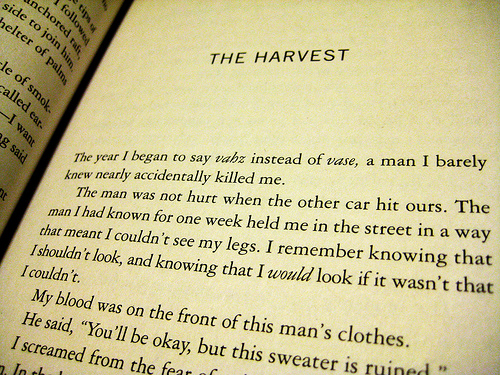
Brevity – keeping things simple, keeping the story moving – is something I always try to keep front of mind in my writing. Is the information necessary? Does it impede the story flow, rather than enrich it? Is it adding anything to the reader’s view? I generally write in a minimalist style, so brevity is important, getting in those key details and trying to find more creative, intelligent and engaging ways to communicate the story.
In an article by Chuck Palahniuk, he broke down minimalist storytelling, based on the work of the amazing Amy Hempel and her story ‘The Harvest’. The rules of minimalism Chuck notes are:
• The first thing you study is “horses.” The metaphor is – if you drive a wagon from Utah to California, you use the same horses the whole way. Substitute the word “themes” or “choruses” and you get the idea. In minimalism, a story is a symphony, building and building, but never losing the original melody line. All characters and scenes, things that seem dissimilar, they all illustrate some aspect of the story’s theme.
• The next aspect, Spanbauer calls “burnt tongue.” A way of saying something, but saying it wrong, twisting it to slow down the reader. Forcing the reader to read close, maybe read twice, not just skim along a surface of abstract images, short-cut adverbs, and clichés. In minimalism, clichés are called “received text.”
In The Harvest, Hempel writes, “I moved through the days like a severed head that finishes a sentence.” Right here, you have her “horses” of death and dissolution and her writing a sentence that slows you to a more deliberate, attentive speed.
• No abstracts. No adverbs like sleepily, irritably, sadly. And no measurements, no feet, yards, degrees or years-old.
In The Harvest, Hempel writes, “The year I began to say vahz instead of vase, a man I barely knew nearly accidentally killed me.”
• What else you learn about minimalism includes “recording angel.” This means writing without passing any judgments. Nothing is fed to the reader as fat or happy. You can only describe actions and appearances in a way that makes a judgment occur in the reader’s mind. Whatever it is, you unpack it into the details that will re-assemble themselves within the reader.
Amy Hempel does this. Instead of telling us the boyfriend in The Harvest is an asshole, we see him holding a sweater soaked with his girlfriend’s blood and telling her, “You’ll be okay, but this sweater is ruined.”
• Last point – “on the body.” Hempel shows how a story doesn’t have to be some constant stream of blah-blah-blah to bully the reader into paying attention. You don’t have to hold readers by both ears and ram every moment down their throats. Instead, a story can be a succession of tasty, smelly, touchable details. What Spanbauer and Lish call “going on the body,” to give the reader a sympathetic physical reaction, to involve the reader on a gut level.
These rules obviously can’t be applied to everyone’s work, but knowing them, thinking about them, will help you in being more creative and cerebral in how you communicate story. I especially like the ‘no adverbs’ rule, and I believe applying this, or at least thinking of options whenever you do use an adverb, makes you re-think what you’re saying and come up with creative solutions. I’ve noted this before, but it’s like Twitter, where you’re restricted by a certain number of characters, forcing you re-think what you want to say, abbreviate, and often you’ll find a smarter, more succinct way of wording it because you have to. You should also apply this to your writing, try to think through the best way to say what you want that is the most evocative and, as Chuck says, the most ‘on the body’, eliciting a physical and mental reaction with the reader that will better engage them with your scenes and characters.
Fifty Feet
If you saw fifty feet, you’d think differently,
Two hundred and fifty toes pointing up to the sun,
Ankles attached to stiffened legs,
Fifty feet of pale soles, worn and calloused from life,
Fifty feet that felt socks and touched water and danced,
Two hundred and fifty toenails degrading in the sunlight,
If you saw it, your perspective would be different,
Feet of twenty five children,
Poking from underneath the plastic,
Charred black, chilled blue,
The feet of twenty five people you know,
Their skin, their touch,
Hearts no longer pumping,
Fifty feet, lying dead still in the gusts,
Waiting for the next world,
Please don’t,
Don’t tell me they are just ‘bodies’,
If you saw fifty feet, you’d see things differently.
New Short Fiction – Tincture Journal
The good people at Tincture Journal are publishing one of my short stories in their latest journal to be released shortly. For more info:
http://tincture-journal.com/2013/11/27/issue-four-table-of-contents/
The Hero’s Journey

There’s a book I read many years ago called ‘The Writer’s Journey’ by Christopher Vogler. In it, Vogler has studied the work of mythologist Joseph Campbell and how it has been applied to storytelling throughout the years. Campbell studied story telling through cultures and generations and found similar elements existed in all tales, more complex than just a beginning, middle and end. Campbell called this ‘The hero’s Journey’ and detailed how the hero would always be faced with certain challenges and hurdles. Vogler took this research and applied it to a more modern medium, film, making it much easier to comprehend and apply, as you have all the reference points in your head already. Vogler’s contention is that all films have The Hero’s Journey at their heart, and he goes on to give example and example of this applied to modern films. And it’s amazing.
If you don’t have this book, you need to get it, in my opinion it is essential reading for all writers. For example, George Lucas used Joseph Campbell’s research to write ‘Star Wars’, plotting out all the key notes based on The hero’s Journey – Vogler discusses this in intricate detail. Interestingly, Lucas used The Hero’s Journey again for ‘Willow’, applying the rules and plot points exactly as noted in Campbell’s research as something of a test to see if following them exactly would be a ticket to success (which, it alone, wasn’t, based on ‘Willow’’s box office performance). Vogler even breaks down ‘Pulp Fiction’ as a challenge in the book.
The thing is, when you read it you’ll note that most of the elements are already evident in your writing. You instinctively know story structure and pace from watching films and reading books, so a lot of it, you’ll fine, is already present in your work. But having the knowledge of how story structure works, understanding why each step happens when it does, all this is invaluable information to have and will help you solidify and strengthen your writing.
The below image breaks down the steps of The Hero’s Journey – some, if not most, of it won’t make any sense without the further context of the book, but these are the elements that occur, or should occur, in all stories in some form. I highly recommend all writer’s obtain a copy and go through it. Essential reading.

The Future of Journalism
I was watching a clip from Russell Brand’s latest show recently. In the clip, Brand was criticising the way he is portrayed in the media, saying they regularly use blatant untruths or information clearly taken out of context. Brand gave an example of an interview he did with MTV, where the presenter asked him a generic question to finish off – ‘What advice would you give the pop stars of today?’ Being a generic question, Brand gave a joke answer – ‘They should all take heroin’. The Daily Mail, Brand says, then ran a story on this under the headline: ‘Brand Tells Justin Bieber to Take Heroin’. This is clearly a sensationalised and mis-interpreted summary of what he’d said, an inaccuracy designed to push up hits.
The sad fact of it is journalists are being forced, to some degree, to report in this way. Tabloid sensationalism has always existed, but the new emphasis on page click metrics means journalists need to do whatever they can to make readers to press that mouse button on the headline. The more sensational it is, the more clicks it’s gonna’ get, plain and simple (I have no doubt Brand knows this too, but was making the point for evocative purposes). In fact, journalism seems to be becoming more and more of a dot-to-dot puzzle of keywords, with journos weaving the story as best they can between the search terms to ensure they maximum ‘click value’, and thus, better advertiser spend.
This got me thinking about the future of journalism, and more importantly, journalist jobs. With all the focus on clicks and sensationalism, that model, at some point, loses it’s effect, right? It’s like when you watch an ad for a TV show and it says: ‘You won’t believe what happens next…’ Then you watch the show and nothing happens. At some point, those promos lose their effect because you know they’re over-selling it to suck viewers in. Surely that’s true for journalists and publications too – the publications that continue to do it will at some point wear down your trust and you’ll look elsewhere for more balanced or more realistic reporting. But traditional media providers, in particular, are been forced into this style of blatant sensationalism. They’re scrambling, doing whatever they can to keep your eyeballs with them as they battle against the rising power of social media platforms. And looking at the data, this is a battle they ultimately cannot win. Here’s why:
Your Local Newspaper is Dead Meat
I read an article the other day, published by TheNewspaperWorks, which trumpeted the ongoing strength of press publications in the real estate sector. The writer backs these claims with data showing a large number of property buyers still rely on press publications, saying:
‘…newspaper real estate sections remain a critical influence in the buying cycle…’
This information was not surprising – the average age of a home buyer is 30+, on a good wage, etc. The major threat to all newspapers is social media, and the vast majority of social media users are under 30 years old. Those two numbers alone, with no other research, correlate to the above data. What’s missing from the NewspaperWorks article is the comparative numbers – the article says the numbers are still strong, but it doesn’t discuss the trends and changes over time. If it did, you’d see that graph descending, showing that over time social media and online use is eating into all readership and advertising numbers. That number will only continue downward as the next generation of consumers, increasingly familiar with social media, continue to move into older demographic markets like real estate. It’s one thing to say the numbers are okay now, it’s another to say where they’ll be in five years time.
Local papers are becoming less relevant as people become more aligned with Twitter and Facebook. Most people get the local paper, flick through, see if there’s anyone they know, then put it down. The local press used to serve more of a purpose in regards to local classifieds and news and events postings, but people these days rely on Facebook groups for information or web searches to find local services. That drop in relevance is obviously resonating with advertisers, as Australian regional newspapers reported a 17.7% decrease in advertising spend in the last financial year. Couple this with the fact that Facebook recently flagged their next advertising target would be small businesses, and the future is looking exceedingly grim for your local paper, which is obviously a major issue for young journalists, many of whom get their career start via cadetships with suburban and regional publications.
The other factor that signals the end of local newspapers – people can now follow local identities and influencers on Twitter and Facebook and stay up to date on local news. Where they once had to wait for the local paper to be published to get an update on a story, readers can now get news and updates as fast, or faster, than the local journalists can. The relevance of that local paper in the information cycle drops with every person who joins a Facebook community group or clicks ‘follow’ on a relevant local influencer, and it’ll be almost impossible for those publications to remain viable businesses as the next generational of digital natives become the target market. There’s nothing you’ll be able to report to them they don’t already know. Within five to ten years, suburban and regional publications won’t exist in hardcopy form.
Metro publications will survive longer, but not a heap longer. The divisive move to paywalls won’t be the solution either – why would a people to access news and information they can obtain for free from their Twitter account? Twitter and Facebook also provide the users with more customisable options for the news they get, so they can not only stay as up to date as any newspaper can, but they can do so on specialised topics and not have to pay for the additional content they won’t read. Of course, the argument is that people will pay for quality content, which is true (and many niche titles have had varyng levels of success with payalls based on this model), but the newspaper is mostly news. How much of it is editorial content – or, more specifically, how much of it is editorial content that readers will pay for when they could just follow the relevant influencers and track the conversations on Twitter and Facebook and remain just as informed? Seems like a tough value proposition, and one that’s no doubt got tougher as mainstream publishers try to produce more click worthy content, what with the keywords and headlines, etc.
Pretty soon, you’re going to be telling your kids how you used to read the news on paper that you bought from the shops, the same way my Dad tells me about how they used to gather round the wireless in the days before TV.
The Generational Shift
Of course, this is nothing new, I’m not blowing anyone’s mind with some revelatory powers of predictive genius, anyone in the media sector is accutely aware of these issues. The issue people may be less aware of is how fast it’s happening. Obviously, the smartphone penetration rate is currently the biggest factor in the shift, and Australia has one of the highest smartphone penetration rates in the world. According to data from Google, Australia’s penetration rate went from 37% in 2011 to 65% in 2013. That is a massive shift in an incredibly short space of time. While the major media corporations are definitely aware of this change, this data would suggest the death of the print newspaper is closer than many would think.
The biggest issue now facing traditional media producers is the generational shift. For the next generation of consumers, social media is already engrained in their day to day lives. It’s part of who they are. They live on Facebook and Twitter. They have no connection to a newspaper in physical form. As that generation comes through, it’ll be impossible to maintain the viability of print editions. But the change is also deeper than that. It’s not only affecting how they consume, but what they consume.
The next generation can choose the news they want see. They can follow whomever they want on Twitter for updates, get the news relevant to their interests, disseminate that with their friends on Facebook. It’s this that poses the biggest challenge for traditional media to capture. It used to be that they would tell us what the news of the day was, what was happening in the world, readers went to them for the info. But now readers can stay ahead of the curve, they can access all the information journalists can, just as fast. Now the media has to tailor their info to the readers in order to win readers with great content. It’s a significant shift in process and one many publications are struggling to combat – how do you stay relevant when you no longer control the information flow?
That’s not to say there’s no place for great journalism, there is and there always will be, but it’s getting harder for journalists to find a niche, an area they can own and make a career out of. The opportunities for journalists, in a traditional sense, are drying up and getting paid work will continue to be a challenge for all those in the field.
‘Branded Journalism’: The Future?
So what do you do? You’re a young journalist keen to get into the field, knowing you’re effectively chasing a dinosaur to ride. Will we lose great writers and insights because they need to get paid doing something else? Sure, there’s more opportunities to present your voice online, and it’s possible you could secure independent advertiser spend to fund that, but with so many voices and fewer central arbitrators, securing that sort of independence is going to remain a challenging proposal. One area that is interesting, that will undoubtedly grow as businesses push to best utilise social media platforms, is branded journalism.
It’s an element that remains key in the new media landscape – the power of storytelling. For a brand, being aware of the power of social media alone is not enough to ensure success. You can’t just fire up a Twitter account and whack on an Instagram profile and be down with the kids. Businesses need to produce shareable content. You want Facebook likes? You have to give people a reason to forward it on. You want re-tweets? People need to see the content and think ‘my followers would be keen to know this’. There has to be some substance to get ‘virality’ – it is one element that cannot be faked (or not entirely, though people continue to try). If businesses want to win in the social media landscape, they need to be active on social platforms, they need to produce engaging content that gets noticed, and they need to understand their online presence, what their target audience want to share. This was supported by a recent article by ShopSocially CEO Jai Rawat (here) in which used data from Searchmetrics to show the influence social media engagement now has on SEO. In the article, Rawat’s number one point to ensure content is more shareable and reaching it’s full engagement potential:
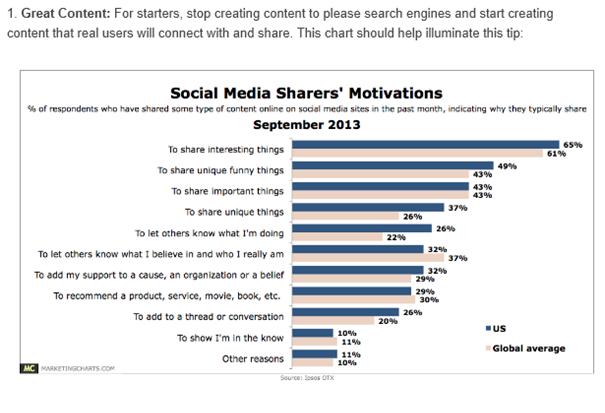
Great content. You know whose best placed to help businesses produce great content? Great writers.
The stories that get shared around the digital landscape are, above all, solid stories. Think about what was the last non-fiction story you re-tweeted (BuzzFeed lists don’t count). Why did you share it? What did it have that made you think your followers needed to see this? As noted on the graph above, people want to share interesting, funny and important things. Or they want to share what they’re doing, what they believe in. This is an area where businesses need engagement, they need real stories, real content that real people will read and share. Definitely, I can imagine some would instinctively recoil at the thought of their journalistic integrity being dictated by a brand affiliation, but there amazing opportunities for journalists and writers to help brands find authentic stories, real stories of people who benefit from their affiliation with the brand. Red Bull do great branded content, Under Armour does some great work – there are great brand stories to be told.
Brands that can provide engaging, interesting content to promote their products without pushing them in your face are the ones that will win the battle for social media dominance. Branded journalism will be one of the key factors in solidifying and strengthening brand image in the new media landscape, and ensuring ongoing success. The key to this will be the stories, making those links organic, making the brand a part of community discussion.
And maybe that need for stories, for intelligent, researched content, will help keep many fellow writers and journalists doing the work they love in the ever evolving media landscape.
Weekly Writing Challenge – Haiku
I haven’t tried one of these before, but I’m having a shot at the Daily post Writing Challenge this week – which is ‘Haiku Catchoo!‘, writing five haiku poems for the week. Haiku poems, as noted in the challenge post are:
‘A traditional haiku has 17 syllables or “sound units” known as morae. The syllables are broken into three lines, where the first line has five syllables, the second line has seven syllables, and the final line has five syllables (5/7/5).‘
I’ve never done one before, but here goes my five:
Lonely
Lonely, I wait for,
The time when you return to,
Hold my hand again
My Son
My son doesn’t speak,
He reaches forward, eyes closed,
And touches my face.
Rain
I can smell the rain,
Coming over the distance,
Grey clouds flood the sky.
Beach
The beach reminds me,
Of a time when I was young,
And nothing mattered.
Flowers
I don’t get flowers,
They die when not in water,
But they make her smile.
 twenty six