Tagged: better writing
novel to film pipeline
The gradual downfall of the novel has been coming for years, and the age of generative AI is set to exacerbate that even further, as more and more platforms get flooded with AI junk, that, by definition, is derivative.
AI tools can only draw on existing data sources, so what you’re going to get is a regurgitation of things that have come before. Now, you could argue that, based on influences, everything is a reimagining of things that have come before it. But AI content is literally a reinterpretation of whatever inputs it has.
Match the declining quality (in broad terms) with a less engaged reading public (scrolling their phones when they have time instead of turning to books), and that sets a clear path for the decline of the novel. Which is why fewer literary works are selling, and we’re seeing fewer and fewer breakout literary sensations as a result.
But there is another impact here that’s less discussed, in the decline of films being adapted from books.
It used to be that new arthouse films would come out every other week, based on this or that novel. But these days, the only films getting a cinema release are big screen action stories, things that have been designed for large screen viewing, as opposed to being watched at home.
Which makes sense. These days, home cinema set-ups largely replicate the cinema experience for films that don’t rely on special effects, and no one’s buying tickets to movies that don’t have some sense of cinematic experience. But that also puts less emphasis on rights sales, and less opportunity for publishers to make money from selling books to filmmakers, which further reduces the impetus for them to concentrate on this element.
The hope had been that Netflix’s local content deals would revive this to some degree, and give more local authors an opportunity to see their literary works on the big screen. But that hasn’t happened. Netflix films are bad, with almost every one I’ve seen basically collapsing in on itself in the third act. Netflix has sought to give directors free reign to create what they want, but either their script selection hasn’t been up to scratch, or the directors need more oversight, as there are just not that many breakout hits in the app.
And that’s not just my opinion. Netflix released 589 originals in 2024, with 79 of them being films.
How many of them do you recall?
On average, Netflix productions receive lower audience ratings. Yet this is the key source of content, with Netflix being the biggest digital distributor, outside of YouTube (which doesn’t produce films) at present.
So again, the book-to-movie timeline has now been altered, to the point that this is not a viable or valuable pathway for most authors or publishers. Which reduces your opportunities even more, and hastens the fall of the novel.
In other words, if you want to get published these days, major publishers have less and less motivation to back your work, as the opportunities for monetization, through direct sales and rights deals, are reducing day by day.
what does good writing mean in 2025?
This is a question that I’ve considered a lot – is good writing the peak of literary form, as in the construction of beautiful sentences, the creation of vivid worlds, the expression of emotion within paragraphs, all based on honed skill? Or is good writing what sells, and thus, defined more by what grabs attention and holds it? Which, based on modern sales numbers, would be more cliche, action romance-style content?
Because to me, great writing is writing that conveys real emotion. Great authors are able to recreate the emotional sense of the scene that they’ve imagined within the body of the reader, making reading a novel the closest thing we have to viewing the world through the eyes of somebody else. The setting, the concept, the idea that you’re exploring, all of this needs to be exuded through the words that you choose, and the specific placement of each verb needs to add to the broader picture, and draw out the emotion of each scene.
This is the pursuit of all great writers, and yet, I would argue that some of the best writers on this front likely wouldn’t sell many copies in the current literary landscape.
Does that mean that this is no longer ‘good’ writing? Is good writing defined by the market? By the readers? Or is good writing based on the sense that the writer gets from creating it?
It’s hard to define, and success, of course, is relative. I once wrote a kids’ book series for my own children, with the idea being that it would expand upon literary concepts and mechanisms as each book went on. So by the third book, we have more metaphor, while the first is more expository and flat. The idea, in my head at least, was that this would open their eyes to literary and storytelling devices, and that would help them create better stories of their own.
Maybe that worked, but then again, if other readers don’t have the same understanding, does that even matter?
If you want to sell books, then more straightforward, escapist stories are doing better right now. The reading public has less time to commit to a novel, so they’re more likely, seemingly, to engage with books that go from point-to-point, in quick succession, with driving, fast-paced narratives that don’t require a lot of considered thought.
This is a generalisation, of course, as there are still some novels that gain traction that do require more analysis and questioning. But I’ve literally been told by some within the publishing industry that as a middle-aged male author, I need to be concentrating on thrillers and fast-paced stories, as opposed to literary fiction.
Because that’s what sells, and as such, should those teaching writing courses be focused on what would be considered good, artistic writing that explores the virtues of the characters, and encourages deeper thought, or should we all sign up for the next action thriller workshop, and concentrate on reimagining James Bond stories in modern settings?
I don’t know the answer, but I can tell you that many great literary works are sitting on hard drives, never to be read, because the market is just not interested in them at present.
And maybe, with short-form video swallowing up all of our leftover attention spans, there’s no way back for more considered, literary works.
establish the rules of your world
I hated the most recent Star Wars films. Not ‘Rogue One’ or ‘Solo’, those were fine, while I really liked ‘The Force Awakens.’ But ‘The Last Jedi’ is, in my opinion, one of the worst films of all time, based on what Rian Johnson had to work with, and what he created as a result.
It’s also the perfect example of the need for definitive rules in world-building, and establishing parameters for your story. It doesn’t matter if it’s a fantasy novel or sci fi, or whatever else, you need to have rules, otherwise there are no stakes.
Because if anything is possible, then nothing really matters.
‘The Last Jedi’ exemplifies this, because it breaks several major rules that have been long established in the Star Wars universe, most notably in regards to Jedi powers which don’t exist.
Luke Skywalker can’t astral project himself across the galaxy. If Jedi are able to do that, why would they ever need to appear in person, and put themselves at risk? Why would they need holographic communications devices if they can somehow do even better, projecting themselves in even higher resolution, simply by meditating?
Jedi can’t see, via some unknown form of connection, what another person is seeing. Because again, they surely would have used this by now, it would have surely been linked to the strength of their personal connections, and we’d have seen it happen in another context.
Princess Leia can’t fly through space.
Of course, people will argue that none of what happens in Star Wars is real, so they can write in anything they want. But this is the point I’m making – you need to establish the rules of your world, otherwise nothing matters, and all sense of emotional connection in the story is lost.
Characters randomly coming back from the dead, things happening that are totally out of character, failing to establish a logical progression to explain a significant shift. These will all kill your story’s credibility, and lose your audience as a result.
Things can’t just happen, and it’s up to you, as the writer, to establish the rules, and/or place the breadcrumbs to facilitate key happenings
adverbs
If there was one single note of craft advice I could highlight to all writers, it would be this:
‘Avoid abstracts. No silly adverbs like sleepily, irritably, sadly, please.’
This is from Chuck Palahniuk, the author of Fight Club. And while I don’t intend for this to be an endorsement of all of Palahniuk’s writing (I love Fight Club, Survivor and Invisible Monsters, not so much his later stuff), it’s one of the best tips for writers in leaning into the ‘show don’t tell’ mindset.
Because a lot of people have trouble understanding what ‘show don’t tell’ actually means. This rule forces you to apply it.
So, rather than saying ‘he moved quickly,’ you’re going to have to come up with a description to add color to that term.
‘He moved like a snake lunging towards its prey.’ Depending on the movement, this would be a more specific, more visceral, and more engaging description that better captures the actual action or scene.
I hate reading bad adverbs. Quickly, rapidly, speedily. Harshly, roughly, leisurely. All of these can be written better, and can help to build the story through creative, mentally engaging, descriptive means.
Adverbs are lazy. I mean, not all of them, and you are going to have to use some. Also, simplicity often works best. But it is worth reviewing any adverbs that you’ve included, and to think about what you’re describing.
I’m willing to bet that in a lot of cases, you’ll come up with a better option.
what AI can’t do
One of my favorite senitments at the moment is that ‘Hollywood is in trouble’ due to AI, with the suggestion being that AI video generators are soon going to enable a new wave of film creation, that will eventually see all kinds of regular folk building their own cinematic empires, because they can generate Hollywood level animation, or similar, with AI tools.
And definitely, AI tools are improving. Each week, there seems to be a new advance in AI video generation, and yes, at some stage, it does seem entirely feasible that you’ll be able to put together a competent, film-length project based on your idea.
But that’s the thing. Creation itself is only a part of the filmmaking journey, and it’s the writing part, in putting together a narrative that resonates with a wide audience, creating characters that work, scenes that pop, ideas that mesh, that’s not easy. And AI cannot, and will not be able to replicate that.
For example, you’ve likely seen those Pixar-style videos generated by AI tools, with people re-posting them saying things like ‘it’s so over’.
But do you know how long it takes the Pixar team to put together a story for one of their films?
Pixar generally has a team of 10 or more writers, some of the best, most experienced minds in the business, who spend several years on story development before it even gets to the storyboard/production phase.
Pixar, like all Disney projects, uses the Hero’s Journey model as its guiding light, which is a formula extrapolated from ‘The Hero with a Thousand Faces’ monomyth structure, and is based on storytelling approaches that have been developed all throughout human existence.
And again, it takes years for them to develop these stories, using the collective experience of a team of storytellers, in order to come up with a narrative that will hit all the emotional pay-offs to maximize resonance.
AI can’t do that for you, and while AI tools may be able to help you refine a script or idea, or even streamline the conversion of your concept into actual screenplay structure, they won’t be able to polish a poor idea to the point where it’ll become a hit.
As such, even if AI tools are able to fully generate the physical elements of movie, very, very few of the ideas that get churned through these tools are actually going to gain any significant audience.
Of course, some will, and there’s no doubt that AI tools will expand opportunities for creators, by giving more people more ways to showcase their ideas in different formats. But even within that, the same rules of creation will apply, which also means that very, very few projects are going to succeed.
If you want to create resonant stories, you’re better off learning about The Hero’s Journey, and applying that to your concepts, than you would be hoping that AI tools will be able to iron out the problems with your ideas.
Most story ideas are not good, most people who think they have a cool concept for a film haven’t done the research into how to create, and it shows in the final product. I mean, even a lot of films that do make it through to production aren’t that great, and they’ve been checked and okayed by a heap of people.
So while AI tools may give you a practical means to bring your ideas to life, they won’t cover for a lack of storytelling knowledge and/or skill.
You should read this book to learn more about The Hero’s Journey in action.
horror fiction
I’ve been reading a bit of horror fiction of late, which I was guided towards via BookTok trends on TikTok.
TikTok is now one of the biggest influences of book sales, with trending titles getting big sales boosts, simply by catching on with the right creators.
So maybe there’s something to it, and my thought process was that maybe I could learn what people are reading, and maybe that might resonate with my own work.
I also came to horror fiction via Jeff VenderMeer’s ‘Annihilation,’ which is a book that I love. Annihilation, the novel, is very different from the movie that Alex Garland made back in 2018, and the book has a whole lot more depth and structural resonance, based on literary devices, not on CGI creatures.
I also love the way that it was crafted. VanderMeer says the idea came to him in a dream, and it definitely has that raw, unhinged creative feel to it, while also being tied back to a traditional Hero’s Journey model.
So I decided to read horror fiction, based on recommendations on TikTok and the results have been…
Well, not great.
A lot of horror stories don’t work for me because they focus on the freaky elements, and not on the story and logic behind what’s happening. You see this in horror movies as well, some weird thing happens, and rather than offering explanation and resolution, you get ‘demon possession.’ The devil possessed them so anything can happen, which is really annoying for anybody that’s looking for a complete story, and a logic within the setting of the narrative.
If demon possession covers everything from heads exploding to people flying, then where’s the tension? And if there are no constraints, then where’s the consequence? I just can’t go with it when you explain away everything as ‘unexplainable,’ because it’s too open-ended to have any emotional pay off.
And so many horror novels are just badly written. They focus on the horror elements, the gore and violence, and everything else is just cliche. The bad guys are clearly bad, because they do bad things, then they get eaten by the monster and you don’t feel anything much about it. The good people are kind and caring and infallible. To me, that’s not how you write a compelling narrative.
But it is interesting to consider from a broader literary industry perspective, with respect to what’s selling at present.
Do you know which chain is the biggest book seller in Australia right now? It’s Big W, and Big W’s book section is primarily focused on cliche-ridden pulp fiction, with limited depth and far too familiar stories.
But that’s what readers are buying, and maybe, then, that’s what writers should be looking to write, if they want to actually sell their work.
What BookTok recommendations have shown me is that cliches still work, and basic story structures still resonate. And maybe, given changes in reading habits, these are the only readers buying enough to sustain authors at present.
Amy Hempel and ‘The Man in Bogota’
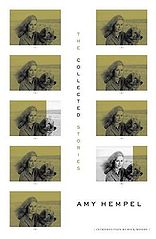
As I’ve raved about many times, I love the work of Amy Hempel. I came to Amy Hempel via Chuck Palahniuk, which seems an odd connection, but a direct one, Palahniuk also cites Hempel as one of his major influences. If you’re a writer or aspiring writer and you’ve never read any of Hempel’s work, I can’t put enough emphasis on how much I think it’s worth seeking her out – the paperback of her collected stories is less than $13 on Amazon, which is criminally cheap.
Hempel is both entertainer and educator in her writing. You wanna’ learn what show don’t tell means, she’ll teach you. Her stories are stripped down, her sentences constructed carefully, every single word is another brick added to the whole. Even describing her work doesn’t do it justice, so here’s an example of Amy Hempel – this is a complete story, six paragraphs in total. I challenge you not to read it and feel caught up by the strength of it.
The Man in Bogota
The police and emergency service people fail to make a dent. The voice of the pleading spouse does not have the hoped-for effect. The woman remains on the ledge – though not, she threatens, for long.
I imagine that I am the one who must talk the woman down. I see it, and it happens like this.
I tell the woman about a man in Bogota. He was a wealthy man, an industrialist who was kidnapped and held for ransom. It was not a TV drama; his wife could not call the bank and, in twenty-four hours, have one million dollars. It took months. The man had a heart condition, and the kidnappers had to keep the man alive.
Listen to this, I tell the woman on the ledge. His captors made him quit smoking. They changed his diet and made him exercise every day. They held him that way for three months.
When the ransom was paid and the man was released, his doctor looked him over. He found the man to be in excellent health. I tell the woman what the doctor said then – that the kidnap was the best thing to happen to that man.
Maybe this is not a come-down-from-the-ledge story. But I tell it with the thought that the woman on the ledge will ask herself a question, the question that occurred to that man in Bogota. He wondered how we know that what happens to us isn’t good.
More information on Amy Hempel.
The Benefits of Bad Storytelling

I watched a really bad movie last night. The characters were flat stereotypes, the plot went no-where, the progressions felt forced. There was basically nothing about it that was any good from a storytelling perspective. But it was kinda great. Not great in the sense that it was actually worth watching, nor that it was even entertaining, but from a writing perspective and seeing the flaws, there’s a heap you can learn from seeing what not to do. Let me explain what I mean.
When you watch a crappy film you know it. Everyone knows it. You’re not engaged by the characters, the scenes become laughable, there’s clichés aplenty. You know this, but maybe you don’t really analyse it and think about the flaws in specific detail. Most people dismiss a bad film as bad and recall a few horrible moments, but what I try to do is really understand those details, learn about the specific elements that made it so bad. Was it the acting? The story? Why did this scene or that stand out as being overly bad?
There’s a distinct value in experiencing bad storytelling, along with good. Viewing great films or reading great books is inspiring, it showcases those who are the best at the craft and awakens your imagination on what’s possible. Bad storytelling can actually have a similar effect, but in the opposite sense – you watch a bad movie and you can learn almost as much from the mistakes, from what the storytellers have done wrong, if you’re paying attention.
What I try to do is I try to imagine the original premise and how I would have done it differently, how I might have fixed it. Now, of course, my view may not be right either, but making myself think about the story, the plot, the characters, awakens my creative brain and gets me thinking more deeply about my own character development and can help me learn what mistakes to avoid, how to communicate with more subtlety. In fact, I’d say bad storytelling can provide the best education on the exact nature of the ‘show don’t tell’ principle, as this is where you tend to see the most blatant examples of the former, through overt exposition and forced story linkage. But you need to think about why it doesn’t work, what made that progression feel out of place or unnatural.
I watched Gone Girl a while back. From what I’ve been told, the book is very good, but the film, for me, left me feeling unsure about the character motivations and feasibility of the plot in the real world. As with writing, anytime your readers feel compelled to re-read a sentence or second guess a detail, that’s bad, as you’re forcing them to break out of the world you’ve created. Too many such moments, and they’ll detach from the story completely – you need to work to eliminate all moments of uncertainty or jarring, within the rules of the reality you’ve created, to build the most seamless and complete experience for your audience. Gone Girl was an example of this for me – as soon as I found myself questioning the reality of the scene, I was out, the story had lost me, and I didn’t enjoy it as a result.
At the same time, you can also learn from things you don’t necessarily like and try to understand why others might like them. I watched the Twilight saga – all of them – and yeah, I wasn’t a fan. But there was a level of compulsion to them. There were soap opera style elements which, I could see, might align people to the characters and story. Most of the time it bordered on ridiculous, a step away from all-out comedy, but there was a tension there. There was something, whether it worked for me or not.
These are just a couple of examples of how you can learn from storytelling that may not be to your taste. If you find yourself turning on a film or book, think back over why, what were the exact moments or elements that made you second-guess them? Through reflection on the details, you’ll start to see the importance of character consistency and story structure. If you couldn’t believe that a character would act the way they did, what would you have done to amplify the necessary elements to make it feel less jarring if you re-wrote it? If you think the storyline was no good, fix it in your mind, build it yourself, focus on the necessary elements to enhance and improve the believability and authenticity of the piece. How could you make it work?
Some bad films are just bad, I know, but it’s worth considering the elements, as it’s all education, all learning. A story you dislike the most might just hold a key lesson to improve the detail of your own work.
Three Notes on Dealing with Literary Rejection
Like every other writer in the history of time, I’ve copped my fair share of rejection letters. It’s tough to take, every one hurts, but you know what? It’s also inevitable. It happens to everyone. Don’t believe me?
- Stephen King was told that his debut novel ‘Carrie’ would not sell as it’s ‘science fiction which deals with negative utopias’. King had so many rejection letters that he kept them spiked on a nail – till the nail got too full and he needed to buy a spike. He seems to have done alright for himself in the end.
- Chuck Palahniuk’s first novel was not the hugely successful ‘Fight Club’, it was actually his third published novel, called ‘Invisible Monsters’. Invisible Monsters was initially rejected for being ‘too dark and too risky’. Palahniuk wrote ‘Fight Club’ as a response, setting out to make it darker, riskier and more offensive. The book was a best seller, and Invisible Monsters was published on the back of his rise to literary fame.
- Many people have heard JK Rowling’s tale, how it took her seven-years to write her masterpiece ‘Harry Potter and the Philosopher’s Stone’, which was subsequently rejected by no fewer than 12 individual publishers. Rowling was broke, a single-mother, a divorcee. She was bordering on poverty, and it was only the fact that the eight year-old daughter of the chairman of Bloomsbury read the first chapter of the book and liked it that it ever reached publication. Now, she’s one of the richest authors in the world.
- “This author is beyond psychiatric help. Do Not Publish” – A rejection note sent to J.G. Ballard for his book ‘Crash’. Crash is disturbing, but it sold well and has never been out of print. The book went on to be translated to film by David Cronenberg and was one of the author’s greatest hits.
- Jack Kerouac was told ‘On the Road’ wouldn’t sell and would be savaged by critics in one of the various rejection notes it received. You’ve heard of that book, right? More than 3 million copies have been sold around the world, and it still sells tens of thousands of copies, every year.
There’s a heap of examples of rejection letters online if you need re-assurance, but the fact is publishers don’t always get it right. No one does, art is always subjective, to at least some degree, so it’s virtually impossible for any one person to say, outright, that a piece of writing is no good. It depends on circumstance, on audience, on a bunch of other factors that come into play when assessing, and while there are many people who have an attuned sense of what makes great writing, there will always be some they’ll miss, that just don’t work for them.
So how do you deal with it? How do you take heart and retain the confidence to pick yourself up and try again after literary rejection? Here’s a couple of tips for coping with the dreaded ‘thanks, but no thanks’ letter and getting on with what you do.
Don’t take it personal. More often than not, the editor/s will have a specific thing in mind, something that they’re looking for. In this case, you weren’t it, but that doesn’t necessarily mean your work is bad. This is particularly true in the case of competitions or journals – sometimes, your work just won’t fit what they’re after. Make sure you read about the judges of competitions, what they like, get an idea of the things they’re interested in. Read about the competition hosts, the competition itself – what are they likely to want to publish as a winner. While objectivity, you’d hope, would be the main driver of any such decision, a local library group whose members are mostly elderly residents is probably not gonna’ select your extreme, cyberpunk masterpiece, no matter how great it is. Make sure you read the journals you submit to, understand what they publish, what they’re looking for. And at the end of the day, don’t take rejection personally. It’s not personal – that piece just didn’t work for what they were after this time. Don’t let it eat away at you and drag you down.
Don’t respond. At least, don’t respond straight away. Your initial reaction will probably be anger and frustration and no matter how you try to hide it, that’ll come across. I was told once that you should ensure you’re 100% confident with the work you submit to journals because if it’s no good and you keep submitting, you can get a reputation, the editors will get to know you and have a negative association before they even begin reading. I don’t necessarily think that’s true -most editors are pretty objective and they read through so much that it’d be hard for them to remember specific names (unless you submitted, like, ten times for every call-out). But one way you can highlight yourself is by responding in anger. Then you’ll be that guy/girl who fired back that one time.
This is true of anything – you should never respond when your emotions are at their highest. When you first receive a rejection letter, and you’re all full-up on frustration and hate, you’re probably gonna’ say something you’ll regret. If you think they’re wrong, you should go prove it – go get published somewhere else and be a success, there’s more than one avenue to take for the literary win.
If you really do have to respond, wait a day, at least, get some perspective, then thank them for their time in assessing your work (it’s always a privilege to have any readers, you need to keep that in mind), and tell them you’ll try again some time. A day later and you’ll feel much more logical, trust me.
Use it as motivation. As noted in the previous point, this is a chance to prove them wrong. Responding and telling them why they’re wrong proves nothing, but showing them why does. Now, I’m not saying you should go and get published then write them a note saying how they were wrong, along with the physical evidence, but shift your mindset from the darkness of rejection and turn that into motivation of future success. If you believe in what you’re doing, if you’re passionate about your work, then you should keep doing it, keep working at it, keep improving and seeking your personal goals. If someone says they’re not interested, fine, seek out someone else who will be and prove to the doubters why they had it wrong. Above all else, you’re writing because it’s who you are, it’s what you do, don’t ever lose sight of that. What other people think can’t change how you feel when doing the work. But rejection is a great source of motivation, to improve, to succeed. Go back and re-assess who you submitted to, see what they’re publishing, learn how to improve your work in-line with where you’d like it to be. Then try again.
Rejection is always hard, in any context. We’ve all suffered through break-ups which leave you devastated and confused. Literary rejection can have the same effect, though (hopefully) on a smaller scale, but the best way to get over it is to look inside yourself, at who you are and what you want to do. What makes you happy? What makes you feel strong, confident, content? That thing that you’re thinking of, that’s what you should be doing, that’s what you need to get back to in order to find happiness within yourself, not someone else. If you’re a writer, you love the work, the research, the plotting, even the editing, because it’s all moving towards making it the best it can be. And that’s incredibly exciting. And yes, you are going to get rejected. But so what? Everyone does. Take it in, action what you can, then go back to doing what you want. Because you never know what’s coming next, what big break could be around the bend. If someone could tell you how to be a success 100% of the time, they would and they’d be a billionaire – because no one can tell you this. There is no definitive path to take. The path to literary success, to any success, is unpredictable. The only guaranteed way to lose is to give up.
Should You Respond to Negative Comments on Your Blog Posts?
A while back, a contact on LinkedIn asked me about how I deal with negative comments on blog posts. I post regularly on LinkedIn, looking at social media marketing and big data, so this was not on the writing posts on this page, but even so, I think it’s a relevant discussion, and one which everyone who posts online is going to deal with at some stage. The fact is not everyone is going to like what you write. This is the same as in regular life – not everyone’s going to like you, no matter how you try. You’ll never please everyone, and while you definitely should read and assess anything and everything that people have taken the time to post in response to your work, you need to also know, within yourself, what the likely outcomes are of your reactions.
‘Never respond to critics’
At one stage in my mentorship which Christos Tsiolkas, Christos advised me to never respond to critical reviews of my work. There’s just no positive outcome, there’s nothing you can say or do that’s going to end up reflecting well on you – if a person says your book is bad and you respond with ‘well you don’t know what you’re talking about’, what then? How will that response reflect on you? Sure, responding might get you some more coverage, maybe it sparks some discussion, some writer taking on his critics, but in the majority of cases in fiction writing you’re debating a difference of opinion. Even if they’ve mis-interpreted your meaning, that’s what they got from your work, that’s the response they had, you can’t really debate that. The unavoidable fact is that the more you put your work out there, the more likely it is that people are going to talk about you – the more people talk, the higher the probability that some of those comments are going to be negative. There’ll always be one. There’ll probably be more than one. The key element to consider is how happy you are with your work – are you, personally, satisfied that you’ve done all you can to make your work the best it can be, the best representation of what you wanted to communicate? From that perspective, you’re better placed to assess whether the critic is raising a valid point worth consideration – you need to be able to assess this for yourself, and think ahead to the most likely outcome of your response or silence. You can’t be sitting over every readers’ shoulder explaining what you meant – people will take what they want from your writing. You have to let them.
‘Always respond to every comment’
Here’s where the non-fiction world differs somewhat – whilst responding to a critic of your fiction work is based purely on a subjective viewpoint, responses and comments on non-fiction work are often based on points of fact, in which case you may need to respond to ensure it’s clear to all that you’ve done the work, that you do know what you’re talking about. The general advice in social media circles is to respond to all comments, positive or negative. But even then, there are some which you just can’t – spammers send through weird things like this:

The article this was posted on was about how social media is ever-evolving. How could I respond to that? What would be the outcome of my response? My judgement in this case was that this wasn’t worth replying to, as there’s nothing to be gained from this – the only possible outcome could be further interactions with what I suspect to be a spammer. So no response.
My basic approach to dealing with negative comments on non-fiction work is stick to logic and avoid emotional response. Emotional response is reactive, so you’re best advised to take a moment to think. You need to appreciate that this person has taken the time to read your piece, that you don’t know what sort of mindset they’re in. From there, you should re-read the comment then only respond if you feel there is likely to be benefit in you doing so. You shouldn’t back away from a challenge – if the commentor is welcoming some sort of debate based on your work, then that’s a great opportunity to generate discussion and make connections with interested parties, but often times that’s not what negative commentors are seeking. Often, they’re just saying things. Understanding which is which is important in your assessment process.
The Comments I’ve Seen
So here’s a few examples of comments on my posts, and how I’ve handled them. This first comment was on a piece about partnerships between social media platforms and tech companies.
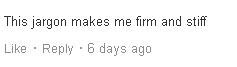
The post had more than 3k views and 100 likes, so obviously not everyone shared this commentor’s opinion that it was loaded with jargon. There’s not really anyway I could respond to this, if I say ‘good’ that provides no benefit. I could say it’s not filled with jargon, but I’m not sure it would’ve served much purpose, and the wording of the comment suggest to me that this is not really an opinion based on logic. I chose to ignore in this case.
This next one was on a piece entitled: “What Does a Lack of Social Media Presence Say About Your Brand?”

Obviously this guy felt pretty strongly about it not being relevant – though it is interesting that he read and commented on this piece on a social media network. Again, no response on this one – I doubt that my reasoning would be changing his mind at this stage.
I quite liked this one, and did respond, as per the screenshot. The piece was about how change is constant in the social media space.

Now, admittedly, I’m not sure what the commentor meant about ‘US competitive standing’ – I’m Australian so this wasn’t really in my sphere of thinking when approaching the topic – but my initial response was ‘why comment?’ The post did pretty well, it had been viewed more than 8k times and received a lot of likes, so this was obviously a common thought. To me, this person was just looking to argue, but I felt compelled to respond in this case because I didn’t want to back away from a challenge. In the end, my response is logical, stating my point, avoiding any personal or emotional conflict in my language. Whilst I do think the original comment was baited and attacking in tone, responding in kind is just not going to be beneficial. There was no further correspondence but I was happy with my response.
And then, of course, there are the people who just want to say things. Whether they’re having a bad day or they dislike the topic or they hate the look of your profile photo, some people just want to say things. Take this one for example from a recent piece (not mine) titled ‘Three Unusual Reasons Why Every Professional Should be on Twitter’:
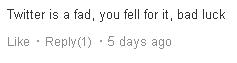
Now, there’s obviously significant evidence to counter this, but even if this was your belief, why comment on a piece about Twitter marketing? Why are you even reading it? Sometimes, people are compelled to say things, no matter what those things are or who they might be broadcast to. If you think it’s worth responding, you should, but there are times when it’s best to just leave them be.
It basically comes down to your own commonsense. You should always read every comment and take in all the info – these people have taken the time to read your work so you owe them the same respect. But you have to consider how your responses are going to be received, remain mindful of the potential outcomes. For fiction, take on board the points raised, consider them, then action them if you feel like there’s something worth investigating to improve your work. If one person comments on a certain aspect that no one else has mentioned, and you don’t necessarily agree with their opinion, then you can leave it. But if two or more people mention the same thing, in isolation from one another, then you need to re-visit and ensure your work best represents what you intended. For non-fiction, respond wherever you can, but only if you think it’s worth doing so.
The worst thing anyone can do is take the comments to heart and give up. Don’t give up. You’re always going to face some level of negativity, it’s important to take it for what it is. It’s one person’s opinion. Don’t take it personal, view it as that, as one person’s thoughts on the work presented, not you personally. Having an idea challenged is actually a great way to solidify and improve your thoughts and processes, we need diverse views to advance our understanding. But also know that sometimes there’s nothing you can say. Either way, every comment is an opportunity to learn.
 twenty six