Tagged: Writing
Reading Out Loud
One of the methods Christos Tsiolkas passed onto me when editing was to read my work out loud. Christos would take a scene I’d written and read it out loud to me, showing me what he, as a reader, would get from it. And what I found was he’d often put a different intonation or emphasis than I’d intended, highlighting how sections were not as clear as I might have thought they were. But then I too would read out a section, and I’d find the same thing. Sometimes the story flow, in your head and as you’ve written it, will not come across that way in the mind of someone else. But reading it out loud helps detect this, helps you see the flaws and iron them out, re-wording and re-working them to ensure the message is clear.
It’s been a massive help to me as I go through, particularly when I’m stuck on a scene or section. It can be embarrassing and you need to find a space to do it, but reading your work out loud can be extremely valuable when editing and re-writing.
Kevin Smith
I’ve been following with interest the production of Kevin Smith’s latest film ‘Tusk’. As you may be aware, Smith’s first steps into this project began on his weekly podcast ‘SModcast’, which he hosts with producer Scott Mosier. The idea came from an article about a man who posted a hoax ad online seeking a room-mate. The ad told the tale of a man who’d been isolated on an island for many years, whose only friend in that time was a walrus, and went on to say that the room was available rent free, provided the new tenant be prepared to wear a walrus costume on demand to remind the owner of the time he’d spent with the walrus, which he considered his true friend.
Along with the many thousands of SModcast listeners, I was witness to this first conversation Smith and Mosier had about the project. That conversation evolved into a ‘what if?’ discussion about a possible horror film, and that has now progressed into an actual Hollywood feature, ‘Tusk’, which Smith is currently editing. The progression has been amazing, not only because of how fast it’s evolved into a living, breathing thing, but that we, as the audience, have been there for every step of the ride.
Kevin Smith is a truly inspirational character. Whether you like his work or not, you have to acknowledge his place as a pop-culture icon. Smith stands as a beacon for all the would-be film-makers out there – a guy who came from nothing and made his own way to major success. Many film-makers working today quote Kevin Smith as an inspiration, and his speaking tours always sell out around the world. Smith has succeeded as a film-maker, but more importantly, Smith has succeeded as an inspirational figure.
I’m not a fan of everything Smith does – even Smith discusses his dislike of some of the films he’s made – but I am a fan of Kevin Smith as a person. He genuinely cares about his fans and about providing them with authentic content and experiences. He looks to provide opportunities and support for others (including his high-school friends who still feature in his projects). He regularly calls for his fans to start doing podcasts, start making films, spruiking the freedoms and opportunities we all have available to us in the digital age. With the progression of ‘Tusk’, he has once again shown how an idea can be realised – no, we don’t all have Smith’s connections, but the process is very similar, albeit with more hoops to jump through.
Smith has been saying for sometime that he is retiring from film-making. That he wants to make way for the next generation, that he doesn’t have anything more to say in film. He said this about ‘Clerks 3’, which is still going through the pre-production process. He said it about another film before that (‘Hit Somebody’), then ‘Tusk’ came out of nowhere. I sincerely hope Smith doesn’t retire from film-making. I hope Smith continues to go with the flow, see what opportunities come up, flow with them right through. Maybe he makes ten more films, maybe none, but just having Smith out there working, showing the next generation how things can be done, how you need to follow your heart and ideas and produce content, whether it goes somewhere or not, is something, I think, many people need. Just having Smith as an example of what can be done if you give it a shot provides so much benefit to not only his fans, but anyone working in a creative field. Just try it. Just send it out. Just have a shot, get your work out there. If you feel passionately about something, if you really want to do it, then you should do it.
One of the things Smith always says is you should be a ‘Why not?’ person, not a ‘Why?’ person. You need to surround yourself with ‘Why not?’ people. You say you want to make a film – why not? You want to write a book – why not? Why not you? Why can’t you be successful? Why can’t this thing you’re working on now be the thing. This is excellent advice and one I think we should all try to apply to our day to day lives, and not just in creative work. Anything is possible, but it has to start somewhere. Why not with you, right now?
Kevin Smith shows us that following your heart and sticking with what you love can lead to success. Working with the people you want, being true to yourself, expressing your own voice – sure, not everyone can make a career out of this, but Kevin Smith is a living example what is possible. I sincerely hope he continues to create and shine light on the path for generations to come.
Brevity
Brevity – keeping things simple, keeping the story moving – is something I always try to keep front of mind in my writing. Is the information necessary? Does it impede the story flow, rather than enrich it? Is it adding anything to the reader’s view? I generally write in a minimalist style, so brevity is important, getting in those key details and trying to find more creative, intelligent and engaging ways to communicate the story.
In an article by Chuck Palahniuk, he broke down minimalist storytelling, based on the work of the amazing Amy Hempel and her story ‘The Harvest’. The rules of minimalism Chuck notes are:
• The first thing you study is “horses.” The metaphor is – if you drive a wagon from Utah to California, you use the same horses the whole way. Substitute the word “themes” or “choruses” and you get the idea. In minimalism, a story is a symphony, building and building, but never losing the original melody line. All characters and scenes, things that seem dissimilar, they all illustrate some aspect of the story’s theme.
• The next aspect, Spanbauer calls “burnt tongue.” A way of saying something, but saying it wrong, twisting it to slow down the reader. Forcing the reader to read close, maybe read twice, not just skim along a surface of abstract images, short-cut adverbs, and clichés. In minimalism, clichés are called “received text.”
In The Harvest, Hempel writes, “I moved through the days like a severed head that finishes a sentence.” Right here, you have her “horses” of death and dissolution and her writing a sentence that slows you to a more deliberate, attentive speed.
• No abstracts. No adverbs like sleepily, irritably, sadly. And no measurements, no feet, yards, degrees or years-old.
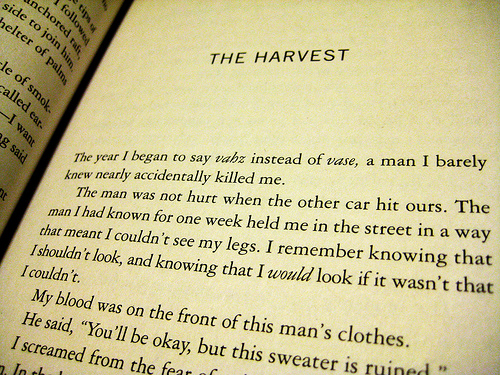
In The Harvest, Hempel writes, “The year I began to say vahz instead of vase, a man I barely knew nearly accidentally killed me.”
• What else you learn about minimalism includes “recording angel.” This means writing without passing any judgments. Nothing is fed to the reader as fat or happy. You can only describe actions and appearances in a way that makes a judgment occur in the reader’s mind. Whatever it is, you unpack it into the details that will re-assemble themselves within the reader.
Amy Hempel does this. Instead of telling us the boyfriend in The Harvest is an asshole, we see him holding a sweater soaked with his girlfriend’s blood and telling her, “You’ll be okay, but this sweater is ruined.”
• Last point – “on the body.” Hempel shows how a story doesn’t have to be some constant stream of blah-blah-blah to bully the reader into paying attention. You don’t have to hold readers by both ears and ram every moment down their throats. Instead, a story can be a succession of tasty, smelly, touchable details. What Spanbauer and Lish call “going on the body,” to give the reader a sympathetic physical reaction, to involve the reader on a gut level.
These rules obviously can’t be applied to everyone’s work, but knowing them, thinking about them, will help you in being more creative and cerebral in how you communicate story. I especially like the ‘no adverbs’ rule, and I believe applying this, or at least thinking of options whenever you do use an adverb, makes you re-think what you’re saying and come up with creative solutions. I’ve noted this before, but it’s like Twitter, where you’re restricted by a certain number of characters, forcing you re-think what you want to say, abbreviate, and often you’ll find a smarter, more succinct way of wording it because you have to. You should also apply this to your writing, try to think through the best way to say what you want that is the most evocative and, as Chuck says, the most ‘on the body’, eliciting a physical and mental reaction with the reader that will better engage them with your scenes and characters.
The Hero’s Journey

There’s a book I read many years ago called ‘The Writer’s Journey’ by Christopher Vogler. In it, Vogler has studied the work of mythologist Joseph Campbell and how it has been applied to storytelling throughout the years. Campbell studied story telling through cultures and generations and found similar elements existed in all tales, more complex than just a beginning, middle and end. Campbell called this ‘The hero’s Journey’ and detailed how the hero would always be faced with certain challenges and hurdles. Vogler took this research and applied it to a more modern medium, film, making it much easier to comprehend and apply, as you have all the reference points in your head already. Vogler’s contention is that all films have The Hero’s Journey at their heart, and he goes on to give example and example of this applied to modern films. And it’s amazing.
If you don’t have this book, you need to get it, in my opinion it is essential reading for all writers. For example, George Lucas used Joseph Campbell’s research to write ‘Star Wars’, plotting out all the key notes based on The hero’s Journey – Vogler discusses this in intricate detail. Interestingly, Lucas used The Hero’s Journey again for ‘Willow’, applying the rules and plot points exactly as noted in Campbell’s research as something of a test to see if following them exactly would be a ticket to success (which, it alone, wasn’t, based on ‘Willow’’s box office performance). Vogler even breaks down ‘Pulp Fiction’ as a challenge in the book.
The thing is, when you read it you’ll note that most of the elements are already evident in your writing. You instinctively know story structure and pace from watching films and reading books, so a lot of it, you’ll fine, is already present in your work. But having the knowledge of how story structure works, understanding why each step happens when it does, all this is invaluable information to have and will help you solidify and strengthen your writing.
The below image breaks down the steps of The Hero’s Journey – some, if not most, of it won’t make any sense without the further context of the book, but these are the elements that occur, or should occur, in all stories in some form. I highly recommend all writer’s obtain a copy and go through it. Essential reading.

The Future of Journalism
I was watching a clip from Russell Brand’s latest show recently. In the clip, Brand was criticising the way he is portrayed in the media, saying they regularly use blatant untruths or information clearly taken out of context. Brand gave an example of an interview he did with MTV, where the presenter asked him a generic question to finish off – ‘What advice would you give the pop stars of today?’ Being a generic question, Brand gave a joke answer – ‘They should all take heroin’. The Daily Mail, Brand says, then ran a story on this under the headline: ‘Brand Tells Justin Bieber to Take Heroin’. This is clearly a sensationalised and mis-interpreted summary of what he’d said, an inaccuracy designed to push up hits.
The sad fact of it is journalists are being forced, to some degree, to report in this way. Tabloid sensationalism has always existed, but the new emphasis on page click metrics means journalists need to do whatever they can to make readers to press that mouse button on the headline. The more sensational it is, the more clicks it’s gonna’ get, plain and simple (I have no doubt Brand knows this too, but was making the point for evocative purposes). In fact, journalism seems to be becoming more and more of a dot-to-dot puzzle of keywords, with journos weaving the story as best they can between the search terms to ensure they maximum ‘click value’, and thus, better advertiser spend.
This got me thinking about the future of journalism, and more importantly, journalist jobs. With all the focus on clicks and sensationalism, that model, at some point, loses it’s effect, right? It’s like when you watch an ad for a TV show and it says: ‘You won’t believe what happens next…’ Then you watch the show and nothing happens. At some point, those promos lose their effect because you know they’re over-selling it to suck viewers in. Surely that’s true for journalists and publications too – the publications that continue to do it will at some point wear down your trust and you’ll look elsewhere for more balanced or more realistic reporting. But traditional media providers, in particular, are been forced into this style of blatant sensationalism. They’re scrambling, doing whatever they can to keep your eyeballs with them as they battle against the rising power of social media platforms. And looking at the data, this is a battle they ultimately cannot win. Here’s why:
Your Local Newspaper is Dead Meat
I read an article the other day, published by TheNewspaperWorks, which trumpeted the ongoing strength of press publications in the real estate sector. The writer backs these claims with data showing a large number of property buyers still rely on press publications, saying:
‘…newspaper real estate sections remain a critical influence in the buying cycle…’
This information was not surprising – the average age of a home buyer is 30+, on a good wage, etc. The major threat to all newspapers is social media, and the vast majority of social media users are under 30 years old. Those two numbers alone, with no other research, correlate to the above data. What’s missing from the NewspaperWorks article is the comparative numbers – the article says the numbers are still strong, but it doesn’t discuss the trends and changes over time. If it did, you’d see that graph descending, showing that over time social media and online use is eating into all readership and advertising numbers. That number will only continue downward as the next generation of consumers, increasingly familiar with social media, continue to move into older demographic markets like real estate. It’s one thing to say the numbers are okay now, it’s another to say where they’ll be in five years time.
Local papers are becoming less relevant as people become more aligned with Twitter and Facebook. Most people get the local paper, flick through, see if there’s anyone they know, then put it down. The local press used to serve more of a purpose in regards to local classifieds and news and events postings, but people these days rely on Facebook groups for information or web searches to find local services. That drop in relevance is obviously resonating with advertisers, as Australian regional newspapers reported a 17.7% decrease in advertising spend in the last financial year. Couple this with the fact that Facebook recently flagged their next advertising target would be small businesses, and the future is looking exceedingly grim for your local paper, which is obviously a major issue for young journalists, many of whom get their career start via cadetships with suburban and regional publications.
The other factor that signals the end of local newspapers – people can now follow local identities and influencers on Twitter and Facebook and stay up to date on local news. Where they once had to wait for the local paper to be published to get an update on a story, readers can now get news and updates as fast, or faster, than the local journalists can. The relevance of that local paper in the information cycle drops with every person who joins a Facebook community group or clicks ‘follow’ on a relevant local influencer, and it’ll be almost impossible for those publications to remain viable businesses as the next generational of digital natives become the target market. There’s nothing you’ll be able to report to them they don’t already know. Within five to ten years, suburban and regional publications won’t exist in hardcopy form.
Metro publications will survive longer, but not a heap longer. The divisive move to paywalls won’t be the solution either – why would a people to access news and information they can obtain for free from their Twitter account? Twitter and Facebook also provide the users with more customisable options for the news they get, so they can not only stay as up to date as any newspaper can, but they can do so on specialised topics and not have to pay for the additional content they won’t read. Of course, the argument is that people will pay for quality content, which is true (and many niche titles have had varyng levels of success with payalls based on this model), but the newspaper is mostly news. How much of it is editorial content – or, more specifically, how much of it is editorial content that readers will pay for when they could just follow the relevant influencers and track the conversations on Twitter and Facebook and remain just as informed? Seems like a tough value proposition, and one that’s no doubt got tougher as mainstream publishers try to produce more click worthy content, what with the keywords and headlines, etc.
Pretty soon, you’re going to be telling your kids how you used to read the news on paper that you bought from the shops, the same way my Dad tells me about how they used to gather round the wireless in the days before TV.
The Generational Shift
Of course, this is nothing new, I’m not blowing anyone’s mind with some revelatory powers of predictive genius, anyone in the media sector is accutely aware of these issues. The issue people may be less aware of is how fast it’s happening. Obviously, the smartphone penetration rate is currently the biggest factor in the shift, and Australia has one of the highest smartphone penetration rates in the world. According to data from Google, Australia’s penetration rate went from 37% in 2011 to 65% in 2013. That is a massive shift in an incredibly short space of time. While the major media corporations are definitely aware of this change, this data would suggest the death of the print newspaper is closer than many would think.
The biggest issue now facing traditional media producers is the generational shift. For the next generation of consumers, social media is already engrained in their day to day lives. It’s part of who they are. They live on Facebook and Twitter. They have no connection to a newspaper in physical form. As that generation comes through, it’ll be impossible to maintain the viability of print editions. But the change is also deeper than that. It’s not only affecting how they consume, but what they consume.
The next generation can choose the news they want see. They can follow whomever they want on Twitter for updates, get the news relevant to their interests, disseminate that with their friends on Facebook. It’s this that poses the biggest challenge for traditional media to capture. It used to be that they would tell us what the news of the day was, what was happening in the world, readers went to them for the info. But now readers can stay ahead of the curve, they can access all the information journalists can, just as fast. Now the media has to tailor their info to the readers in order to win readers with great content. It’s a significant shift in process and one many publications are struggling to combat – how do you stay relevant when you no longer control the information flow?
That’s not to say there’s no place for great journalism, there is and there always will be, but it’s getting harder for journalists to find a niche, an area they can own and make a career out of. The opportunities for journalists, in a traditional sense, are drying up and getting paid work will continue to be a challenge for all those in the field.
‘Branded Journalism’: The Future?
So what do you do? You’re a young journalist keen to get into the field, knowing you’re effectively chasing a dinosaur to ride. Will we lose great writers and insights because they need to get paid doing something else? Sure, there’s more opportunities to present your voice online, and it’s possible you could secure independent advertiser spend to fund that, but with so many voices and fewer central arbitrators, securing that sort of independence is going to remain a challenging proposal. One area that is interesting, that will undoubtedly grow as businesses push to best utilise social media platforms, is branded journalism.
It’s an element that remains key in the new media landscape – the power of storytelling. For a brand, being aware of the power of social media alone is not enough to ensure success. You can’t just fire up a Twitter account and whack on an Instagram profile and be down with the kids. Businesses need to produce shareable content. You want Facebook likes? You have to give people a reason to forward it on. You want re-tweets? People need to see the content and think ‘my followers would be keen to know this’. There has to be some substance to get ‘virality’ – it is one element that cannot be faked (or not entirely, though people continue to try). If businesses want to win in the social media landscape, they need to be active on social platforms, they need to produce engaging content that gets noticed, and they need to understand their online presence, what their target audience want to share. This was supported by a recent article by ShopSocially CEO Jai Rawat (here) in which used data from Searchmetrics to show the influence social media engagement now has on SEO. In the article, Rawat’s number one point to ensure content is more shareable and reaching it’s full engagement potential:
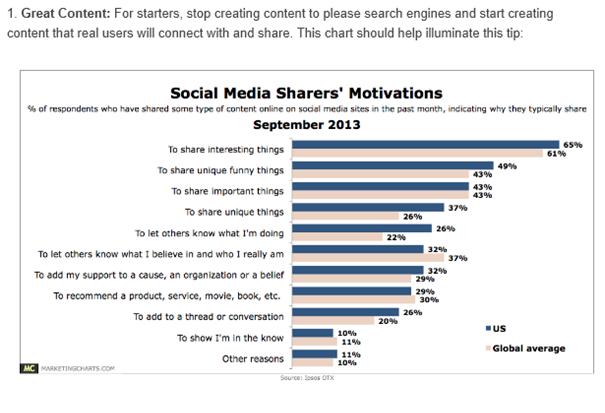
Great content. You know whose best placed to help businesses produce great content? Great writers.
The stories that get shared around the digital landscape are, above all, solid stories. Think about what was the last non-fiction story you re-tweeted (BuzzFeed lists don’t count). Why did you share it? What did it have that made you think your followers needed to see this? As noted on the graph above, people want to share interesting, funny and important things. Or they want to share what they’re doing, what they believe in. This is an area where businesses need engagement, they need real stories, real content that real people will read and share. Definitely, I can imagine some would instinctively recoil at the thought of their journalistic integrity being dictated by a brand affiliation, but there amazing opportunities for journalists and writers to help brands find authentic stories, real stories of people who benefit from their affiliation with the brand. Red Bull do great branded content, Under Armour does some great work – there are great brand stories to be told.
Brands that can provide engaging, interesting content to promote their products without pushing them in your face are the ones that will win the battle for social media dominance. Branded journalism will be one of the key factors in solidifying and strengthening brand image in the new media landscape, and ensuring ongoing success. The key to this will be the stories, making those links organic, making the brand a part of community discussion.
And maybe that need for stories, for intelligent, researched content, will help keep many fellow writers and journalists doing the work they love in the ever evolving media landscape.
Becoming an ‘Author’

I read this excellent article by author Christopher Currie recently. It raises many of the issues and observations that I’ve found since becoming a published author, and those issues are part of the reason my second novel has been de-railed so many times. Chris is an excellent writer, and he has succinctly put into words many of the downsides of being published in a way that’s not complaining about success, which is one of the things that I’ve been most fearful of when discussing the same things.
I met Chris at the National Young Writers’ Festival in Newcastle several years ago, though Chris, I’m sure, either thinks I’m a total douche or an incoherent idiot – I treated Newcastle like a weekend off and was several beers into the night when we met. I’ve always felt bad about this, because I really like Chris’ work and his observations on writing – but this article in particular stands out to me because it’s talking of the negatives of the other side of publishing, of being an actual, published author.
As Chris notes, he is not complaining about success – and I too would never complain about being published. It’s a massive achievement and the people I’ve come into contact with have been amazing, and it’s the only thing I’ve ever really wanted to do. Writing, also, is almost an instinctive process for writers, it’s something we have to do. I can ignore it for periods, but it’s always there, stories being written in the back of my mind. Being published has opened up a heap of opportunities and it remains my dream to be a full-time author. But that’s where things get a little more complicated, and this is what Chris discusses in his article.
I guess the first, and main, point, is that becoming a published author will not necessarily change your life. When I first signed a book contract, the company I was working for was undergoing a takeover. People all about the place were stressing about losing their jobs, doing all they could to make good with the incoming managers. It was a pretty sad situation, a lot of good people, good employees, stressed because of something beyond their control. Me, I had a publishing contract. I thought I was going to have to leave work soon either way, heading off on book tours, doing talks. I was about to become a full-time author, so losing my job didn’t really matter to me too much. The idea in my head was ‘book gets published, you become full-time author’ – that becomes your job, your career. But I never really thought through how that might work.
The reality is not much changed. I was lucky enough to be retained at work and when the book was released I did a few launches and talks and interviews and then, about a month later, all was quiet again. It was back to normal life. The amount of money I made from my book was actually pretty good – I won $15,000 in the Victorian Premier’s Literary Awards on top of my book contract – but it was not enough to quit my job. I then sold the film rights, and that was massively exciting, and they signed up a director and we had meetings, wrote a screenplay, all was moving along. Then that production company folded. And by now it was several months after the book’s release so the ‘hype’ around it was gone and no other film companies were looking to pick it up (several have been interested ever since but it’s never been picked up). And life was back to normal. I wasn’t a full-time writer. Chris notes this, that you’ve only got a limited shelf life, and it’s totally true, then you’re back to where you were. I’ve seen lots of discussions and articles on this, and it’s hard to know if there is a way to fix it, but for me, I just couldn’t see how I was going to generate enough money from writing alone to be a full-time author, which was difficult to take, but that’s how it is.
The second down side, I found, was the publicity. Most of it was great, great people, good to get your name out there, have people discuss your work. But the negative reviews hurt. Bad. I only had a few, but they were in major publications. I’m pretty thick skinned with my writing, I can take people having a go at me and my work, no problem. But this was something I was immensely proud of, that not only me, but my editor, my publisher, other people had believed in and put their own hard work into. And then someone can totally trash it with a few paragraphs. It hurts, but again, that’s how it is. Not everyone’s going to like your stuff, you can’t write for every person. I’m much more comfortable with that now, but it was a learning curve.
The third issue I had was with the next book. For months after the book came out people always asked what I was working on next, and it was great, people were interested. Then the second novel got bogged down and it wasn’t working and people kept asking and in my head I was like ‘stop asking about it, it’s killing me’. This is no-one’s fault but my own, but Chris made an interesting note in his article – that he, in some ways, liked it more when he was unpublished. When there was no expectation. I can totally see where he’s coming from. I had an okay manuscript on the way by the time my first book was published. I signed a new contract as soon as it was offered, with the publication date set for a year or so later. This was what I’d always wanted, I was on my way, I could do this. I completed a first draft, had it all down, the story, everything was there. But it wasn’t great. I knew it. My publisher knew it. I went back to it, tried to fix it, but started getting myself in knots. Nothing was coming together, nothing was flowing, it wasn’t what I wanted it to be. And the most frustrating part – I knew exactly what I wanted it to be, I just couldn’t get it to work. I am still working on it, still writing that second book (among other projects), and I remain absolutely confident it’s going to be great, it’s getting closer each day. But the pressure I put on myself is what has blocked me up. I was no longer just writing something that maybe someone might read some day, maybe my friends would read – I was writing something that would be seen by a publisher. This had to be amazing. Not good, this had to be great. That expectation, my own expectation, has set such a high bar that it’s made it much more difficult to be free and flow with the story.
As I say, these are not complaints or not negative enough to ever want me to stop writing. They are more observations from the other side, which I don’t see a heap of. I can’t help but love writing. I do it every day, and I love getting that flow right, having a story form in my head, the sentences stringing together. I love having to get up and scratch around to find a pen in the middle of the night to get down some crucial sentence or note. I love everything about being a writer. And yeah, it’s hard, these points just attest to the fact that it remains hard as you go. I have no doubt that big name authors have the same challenges and issues. But it’s worth it. Nothing’s better than when everything feels right with a piece and you can’t wait for someone, anyone, to read it. When you know that you’ve been able to re-create the feeling you had when writing it in the body of another person. That communication is amazing. Nothing else comes close, for me.
And nothing beats the smell as you flick the pages of your own book.
As I work my way back into writing, getting more ideas and notes down, trying different ways to remain creative and create better work, this is what I keep in my mind. It’s tough, but you’ll get it right, it’s hard, but it’s always close to that perfect stream of a story.
Poetry
I’ve written a couple of poems in the last couple of days. Not rhyming couplets, but free-form poetry, which is basically abbreviated storytelling (like this), boiling down a tale to it’s bear details and flow. I’m interested to see if, by doing this, I can translate some of the style back into longer form prose to tighten up descriptions and think more creatively.
It’s kinda of like how when you use Twitter you’re much more restricted, so you abbreviate and reduce and cut down you sentences and as you do so, you realise that you probaby didn’t need such a long description in the first place, as the shorter one works just as well and allows the reader to engage with the words more, as they have to think for themselves and put the image together in their own mind, rather than have it prescribed.
It’s another form of ‘active creativitiy’ I guess, keeping you creative mind active so you continue to think creatively as you go, so you remain open to creative thoughts and visualisations. I even did a couple of drawings the other day, just to see (they were petty bad). Another thing I’ve enjoyed recently has been catching the train. I’ve headed into the city a couple of times (I live about an hour outside Melbourne) and it’s been good, just sitting on the train, watching the people come and go. Takes me back to when I was a teenager, reading books at train stations and heading some place to meet some girl. I defintely feel that all these little things help maintain creativity and an active mind, and hopefully that’ll lead to some solid writing as I continue working on a couple of different projects.
Also, on creative output in different forms, did anyone see Justin Bieber’s latest ‘street art’? I have no real sense of Bieber, I’m not interested in him, but I’m not the target demographic, I get that, but recently he’s taken to doing graffiti – he got arrested in Brazil or something. He recently posted this picture:
So the message is positive, but that picture is, er, not good. I’ve seen some street artists do some amazing things with spray paint, even just looking out the window of the train as it passes I’ve seen good stuff. This is like a child’s drawing. And he felt so good about it that he posted it, so he’s pretty happy with how it looks. I mean, if he’s happy with it, he’s happy, and his fans will probably love it either way. But that is not good.
Commercial Realities
I caught up with a writer friend today and we were talking about the difficult commercial realities of being a writer, particularly in with the current state of the publishing industry. This is an issue that’s being discussed in many writing communities at the moment (including here), and being felt by the media industry in general – with so much content available for free online, it’s harder and harder to afford to make a career out of writing, or indeed, any artistic pursuit.
One of the things we went on to discuss was the state of consumption, and how media consumption may be changing the publishing industry. We generally have an accepted story structure in mind when we view things, based on movies we’ve seen and books we’ve read. We know there’s a beginning, middle and end and we have a good feel for what should happen in between, and this is how it’s always been, according to Joseph Campbell and other academics. But it feels like we may be on the cusp of a change to the way writing and story structure is accepted.
I noted this when my three year old son was watching Superman clips on YouTube. I was watching him as he clicked through, and he got onto some of the old Christopher Reeve Superman clips, and he loved them. This prompted me to get out the orginal Superman movie to show him, thinking he’d be excited by it. But he was totally bored by the storyline. ‘Find Superman’ he said, handing me the remote to fast-forward through. Granted, he’s a three year old, so he’s not really into storylines so much, but maybe his approach is indicative of a shift. He’ll never need to sit through the boring parts, he has YouTube. Maybe he’ll grow up with a different story progression in mind because of this. Maybe, the entire way we view films and books will need to change with the next generation.
I’m sure we’ve already seen examples of this – those Transformers films make almost no sense, but they are constant highlights. It’s possible that that’s what we’ll see more of, highlight reel films and that will inform the next generation.
Now, I don’t think that will mean the death of storytelling – I think there’s actually examples in the past year of a resurgence in film story – but I do think it’s something that will drive the commercial reality of being a writer, and may become another barrier for us to climb over, which is unfortunate. I believe we’re already missing out on some great novels even being produced because writers cant afford to write them. I believe that’s the main reason most authors only ever publish one book. And it’s a shame that we can’t (or haven’t yet been able to) find better structures to ensure literature and the arts are better funded so we don’t miss out on potentially great work.
There are discussions on this, I know, and hopefully they do lead to more opportunities for artists to survive amidst the ever-mounting commercial pressures.
Night Traffic
I used to see her at the train station, waiting on the steel bench seats, headphones on, reading a book. I used to see her and wish she’d look up or that she might get on the carriage and sit near, but she was always just waiting. One night in the winter I got off at her station and she was there. Breath puffing clouds up through the streetlight and I walked over, her in a beanie and gloves and reading a book and I sat down on the bench seat, waited. I was all pimples and bad hair, I know I wasn’t anything, but I hoped that something might happen, that there might be some reason for us to talk.
‘Cold isn’t it?’ I said, but I said it so quiet that no one would have heard and then I could hear a muffled hi-hat whispering from beneath her beanie and I sucked in a breath through my teeth. Wringing hands in the pocket of my hoodie. Who was I? I thought. She was wearing black jeans and boots and I was too scared to look up any higher than that and she lit a cigarette, the smell filling the air all around and I turned to the smell and she was looking right at me. Eyes painted black. Staring.
‘What are you doing?’ She asked.
‘Oh me, oh, nothing.’
‘Why are you sitting here?’
‘Oh, I just sat… sorry.’
‘No, don’t be sorry, but there’s seven other seats all down the platform and no one else around, just wondering why you chose to sit there.’
‘Oh…’ I had nothing. ‘I didn’t really think about it, I just sat down.’
She held her stare as she took a long drag, let it leak out her mouth, trailing into the night.
‘What train are you waiting for?’ She asked.
‘Ah, the next one.’
‘When is it?’
‘I don’t know, it’s coming soon I’m pretty sure…’ I leaned forward to see the TV screens.
‘You don’t even know.’ She smiled, her eyes narrowed. ‘You have no idea about the train, do you?’
‘Oh, I don’t know exactly, but…’ I faded, kept looking for the detail on the TV screens, couldn’t make it out. She moved into my line of sight, here eyes moving all round my face.
‘Come on,’ She said, and she stood up, pulled her ear phones out from under her beanie. ‘Come with me.’ She held out her hand.
We walked along the footpath in the night, out through the park and past the abandoned playground. We walked along the flow of headlights washing past and the fast food stores and service stations all buzzing through the darkness and she lead the way up a hill, feet slipping on the grass. She pulled me up to the top. It was an overpass, a footbridge over the traffic. Four lanes of cars flashing back and forth beneath. She sat right up at the edge, her legs dangling over the side, pulled my hand to come down and join her. We watched the lights zipping beneath our shoes, so close. I could feel the rush of the trucks humming through my feet.
‘Sometimes I just come here.’ She said. ‘And I just sit here for hours watching. The lights flowing through.’ She was looking out, her hair flickering in the gusts. ‘If you close your eyes you can pretend like you’re the one who’s moving, the noise and the flow rushing by beneath as you glide along.’ She closed her eyes, put her arms out ahead of herself like Superman. She turned to me, smiling. ‘Do it.’ She said. I closed my eyes, pretended to fly. Imagined the still cars and trucks flashing underneath. It was an odd sensation, a trick of the mind. It did feel like you were moving. Flying. I opened my eyes.
‘It’s cool, right?’ She said. I nodded, closed my eyes again.
‘It’s cool.’ I said.
‘I’ve seen you.’ She told me. ‘I see you on the train all the time. I’ve always hoped you might get off at my station.’ And the flying sensation filled through me. The shadows moving across her face in the passing headlights. ‘For some reason I thought you might like this.’ She told me.
Little Things
People say that if you put a sea shell up to your ear, that you can hear the rushing of the ocean. The waves rushing up the sand then back out. But you can’t. What you hear is your memories. Sea sounds washing round inside your head. Cold edges of the shell pushed up against skin.
He can remember the softness of her eyes when she’d washed off her make-up, the curve of her spine up against his chest. The pops of her lips touching along his neck. He can remember watching her face when she didn’t know he was looking, strands of hair playing across her face in the sunset. These are the things. The details fading over time. He can’t figure how to keep them.
Put an ear to his chest and you won’t hear these things in his heart. What you’ll hear is just an empty shell. Lost at sea.
 twenty six