Tagged: Writing tips
The Importance of Self Confidence in Writing
As with most things in life, your level of self confidence will dictate your success in writing. The difficult thing about that is, your mind is something that’s very difficult to change. Tony Robbins-type motivation will only go so far, and even then, only for certain people. For others, re-configuring the way you perceive yourself is an incredibly large hill to climb.
We’ve all seen people struggle with depression and anxiety – if changing their perception was easy, they’d be doing it. I’ve seen and heard of horrific stories of people who just couldn’t change the way they saw things, no matter how much logic was presented to the contrary. It’s heartbreaking. Changing your thinking is hard to do. Some find it impossible.
But as with most things, how confident you are in your work, how much you can make yourself believe in what you’re doing, will play the most significant part in your success. If you don’t believe in yourself, you won’t send your work out, you’ll second guess everything, you’ll think you’re not good enough. If you think that, that will most likely come across in what you do. If you don’t believe in yourself, you’re already making it difficult for anyone else to do so. So what do you do?
If you believe in something, if you feel in your heart that what you are working on is the thing that fulfils and sustain you, the thing that you could do forever and be happy, then you have to work at it. If this is the thing that you can get lost in, that you can be doing for hours on end and not even notice till you look down at the clock, the thing you feel more at home doing than anything else, then you have to go for it. A lot of people never get the chance to find that thing, that perfect merging of elements that can make them feel that this is it for them, this is what makes them happy. Not everyone finds their thing., so if you do find it, you need to explore it, you need to work at it. You need to do it.
It’s not easy. It’s not easy to push yourself, particularly when you don’t have the self confidence to maintain motivation. People are going to tell you that you can’t do it, that you’re not good enough, people are not going to be universally supportive. You can’t expect them to. The supporter you need is you. It involves taking risks, putting yourself on the line, taking the hits. You’re going to feel lost, you’re going to feel down, you’re going to make mistakes and embarrass yourself (oh, the mistakes). But you take it, you learn from it, and you move forward. As soon as you stop taking risks, you stop, period – you have to put yourself on the line, put your heart into what you do. Only you put everything in can you produce something truly great, something resonant. When you can find that plain where you’re sharing emotion, not just words, where you can feel the tension within each breath of each character and every moment in the scene. When it feels as real as anything you’ve lived. Then you know, you know in your heart that this is it for you, this is where you should be. Then you owe it to yourself to push, to keep putting in the work. The more work you do, the better you get.
Self confidence is a key element of success. Believing in yourself will sustain you when nothing else is left. You have to have the strength and courage to follow your heart, and hope that your heart leads you in the right direction. You have to believe that you can, always.
Take risks, send things out, take in the negative. Make it all part of what you do.
You have to believe, you have to work, and you have to make it happen.
You. No one else.
Five Notes to Help Improve the Quality of Your Blog Writing
Reading through a heap of blogs each morning, one thing that stands out is the quality of the writing. Don’t get me wrong, many of them are excellent, but there are some that are well-researched and written by a professional who clearly knows his/her field, yet their writing is flat. It’s like reading an academic paper – very informative and valuable, but a slog, and most of the time I just move on, there’s other content to get through. Some of these posts would be significantly improved if the author noted a few simple changes, language economics, if you will, that can greatly improve the fluidity of your content.
Next time you write a blog post, try applying some of these to your work, test whether they might improve the flow of your piece. These are minor, simple changes that can make a significant difference to your content, and, by extension, it’s reach.
1. Remove all mentions of the word ‘just’. There are, of course, some places where ‘just’ is still necessary, but more often than not, ‘just’ just holds up the sentence flow. When writing a blog post you want to be authoritative, state what you believe. ‘It just won’t work’. ‘It just doesn’t add up’. Anytime you write the word ‘just’, go back and review the sentence and see if it might read better, stronger, without it. If you can say the same thing in fewer words, you should, always. And quite often ‘just’ ends up being just unnecessary.
2. Remove weakening ‘I’ statements. ‘I think…’, ‘I doubt…’ You’re the author of the piece, anything you say is your opinion. There’s really no need to state this again in your article.
‘I think a better way to do things is…’
You have to stand by your words and state them as fact. If you don’t believe they are fact, don’t say them, but if you’ve done your research and you’re making a point, that statement will be more powerful if you take out the self attribution.
‘A better way to do things is…’
Much stronger, that’s a voice readers will pay attention to. ‘I’ statements can be very strong in some contexts, so you shouldn’t remove them wholesale, but it is worth reviewing each to test if the sentence reads stronger without it.
3. Use definitive language. This somewhat reinforces the first two points, but it’s crucial that your statements be definitive when necessary. In my previous job, I remember seeing an e-mail where a salesperson had asked someone from my team whether a job could be done by a certain time. The response the salesperson got was ‘Should be fine.’ ‘Should be fine’ is not good enough – the sales team are dealing with clients, they need to know whether this will or won’t happen, and they shouldn’t have to waste time sending a clarifying e-mail because of this person’s weak response. ‘I think that’s right’ bears significantly different meaning to ‘That’s right’ – the second one gives you the answer, that’s how it is. That person knows what they’re talking about and you can have faith in what they say (so long as they are, in fact, right). You need to be definitive in your language and give clear, authoritative answers. If you’re reviewing your work and you find uncertain statements, clarify them or cut them out.
4. Be mindful of the over-use of adverbs like quickly, rapidly, slowly, etc. Sometimes these are already implied by the surrounding context and only serve to slow up your sentences. ‘He ran quickly’ – well, yeah, he ran, I’d assume he’d do so ‘quickly’. ‘It fell rapidly’. Yeah, gravity’ll do that. Sometimes that secondary adverb is not adding anything to the sentence and can be taken out to better suit the flow of the piece.
5. Try to frame things in the form of questions. This is one that will become more relevant in future, but worth considering now to try and get your head around how it’s going to work. In their most recent algorithm changes, Google made note of the move towards ‘conversational search’ – people speaking their search terms instead of typing them, then using follow-on questions based on the preceding search. When people do this, they won’t phrase things as formally as they would when writing. The functionality of speech based search relies on the text being conversational, how you would speak normally. You should be able to say ‘Where are the best beaches near me?’ and Google should come back with the relevant listings. In future, you’re going to get better search results for your content if you ensure questions like this are built into your blog posts. If you can match likely user questions, you improve your chances of showing up as a relevant item. It can be difficult to do, putting questions in doesn’t always gel with story flow (and the quality of the content should always come first), but keep it in mind. Can you build relevant questions into the piece that will work for both the flow of the content and for future search requirements?
And one other last note – where possible, always let your posts sit for at least twenty-four hours before publishing. I can’t tell you how many times I’ve written something that I thought was brilliant, only to re-read it the next day and be totally deflated. You’ll always find errors and things you want to change if you give yourself some distance from it and clear your head.
These rules are not prescriptive, there are, of course, places where they won’t apply, but it’s worth keeping them in mind as you go, testing your sentence structures and statements and looking for ways to make your work stronger, more bold. Using definitive language will help establish your authority on a topic and make it a more compelling reader experience, improving your content quality and performance overall.
Now read this alternate last sentence and see if you agree:
These rules are not prescriptive, there are, of course, places where they don’t apply, but I think it’s worth keeping them in mind as you go, testing your sentence structures and statements and looking for ways to make your work stronger, more bold. I believe using definitive language can help establish your authority on a topic and make it a more compelling reader experience, improving your content quality and performance overall.
Makes a difference, right?
Reading Out Loud
One of the methods Christos Tsiolkas passed onto me when editing was to read my work out loud. Christos would take a scene I’d written and read it out loud to me, showing me what he, as a reader, would get from it. And what I found was he’d often put a different intonation or emphasis than I’d intended, highlighting how sections were not as clear as I might have thought they were. But then I too would read out a section, and I’d find the same thing. Sometimes the story flow, in your head and as you’ve written it, will not come across that way in the mind of someone else. But reading it out loud helps detect this, helps you see the flaws and iron them out, re-wording and re-working them to ensure the message is clear.
It’s been a massive help to me as I go through, particularly when I’m stuck on a scene or section. It can be embarrassing and you need to find a space to do it, but reading your work out loud can be extremely valuable when editing and re-writing.
Brevity
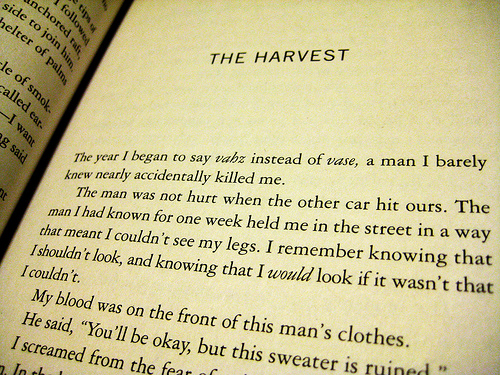
Brevity – keeping things simple, keeping the story moving – is something I always try to keep front of mind in my writing. Is the information necessary? Does it impede the story flow, rather than enrich it? Is it adding anything to the reader’s view? I generally write in a minimalist style, so brevity is important, getting in those key details and trying to find more creative, intelligent and engaging ways to communicate the story.
In an article by Chuck Palahniuk, he broke down minimalist storytelling, based on the work of the amazing Amy Hempel and her story ‘The Harvest’. The rules of minimalism Chuck notes are:
• The first thing you study is “horses.” The metaphor is – if you drive a wagon from Utah to California, you use the same horses the whole way. Substitute the word “themes” or “choruses” and you get the idea. In minimalism, a story is a symphony, building and building, but never losing the original melody line. All characters and scenes, things that seem dissimilar, they all illustrate some aspect of the story’s theme.
• The next aspect, Spanbauer calls “burnt tongue.” A way of saying something, but saying it wrong, twisting it to slow down the reader. Forcing the reader to read close, maybe read twice, not just skim along a surface of abstract images, short-cut adverbs, and clichés. In minimalism, clichés are called “received text.”
In The Harvest, Hempel writes, “I moved through the days like a severed head that finishes a sentence.” Right here, you have her “horses” of death and dissolution and her writing a sentence that slows you to a more deliberate, attentive speed.
• No abstracts. No adverbs like sleepily, irritably, sadly. And no measurements, no feet, yards, degrees or years-old.
In The Harvest, Hempel writes, “The year I began to say vahz instead of vase, a man I barely knew nearly accidentally killed me.”
• What else you learn about minimalism includes “recording angel.” This means writing without passing any judgments. Nothing is fed to the reader as fat or happy. You can only describe actions and appearances in a way that makes a judgment occur in the reader’s mind. Whatever it is, you unpack it into the details that will re-assemble themselves within the reader.
Amy Hempel does this. Instead of telling us the boyfriend in The Harvest is an asshole, we see him holding a sweater soaked with his girlfriend’s blood and telling her, “You’ll be okay, but this sweater is ruined.”
• Last point – “on the body.” Hempel shows how a story doesn’t have to be some constant stream of blah-blah-blah to bully the reader into paying attention. You don’t have to hold readers by both ears and ram every moment down their throats. Instead, a story can be a succession of tasty, smelly, touchable details. What Spanbauer and Lish call “going on the body,” to give the reader a sympathetic physical reaction, to involve the reader on a gut level.
These rules obviously can’t be applied to everyone’s work, but knowing them, thinking about them, will help you in being more creative and cerebral in how you communicate story. I especially like the ‘no adverbs’ rule, and I believe applying this, or at least thinking of options whenever you do use an adverb, makes you re-think what you’re saying and come up with creative solutions. I’ve noted this before, but it’s like Twitter, where you’re restricted by a certain number of characters, forcing you re-think what you want to say, abbreviate, and often you’ll find a smarter, more succinct way of wording it because you have to. You should also apply this to your writing, try to think through the best way to say what you want that is the most evocative and, as Chuck says, the most ‘on the body’, eliciting a physical and mental reaction with the reader that will better engage them with your scenes and characters.
The Hero’s Journey

There’s a book I read many years ago called ‘The Writer’s Journey’ by Christopher Vogler. In it, Vogler has studied the work of mythologist Joseph Campbell and how it has been applied to storytelling throughout the years. Campbell studied story telling through cultures and generations and found similar elements existed in all tales, more complex than just a beginning, middle and end. Campbell called this ‘The hero’s Journey’ and detailed how the hero would always be faced with certain challenges and hurdles. Vogler took this research and applied it to a more modern medium, film, making it much easier to comprehend and apply, as you have all the reference points in your head already. Vogler’s contention is that all films have The Hero’s Journey at their heart, and he goes on to give example and example of this applied to modern films. And it’s amazing.
If you don’t have this book, you need to get it, in my opinion it is essential reading for all writers. For example, George Lucas used Joseph Campbell’s research to write ‘Star Wars’, plotting out all the key notes based on The hero’s Journey – Vogler discusses this in intricate detail. Interestingly, Lucas used The Hero’s Journey again for ‘Willow’, applying the rules and plot points exactly as noted in Campbell’s research as something of a test to see if following them exactly would be a ticket to success (which, it alone, wasn’t, based on ‘Willow’’s box office performance). Vogler even breaks down ‘Pulp Fiction’ as a challenge in the book.
The thing is, when you read it you’ll note that most of the elements are already evident in your writing. You instinctively know story structure and pace from watching films and reading books, so a lot of it, you’ll fine, is already present in your work. But having the knowledge of how story structure works, understanding why each step happens when it does, all this is invaluable information to have and will help you solidify and strengthen your writing.
The below image breaks down the steps of The Hero’s Journey – some, if not most, of it won’t make any sense without the further context of the book, but these are the elements that occur, or should occur, in all stories in some form. I highly recommend all writer’s obtain a copy and go through it. Essential reading.

 twenty six