Tagged: story writing
Three Killers of Great Writing
There are three things in life that always seem to be the source of conflict and misery, three things that I see happening on a daily basis that irk me and cause much shaking of the head. These are things that I can’t sympathise with or reconcile, and, coincidentally, these three can also be the killers of great writing.
The three things that always carry with them the potential for issue and angst are laziness, ignorance and selfishness. Here’s how they relate in a writing context:
Laziness is pretty self-explanatory, you have to get yourself moving, you have to do the work to see the results. You can’t expect to sit down at your PC, write a few thousand words, then send it off and let the publisher bidding war to begin – this happens to no one. As noted in a previous post, writing is work, and you have to do it everyday. You have to read, you have to learn how to communicate your story, it takes time to get it right. If you’re truly committed and the story is something you have to get out, you’ll always find the time. You’ll make the time. That’s not to say the cause of incomplete work is always laziness, I realise people have a lot going on in their lives, but laziness is indeed a killer for writers. If you’re lazy, you won’t start the work. If you’re lazy, you won’t finish. If you’re lazy, you won’t do the required research and editing and re-writing. Laziness is not an option for writers, you just have to get it done. No one’s going to make you sit down and write, you’re the one who has to push yourself. Without the effort, you can’t achieve the result.
Ignorance is something we all see everyday, people ignorant of their impact on others, ignorant of how their actions affect other people. Ignorance is a killer in writing because you have to be aware. You have to understand what works and doesn’t work in your writing, you have to take on board feedback and asses your work to ensure it aligns with your goals. I’ve seen a heap of writers who’ll get feedback, totally ignore it, then hand their work to someone else, hoping they’ll get a result more to their liking from them. You can’t flat out ignore feedback. Maybe someone tells you something you don’t agree with, maybe someone criticises you unfairly – my general rule is that anytime something is raised I’ll re-read it. If it communicates what I wanted it to, then it’s fine. But if more than one person highlights the same issue, then it needs to be re-worked. If you want to improve as a writer, you have to listen to the feedback, you have to hear what people are saying. Your aim is to create something undeniable, something so great that even your biggest critics will have to concede that it’s well done. To do that, you have to listen, you have to read, and you have to know what works.
Selfishness in a writing context is getting too caught up in your own world. Writing is solitary, self-involved for the most part, and sometimes we can get so tied up in it that it’s all we want to talk about and all we want others to talk about in our presence. Sometimes it leads to you dominating conversation in order to keep it tied to what you need, pushing people for feedback on your work. The risk of being selfish is you can get stuck on other people’s opinions, you can procrastinate, waiting for feedback, and you can turn helpful readers away by pushing too hard for commentary. And the essential point here is, you need to know your work. You definitely need readers, you need that feedback from as many sources as you can get, but you need to know what you’re trying to achieve first. Once you’ve written, re-read, edited, re-written – once you’ve done all you can to ensure your story is as close as you’re able to achieve by yourself to what you want to communicate, then you can seek readers – but always understand, having anyone read your work is something you should be grateful for. They are taking time out of their day for you, for your story. Even the worst feedback is worth hearing, worth taking in – maybe it gives you nothing, but maybe it makes you re-read a section and you find a way to improve the way it’s written. All your readers are valuable, and you need to be careful not to push them away or argue with their perspective. Let them read it in their own time, let them say what they want to say – some will have alot of comments, some nothing at all, and that’s fine, so long as you know what it is you’re trying to achieve. Their opinions serve as a guide, a reminder, a new perspective on your work. You need to let them read and think it over, then come back to you when they’re ready – hopefully, your story is so compelling that they can’t help but respond, but not everyone will see it that way. Don’t be selfish, don’t get caught up in the need for response. You are your chief motivator.
The one other thing that always stands out in day to day life is people being unkind. This doesn’t have a writing application, as such, but something worth noting in your regular interactions. Don’t be unkind, don’t be mean for the sake of it. Every evil action in the world is caused by some level of unkindness, moments in people’s lives that could have been avoided. There’s no need to be unkind, everyone’s got their reasons for doing what they do. There’s no reason to contribute to negativity any further.
Creativity Without Constraint

I was once asked for my thoughts on writing controversial content, where you balance between ‘confronting’ and ‘gratuitous’. My novel ‘Rohypnol’ has a lot of graphic scenes, and it’s something I was criticised for in a few reviews, that it was gratuitous, violent for the sake of it. Some felt there was no need to go into that level of detail, that much of the horror could’ve been implied and left to the imagination. But I disagree. There was a definitive purpose to what I wrote, and there is, I believe, a reason why people need to include such detail, where warranted, within the context of their work.
One of the inspirations behind ‘Rohypnol’ was a French film called ‘Irreversible’, directed by Gaspar Noe. Noe is well-known for his controversial films and has received much the same criticism, that he glorifies violence, rather than exposes us to it. This is most evident in the extreme violence of ‘Irreversible’. In the opening scenes, there are two guys looking for another man, called La Tenia. They’re in a nightclub, looking for Le Tenia and (if you ever want to watch the film, stop reading now) when they do locate him, they get into a fight and kill him. More specifically, they kill him by beating his head in with a fire extinguisher. And you see every single hit, every detail. You feel everything in this scene. There is no escaping the violence – it’s sickening, it’s so bad you have to look away. It’s horrific and it just gets worse and worse. The viewer has no context for this scene, it’s two guys getting in a fight with another. There’s no lead-up or backstory, you’re just thrown in. The violence is the most extreme you’ll ever see on film, everything about the scene is horrific – the camera moves and swirls round amidst strobing nightclub lights and grinding bass music. The whole sequence is designed to make you sick. Not a great way to start a film, right? Why would a director want to make the audience ill, especially so early in the film?
There is method to Noe’s madness. The film is called ‘Irreversible’ because the storyline moves in reverse – we start with the horrific ending to tragic story. The point Noe’s making is that violence cannot be justified. Responding to violence with violence is not an answer, in any context – but that is exactly what Hollywood films glorify. We’ve grown up seeing revenge films, feeling for the wronged man, siding with him and hoping he’ll make the bad guys pay in the end. That’s justice, that’s what we want to see – that’s what we want to do when we’re wronged. And that’s wrong. That shouldn’t be the way violence is presented. It’s not an answer, it doesn’t solve problems. Noe’s mission with ‘Irreversible’ was to display, in graphic form, what’s wrong with Hollywood action films. Had the movie played in chronological order, you’d have seen that La Tenia had brutally raped and murdered the wife of one of the men. You’d see this, and you’d side with the man, then when they did finally catch up with La Tenia in the nightclub, you’d want him to get killed. You’d want to see him pay. But there’s no right in responding with further violence.
Noe set out to make the film as uncomfortable and violent as he could to show what violence is really like – in that scene, where you want to look away, where many people walked out of the cinema – that’s how you would feel if that situation where to happen in real life. Violence is not ‘cool’, there’s no shotgun-like sound when someone punches someone in the face. There’s no good guys and bad guys in real life. Violence is horrific and frightening – it’s something everyone wants to avoid at all costs. That’s the point of the scene. You don’t want to see this. You don’t want to condone this. We should do all we can to avoid this sort of thing happening. Seeing someone get their head beat in would affect you in ways you can’t even imagine, it would traumatise you for life – yet in most films, people get revenge, blow people up, shoot them in the head and we get nothing. It’s left to our imaginations, and we don’t picture the extreme violence that actually occurred. We just note that the bad guy got killed. Case closed. Hollywood films should not portray violence as a light, humourous, nothing event that just happens. Because that, by extension, is what we’re teaching kids. If more films portrayed violence as Noe does in ‘Irreversible’, I’ll bet you see such acts of violence reduce. Everytime I see another report of violence in nightclubs, of stabbings and glassings and beating. When I read reports of attacks getting more brutal, kids more devoid of consequence, I always think of ‘Irreversible’. Honestly, it should be on the high school curriculum.
‘Irreversible’ played a big part in the way I portrayed violence in my book. My intent was not to be gratuitous – and I absolutely don’t believe it ever crosses over that line – my goal was to be honest to the story and scenes within it. If you would feel horror, dread, happiness, joy – your responsibility as the author is to communicate that, translate those emotions into the body of the reader. Definitely, I could have left the action out, left the violence implied, but that’s not the point. If monsters like the characters I’d created actually did exist, if they committed horrendous acts like the ones presented, then feeling the detail is important. Yes, it’s confronting, yes it’s shocking, but we need to be confronted and shocked sometimes, we need to face the reality of violence as it is. This is the only way people will ever understand the impacts, the horrific nature of such crimes. And by making people aware, hopefully that inspires more people to avoid it in real life. We shouldn’t, as writers, play down violence, leave it as something that just happens, then move on with the rest of the story. If something terrible occurs, it’s important to be honest, show the necessary detail in order to make the reader feel what you felt when you wrote it. This remains true in all writing – be honest to the story you’ve created, express the reality of your world. What’s happening needs to be real – so be real, be honest with the detail, and never shy away from saying what needs to be said. Don’t be constrained by how people might respond, how people might feel, just get it down, write fuelled by your emotion, and let the story dictate the detail necessary to communicate each scene.
Writing is Work

One thing that all writers need to be aware of is that writing is work. No one has ever sat down, typed up their piece, sent it off, then rode the serpent of success all the way to the bank. You get better at writing by writing, everyday. You achieve success by reading as much as you can, researching, taking on criticism – always learning and improving. Every rejection is part of the work. Every failure is part of the work. All of these things are part of the journey towards improvement and success – you can’t achieve what you want from your writing without failing every now and then. Your best work is driven by emotion, so you’re going to make mistakes as you rush to get your ideas out – and it’s often when you’re riding the edge of your comfort zone that you really hit the right notes, so you need to push yourself, you need to make mistakes and get criticised for it, you need to cop a rejection letter every now and then. It should drive you on, not knock you down.
Don’t ever be afraid to send your stuff out or refrain because of what someone else might think – everyone mis-steps, everyone makes a fool of themselves every now and then – this is part of the work also. Whenever I get rejected, my internal response is to make them regret it. I’ll succeed and show them that they were wrong. And it’s often not your writing that has been rejected anyway, it just didn’t fit what that editor wanted for that publication at that time. So take it in – no problem, wasn’t for them – show them what they missed out on by succeeding elsewhere.
The one thing you need to dedicate yourself to is becoming the best writer you can be. I’m always committed to being better, to reading more, to finding out what works and what doesn’t, and improving myself. I don’t want to be another good writer, I want to be the best writer there is. I want people to know my work, relate to it, to feel what I felt when I wrote it. To do that, I need to keep improving, keep working. The more you write, the easier the sentences flow.
Now I’m never going to be the best writer there is, but that’s not the point. If you don’t aim to be the best, what are you aiming for? If you aren’t aiming to maximise your abilities to their best potential, then what’s the plan? Just try your best and see what happens? Having a high expectation of your work is what will push you on and drive you to improve – I may not be the best, but the more I work towards that goal, the closer I can get to it, and the closer I get to it, the better I become. Maybe I’m not the best, but I’ll be better than I was yesterday, and I’ll be better again tomorrow, and the next day, and every day for as long as I can put words to paper. And that’s the goal, to always be improving. The goal needs to be unattainable, it needs to be too high to ever meet, like a rabbit skimming out ahead of the greyhounds. I aim to be the best, I intend to be the best writer you’ll ever meet. Maybe I won’t be, but I’ll keep working anyway.
Writing is work, it’s constant – like anything, it’s about practice, passion and persistence. Ultimate success won’t come easy, but it shouldn’t. Otherwise it wouldn’t be an achievement, right?
Writing in Airports
A great place to write is the airport. It sounds weird at first, but it actually makes perfect sense. Chuck Palahniuk noted this in an interview at some stage (I can’t find the link), that he likes to write in airport lounges, in amongst the travellers and tourists. You get to eavesdrop on conversations and hear how people actually talk – which, of course, you can do in most public places – but the thing that makes airports different is the feel, that sense of adventure that hangs in the air.
People at airports are excited. They’re headed off on an adventure or returning from one. They’re saying goodbye to loved ones or anticipating being reunited. The atmosphere in an airport is like no other, that tangible sense of everything being alive, on the edge of a greater emotional high any moment. There’s no place where there’s more raw feeling in a room – tension, excitement, nervousness. People returning to cold grey days in shorts and beach tans. Businessmen embracing their young kids, the little ones in pyjamas and slippers.
What you do is you find a place in an airport lounge – you can’t go through to the international terminal without a ticket, but you can sit outside the arrivals amongst the families (some of them, you can tell, haven’t seen each other for a long time). If you check the arrivals, you can find the gates where people are arriving from holiday destinations – those are more alive than business travellers. You can move around from area to area, get a feel for the different aspects. Then later, you can go out to where the planes come into land – in Melbourne there’s a car park for the plane spotters to stand and feel the rush of the 747s as they descend to the runway. It’s pretty amazing, seeing a flying plane up that close. There’s even a food van permanently stationed there, it’s that popular a location.
As writers, you need to feel the emotion of others, to empathise and see things from the perspective of other people. Airports are great for getting a sense of this. People at the edge of their emotions are more open, unable to contain themselves within normal social restrictions. Think about when someone cries – you can feel their pain, as if they’d just given you a direct line into them. It’s not what they want you to see, not the persona they want to project. This is who they really are. And for that moment, you can connect, be on the same emotional plane. You’ve been there before, you know what it’s like to be at that overwhelming stage where you can no longer contain yourself. Those times, where emotions are pushed to the surface, are where you really understand our connection, what makes us all human. How we’re all fundamentally alike, we’re all doing what we can. Those moments are crucial for writers, being in those moments, feeling them fully. This is how you get to the heart of your writing. This is how you understand what resonates, how your readers feel. How your characters will respond to this or that situation. You need to know people, what motivates them, what makes them tick. And to do that, you need to understand yourself, how you would feel if you were this person and this was happening to you.
Shared experiences of strong emotions allow you to get a feel for that moment, to connect with the people around you.
Airports always awaken memories in me. Places I’ve been, moments with friends. People are experiencing that same excitement in every moment, and being around it, there’s a real buzz, and real sense of shared existence. That’s what makes writing in airports so interesting. Being there with them, seeing the peaks of emotion, touching at the surface. It’s exciting and awakening and equalising, all at the same time. And it can open your mind to all kinds of creative streams.
Writing at Night
Mostly I write best at night, when the house is silent. I’ve always done this – for a while, my girlfriend (now wife) worked nights, and it gave me the perfect opportunity to stay up in the study, all the lights switched off, just the monitor screen to light the way.
When I needed a break, I’d take walks. I liked doing this in summer, when people’s windows were all open to the night and you could catch little pieces of intimate conversations drifting on the wind. You’d hear TV voices whispering, the sound of a baby crying through the streets. I liked to just walk along beneath the street lights and feel the rush of the breeze.
There’s something about the night. The stillness, maybe, the isolation from the waking world. Maybe an escape, of sorts, being free to wander around the world without complication. It was like whole sections of the city were abandoned, waiting for you to find them. The streetlights curving round corners in continuous streams.
I’d always found it easier to block everything out at night, to connect with the words on deeper level than just grammar or logic. When you can see that next level, what’s happening between the words, and you can start to understand the depth of each sentence, the perfect flow and placement of each word. How the detail connect in the readers mind. It’s that hum you can get into, that place where the neurons of the story start to connect and fire, and the piece just comes to life. I’ve got better at being able to tune into it anytime now – mostly through writing everyday – but there’s something about the night that’s always alluring, that appeals to those of us engaged in more solitary pursuits. Some find it in music, some in meditation – I guess it’s in a similar vein to those things. It’s that state you can withdraw into and encase yourself inside an idea – a story, an artwork. Where everything else gets quiet and you can see the full picture developing with each sentence, till it’s clear as any memory. You can smell it, feel it. And then the writing just flows out.
Night time has always provided me the most freedom to find it.
What about you, when do you find is the best time to write?
Taking in the Detail of the Moment
Sometimes my eyes will catch onto an eagle when I’m driving. I’ve even pulled over on occasion to watch them in flight, huge wings spread wide as they float across the wind.
One time down at the beach, a man and a woman pulled up and run out onto the sand. They were a distance away from us, and they were wearing formal clothes – him in full tuxedo. This was mid-morning on a cold, overcast day, and they ran down onto the wet sand then the woman pulled back, dropped down onto the beach and let go of his hand and he kept on running, black leather shoes clapping into the waves.
Paying attention to detail is one of the key traits of a writer, and it’s little moments like this that capture your imagination, fuel your creative mind. These happenings, flourishes in your day to day life, can open up a whole new world of possibilities in your mind, thinking over how they came to be, what lead to them occurring. Allowing yourself to take in the moment and letting your mind run with it can lead to ground-breaking moments for story ideas. Even if you have an outline constructed, details like this can form key parts of your narrative, taking in the detail of the scene and trying to put yourself into another person’s skin.
You need to let yourself get caught up in the detail, let your creative mind open, just go with it now and then. Take a train into the city one weekend and just look around. Take a drive on the backroads and see where it takes you – not physically, but mentally. Allow yourself to be totally open to the detail of your surroundings, see what your attention catches onto.
Detail adds texture to your work, authenticity. Detail comes from paying attention – writers are naturally curious, naturally attentive to what’s happening around them. It’s worth taking the time, whenever you can, to just stay with the thought, allow the stories to unfold. It’s moments like this that exercise your creative mind and show you the depth in the fabric of the world. There’s so much we don’t know, so many lives and perspectives that we can never experience. Taking a time to wander can bring you closer to the finer details of life and allow you to expand your understanding and expose moments of true art, by your own terms and definitions.
Things I’ve Learned From Doing Panel Discussions and Literary Events
In my time as a writer I’ve done a few events. It’s part of the publishing, even writing, process – at some stage, most writers will have to do a talk or a reading or an event of some kind. And at first, it’s frightening. Writing is generally a solitary pursuit, just you and the sound of a keyboard clicking away in a quiet room, so it’s a pretty big leap to go from an audience of no one to a crowded room waiting to hear what you have to say. You learn a heap from every event you do and there are some major lessons I’ve learned from my experiences – I figured they might help others in their preparation for literary events. So here’s some of the things I’ve taken in from my turns as a literary event speaker.
1. Don’t read out a totally pre-written speech. Or if you do, practise it with an audience first. I wrote speeches in intricate detail for all the early events I did. I drafted them, read them out loud, held them shivering in my nervous hands as I stood up in front of the audience. But then one day I figured something out. At all these events, I also watched other authors speak, checked out how they did it. The best of them were confident, assured characters who owned the stage. They read the crowd, they played off the energy of the room, and most of the time the didn’t read from a script. Because they didn’t have to. When you’re starting out, you get so hung up on the fact that you need to be great, you need to provide an intelligent, informative, lecture, that you start to move away from why you’ve been asked to speak in the first place. You spend so much time trying to sound like a real writer that you forget that you actually are a real writer. Your thoughts and opinions are all you need, your stories from your experiences. Definitely, it’s worth analysing the topic, writing notes, getting an idea in your head of what you might say, but you need to think about the audience, what they see. If you’re up there with your head down, scanning a print out, probably reading too quickly – do you think that’s going to be engaging for the audience? You don’t need to have intricate details, you just need an outline and some notes, then you just speak about your what you know. It comes across much more natural, more comfortable, if you can speak like a real person, rather than what you think an author should sound like. Trust me, I’ve spent ages thinking over what an intelligent author would say and trying to do that, as opposed to just saying things how I would normally speak. It’s much better to just be you.
2. The audience want to hear what you have to say. They’re not there to attack you or criticise. Most literary event audiences would love nothing more than to have the opportunity you’ve got, to be up on that stage, and they’re keen to hear what you, as a chosen panellist, can contribute to the discussion. Sometimes it’s nerve-wracking, thinking of all those eyeballs looking at you, but you have to remember, again, what it’s like sitting in the audience. Would you be judgemental of someone who was a bit nervous? Who was doing their best to present their knowledge and experience? I wouldn’t, and definitely if it was clear the person was being themself, talking about how they do things, I’d appreciate it. I’d probably relate to it. The audience wants to know you, they want to know what you do. If there’s something you’re not sure about, but that’s your experience, you should just say what you think. More often than not, people will link with your struggles, they want to hear about those details too, so no need to be nervous or hide anything or try to be something you’re not. They want to hear you, you’re good, there’s nothing to be nervous about. You’re honest and real, that will resonate with the crowd.
3. Don’t drink red wine if you’re wearing a white shirt and you’re about to go on stage. Yep, this happened. When I was at the Victorian Premier’s Literary Awards, some dude turned too quick with a glass of red and splashed my shirt, a white one I’d bought just for the occasion. That was nerve-wracking. Luckily I got most of it out and the mic stand covered the stain either way. They also used a bad photo of me that was projected onto this massive screen (you needed a picture for the entry, so I just took one of myself, not thinking there would come a time when it would be blown up to 50X and beamed into a room of tuxedoed important-types) and the host made fun of me for being nervous (in fairness, it was the perfect set-up – two very young kids had done a reading immediately before me and when I got up to the stage it was the perfect chance for him to say: ‘Geez, you’re more nervous than those two kids’ – hilarious) but the point is, be careful what you wear and what you eat if you’re going up on stage. You’re nervous already, you don’t need any more reason to be self-conscious.
4. Enjoy yourself. Literary events are fun. Yes, people paid to get in, and yeah, they’ll expect something for their money, but that’s not all on you (unless you’re doing a solo talk, in which case it is) and regardless, the event will be more entertaining if you’re relaxed. The more nervous you are, the more that’ll come across, and you’ll be able to feel it all through the room. You need to try and enjoy the moment, they don’t come around that often for most. Remember that you’ve done the hard work to get there, you are a writer, someone these people want to hear from. You aren’t a fraud, a poser whose fluked his/her way into this, you’re successful, you have experiences people want to know about. Literary events are supposed to be enjoyable and engaging. Audiences would rather you be open and alive than stuffy and academic the whole time. Relatable experiences are more resonant than hard-nosed lessons – they can read about those in any number of how-to books. Be real, be genuine, tell people about your blocks and difficulties as well as the good stuff. And have fun with it.
5. Don’t walk around flashing your ‘Artist’ lanyard expecting people to ask for your autograph. No one’s gonna’ do it, rock star. Unless you’re JK Rowling or Stephenie Meyer, no one’s going to be too bothered about who you are out on the street. Yes, you should feel proud that you got invited, but don’t get too far ahead of yourself. Ain’t no one at the food court gon’ care that you’re the keynote speaker of the day.
Overall, you need to try not to take literary events too seriously. Yes, you want to put in a good performance and no, you don’t want to go in under prepared and sound like a fool, but generally when I’ve over prepared I’ve looked more foolish than the former. You should do your research, learn what you need to know, ensure you can handle the situation. But then you’ve got to be yourself. Don’t get caught up trying to be what you think the audience want, be you. It’s the only way to truly succeed and stand out as a speaker. Authenticity will shine through much more than any lessons you’d like to impart. Trust in your ability and knowledge, share what you know, what you think the audience can learn from, and show who your are.
First Person, Second Person, Third Person – Which Perspective to Use?
One thing that a lot of writers have trouble with is perspective and tense. In itself, people can switch tense mid-sentence and some have trouble staying consistent, but a bigger and more challenging question is what perspective/tense should you use? There’s no definitive guide as to which works best for each story type – any can work if done well – but there are some basics that are worth considering:
First Person – Present Tense: ‘I wake up in a strange room, looking up at the ceiling’. This is the logging things as they happen. I’ve found this best used in action novels and faster paced books, as it’s more immediate, things are coming at you quickly. It lends itself to sharper, quicker prose, as it’s the language is progressive.
First Person – Past Tense: ‘I woke up in a strange room, looked up at the ceiling’. This is also effective in faster paced novels, but the ‘looking back’ style lends itself to more introspection by the narrator – if you’re writing a book where the main character is doing a lot of internal monologue, thinking over how he/she feels or sees things, I think this is a more effective voice to go with than First Person – Present Tense.
Second Person – Present Tense: ‘You wake up in a strange room, looking up at the ceiling’. This is also another good one for faster passed pieces, though rarely is it used for an entire novel length. The best uses I’ve seen have come in the form of chapters within a larger work, break-out switch-ups that work to amplify a segment, give the reader a sense of being drawn in.
Second Person – Past Tense: ‘You woke up in a strange room, looked up at the ceiling’. I actually don’t find much difference in effectiveness between Second Person – Past and Second Person – Present, the reader effect is similar. I would think the use of this would depend on the style of the rest of the book – unless you were using Second Person exclusively, which most authors are not.
Third Person – Present Tense: ‘He wakes up in a strange room, looking up at the ceiling’. Third person is a great way to explore more of the world your characters are in. Third Person – Present – as with all ‘present’ tenses – is good for faster moving narratives, as it keeps things immediate. Third person allows you to explore more perspectives within the story, whilst also only revealing the motivations of characters when you need, as opposed to First Person, which generally forces you to reveal the inner thoughts of your narrator all through.
Third Person – Past Tense: ‘He woke up in a strange room, looked up at the ceiling’. Similar in effect to present tense. I find most fantasy novels are written in Third Person – Past, as it allows for the writer to reveal more about the world he/she has created through historical or atmospheric exposition, which is required when you need to reveal the rules of a new world. Third Person enables you to reveal what you want when you want the reader to know it, as opposed to First Person, which is more confined to what the narrator knows.
These are obviously very quick overviews, and are in no way encompassing of the intricacies of each style, but hopefully they give you an idea of the purpose and strengths of each. Choosing the style of your piece is a big factor in determining how it will resonate with readers – each story has it’s own unique voice, and it’s important to understand the emotional arc of your tale – what you want to reveal and when – to help you determine which voice is best. Some authors will go their entire careers only writing in one style, but the best can switch between them, utilising the strengths of each to create the most compelling literature – even including sections of different styles in one work.
It’s about looking at your story plan, as a whole, and understanding what you want your reader to feel as they move through. You’ll generally be influenced by writers you admire, but always worth considering how to best use perspective and tense before you write, thinking about what’s the best fit. If your story is fast paced, then present tense is probably better. If your piece takes into account the perspectives of various characters, third person might work best. There are no definitive rules, but playing over the sentences in your mind in the different styles will eventually reveal which one is the most natural fit for your story’s voice.
Handwriting
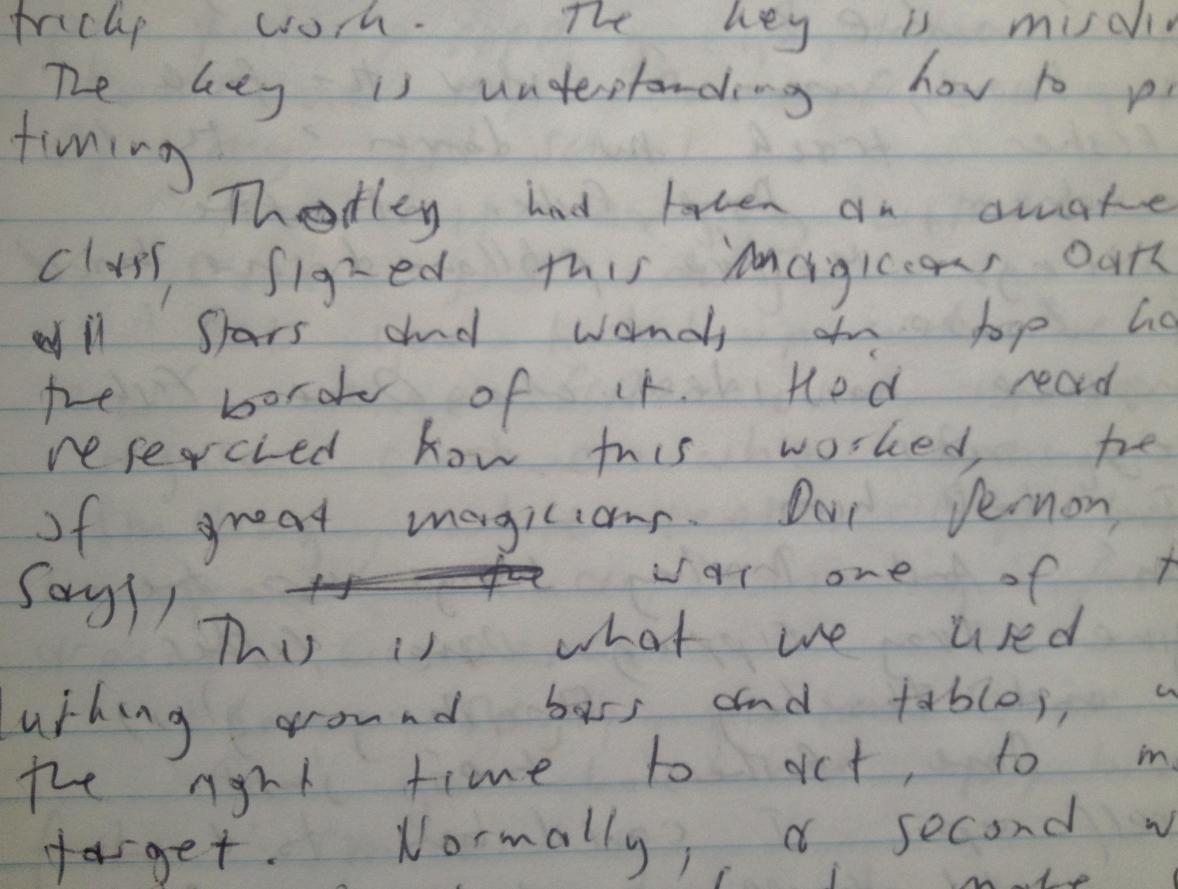
One thing I’ve found to be almost universally true of writers is that we all have terrible handwriting. My theory is that because our heads get rushed with creative ideas, our minds flashing by creating whole worlds from the seed of a single thought, our hands struggle to keep up the pace. As a result, we form a sort of scribble that we can get down fast enough to capture our ideas which is also legible enough to enable us to translate what we’ve put down. I honestly have no concerns about people reading my notes, no self-consciousness about what they might find, because there’s almost no chance they’ll be able to read them. It’s like a cross between cursive and hieroglyphics, the only things missing are a few illustrations of the Eye of Ra and a cat or two (if I were to add these pictures in, it would, if anything, make more sense). It’s even worse when I wake up in the middle of the night with an idea that I just have to get down – I don’t want to wake the kids, so I scribble notes in the dark. In the morning I see these sloping sentences, wilting down the page. It’s generally enough for me to remember what I was on about, but that’s about all it’s good for.
But despite this, despite the fact that my handwriting resembles that of a cliche movie psychopath, I write almost everything by hand as a first draft. My approach is that I write first on inspiration – I play an idea over and over in my head till I start to imagine it in full sentences and it’s almost too much for me to not write it out. Then I get a pen and start putting it down – I find the connection between thought and handwriting more natural than typing it out straight away. This is mostly for fiction work and longer form non-fiction, for many shorter pieces (like this one) I can put down a few notes when they come to me then just type it when I get the chance. But for more involved stuff, it will almost all be done by hand first. I would say 85% of my first novel is scrawled across three or four Spirax notebooks that are now somewhere in my study. Every element of the book started in handwritten form.
The next phase of writing is the logical, where I make sense of the writing, clarify the paragraphs and structures, etc. I find that having a hand written version to start with is conducive to this practice, as you have to re-write every single letter. You can’t pick and choose, you have to go over each part as least once, giving you a more analytical overview of the work. As I go, I’ll add in bits where they fit, I’ll read sentences out loud if they don’t feel right. I’ll re-construct parts entirely if I ever feel myself drifting from the story – that’s the best indicator that what you’ve done isn’t working. The story should hold your attention, even if you’re the one who wrote it. While you’re very familiar with the content, if you feel yourself drifting at all, thinking about the shopping, a TV show, anything other than the piece as you read, it’s worth going back and re-working the section you faded from to ensure it keeps the reader hooked. If you’re drifting, most likely your readers are gonna’ drift too. And again, having a handwritten start point helps highlight things like this because you have to read it all in order to enter it in. It effectively forces you into doing a full second draft before you can do anything else.
I then try to leave my work for as long as possible to get objective distance from it, clear my head of it so I can re-read it more as a reader than a writer. Even when I read novels I always think of ways I would change sentence structures and paragraphs, so editing comes pretty natural for me, particularly with the perspective of leave from the work. And by that stage it’s moved into a full-typed form – I might write hand-written notes down as I think of them, but my reliance on the pen is gone by that third draft stage – and definitely, no one would have read anything I’ve written till after that third draft stage. Even if I think I’ve put down something great, I always resist sending anything out till I’ve had that distance from it – I ALWAYS find things I want to change once I have some perspective.
Over the years I’ve seen experts lament the erosion of handwriting. There’s an idea that handwriting will one day cease to exist, that kids these days barely have any use for it now – just as younger generations are baffled by old school telephones, one day they’ll be scratching their heads as they look at pens end pencils. To some degree I think it’s a valid concern, but more likely, reliance on hand writing will reduce, not cease. I still love the flow of writing from my head and through the pen, I still enjoy the feel of paper, of seeing words indented into the page. Obviously I don’t know, but I don’t get the feeling that hand writing is totally falling away. I sincerely hope it isn’t, as, for me, it’s crucial to the writing process. I can only imagine it will be of benefit to many other writers in future, and if they’re not learning it, maybe they’ll never discover it, and we’ll miss out on great works as a result.
Breaking Down Novel Writing into Achievable Daily Targets
A long time ago, I remember reading an interview with a young author in the paper. She’d just had her first novel published, and she talked about how she’d done an ‘apprenticeship’ in novel writing by writing short stories – writing as many as she could, entering them into competitions, etc. This note stuck with me – at the time I was into short story writing exclusively. I was reading a lot of Amy Hempel, Alice Munro and Lorrie Moore and I was all about being a short story writer. Who needs to write a novel? Short story’s where it’s at. This, at least in part, was because the thought of writing 50,000+ words was way too daunting to contemplate. That word count is a massive mountain to climb. I had attempted a novel, kind of, but it was half way through 30 pages in so not quite long enough.
But this idea of doing an apprenticeship in short story opened my mind to the idea of planning a novel in short story form. I didn’t know that I’d be able to write a novel but I could give you 100 short stories, no problem. I was writing new pieces everyday, coming up with new ideas, it became more conceivable for me to visualise a novel as 50 connected short stories. 50,000 words = scary. 50 short stories = doable.

This is how I planned and wrote my first novel (and planned my second, the writing has been slightly more problematic). I thought of an idea, of a concept that I thought would work. I thought of the key points, played them over and over in my mind and then, once I had a basic skeleton of the story, I sat down and wrote a list of 50 short pieces that would tell the story. Suddenly I could see how it was possible, writing short stories, one by one, was easy, I could knock them over at a rate of one a night. If I could get a solid plan down, I could do it. And with luck, lonely nights, and a lot of persistence, I did.
Of course, there was a lot more that came up along the way – extra planning, re-plotting, adding in chapters to build additional context once the themes were clear (note: the themes of your novel will only be 100% clear once you’ve completed your first draft), getting the voice right – there was more work to be done than one planning session. But it did work, and I do think this is a solid way to go about writing a novel. If you’re dedicated to writing a book but having trouble visualising such a vast amount of content, I’d recommend this as a process to help rationalise the workload, to break it down to an digestable amount. Writing 1000 words a day is something you should commit to, if you can, and if you’re able to do that, you can write a chapter a day. And eventually it will start to take form.
 twenty six