Tagged: how to write a novel
Writing in Airports
A great place to write is the airport. It sounds weird at first, but it actually makes perfect sense. Chuck Palahniuk noted this in an interview at some stage (I can’t find the link), that he likes to write in airport lounges, in amongst the travellers and tourists. You get to eavesdrop on conversations and hear how people actually talk – which, of course, you can do in most public places – but the thing that makes airports different is the feel, that sense of adventure that hangs in the air.
People at airports are excited. They’re headed off on an adventure or returning from one. They’re saying goodbye to loved ones or anticipating being reunited. The atmosphere in an airport is like no other, that tangible sense of everything being alive, on the edge of a greater emotional high any moment. There’s no place where there’s more raw feeling in a room – tension, excitement, nervousness. People returning to cold grey days in shorts and beach tans. Businessmen embracing their young kids, the little ones in pyjamas and slippers.
What you do is you find a place in an airport lounge – you can’t go through to the international terminal without a ticket, but you can sit outside the arrivals amongst the families (some of them, you can tell, haven’t seen each other for a long time). If you check the arrivals, you can find the gates where people are arriving from holiday destinations – those are more alive than business travellers. You can move around from area to area, get a feel for the different aspects. Then later, you can go out to where the planes come into land – in Melbourne there’s a car park for the plane spotters to stand and feel the rush of the 747s as they descend to the runway. It’s pretty amazing, seeing a flying plane up that close. There’s even a food van permanently stationed there, it’s that popular a location.
As writers, you need to feel the emotion of others, to empathise and see things from the perspective of other people. Airports are great for getting a sense of this. People at the edge of their emotions are more open, unable to contain themselves within normal social restrictions. Think about when someone cries – you can feel their pain, as if they’d just given you a direct line into them. It’s not what they want you to see, not the persona they want to project. This is who they really are. And for that moment, you can connect, be on the same emotional plane. You’ve been there before, you know what it’s like to be at that overwhelming stage where you can no longer contain yourself. Those times, where emotions are pushed to the surface, are where you really understand our connection, what makes us all human. How we’re all fundamentally alike, we’re all doing what we can. Those moments are crucial for writers, being in those moments, feeling them fully. This is how you get to the heart of your writing. This is how you understand what resonates, how your readers feel. How your characters will respond to this or that situation. You need to know people, what motivates them, what makes them tick. And to do that, you need to understand yourself, how you would feel if you were this person and this was happening to you.
Shared experiences of strong emotions allow you to get a feel for that moment, to connect with the people around you.
Airports always awaken memories in me. Places I’ve been, moments with friends. People are experiencing that same excitement in every moment, and being around it, there’s a real buzz, and real sense of shared existence. That’s what makes writing in airports so interesting. Being there with them, seeing the peaks of emotion, touching at the surface. It’s exciting and awakening and equalising, all at the same time. And it can open your mind to all kinds of creative streams.
Writing at Night
Mostly I write best at night, when the house is silent. I’ve always done this – for a while, my girlfriend (now wife) worked nights, and it gave me the perfect opportunity to stay up in the study, all the lights switched off, just the monitor screen to light the way.
When I needed a break, I’d take walks. I liked doing this in summer, when people’s windows were all open to the night and you could catch little pieces of intimate conversations drifting on the wind. You’d hear TV voices whispering, the sound of a baby crying through the streets. I liked to just walk along beneath the street lights and feel the rush of the breeze.
There’s something about the night. The stillness, maybe, the isolation from the waking world. Maybe an escape, of sorts, being free to wander around the world without complication. It was like whole sections of the city were abandoned, waiting for you to find them. The streetlights curving round corners in continuous streams.
I’d always found it easier to block everything out at night, to connect with the words on deeper level than just grammar or logic. When you can see that next level, what’s happening between the words, and you can start to understand the depth of each sentence, the perfect flow and placement of each word. How the detail connect in the readers mind. It’s that hum you can get into, that place where the neurons of the story start to connect and fire, and the piece just comes to life. I’ve got better at being able to tune into it anytime now – mostly through writing everyday – but there’s something about the night that’s always alluring, that appeals to those of us engaged in more solitary pursuits. Some find it in music, some in meditation – I guess it’s in a similar vein to those things. It’s that state you can withdraw into and encase yourself inside an idea – a story, an artwork. Where everything else gets quiet and you can see the full picture developing with each sentence, till it’s clear as any memory. You can smell it, feel it. And then the writing just flows out.
Night time has always provided me the most freedom to find it.
What about you, when do you find is the best time to write?
Things I’ve Learned From Doing Panel Discussions and Literary Events
In my time as a writer I’ve done a few events. It’s part of the publishing, even writing, process – at some stage, most writers will have to do a talk or a reading or an event of some kind. And at first, it’s frightening. Writing is generally a solitary pursuit, just you and the sound of a keyboard clicking away in a quiet room, so it’s a pretty big leap to go from an audience of no one to a crowded room waiting to hear what you have to say. You learn a heap from every event you do and there are some major lessons I’ve learned from my experiences – I figured they might help others in their preparation for literary events. So here’s some of the things I’ve taken in from my turns as a literary event speaker.
1. Don’t read out a totally pre-written speech. Or if you do, practise it with an audience first. I wrote speeches in intricate detail for all the early events I did. I drafted them, read them out loud, held them shivering in my nervous hands as I stood up in front of the audience. But then one day I figured something out. At all these events, I also watched other authors speak, checked out how they did it. The best of them were confident, assured characters who owned the stage. They read the crowd, they played off the energy of the room, and most of the time the didn’t read from a script. Because they didn’t have to. When you’re starting out, you get so hung up on the fact that you need to be great, you need to provide an intelligent, informative, lecture, that you start to move away from why you’ve been asked to speak in the first place. You spend so much time trying to sound like a real writer that you forget that you actually are a real writer. Your thoughts and opinions are all you need, your stories from your experiences. Definitely, it’s worth analysing the topic, writing notes, getting an idea in your head of what you might say, but you need to think about the audience, what they see. If you’re up there with your head down, scanning a print out, probably reading too quickly – do you think that’s going to be engaging for the audience? You don’t need to have intricate details, you just need an outline and some notes, then you just speak about your what you know. It comes across much more natural, more comfortable, if you can speak like a real person, rather than what you think an author should sound like. Trust me, I’ve spent ages thinking over what an intelligent author would say and trying to do that, as opposed to just saying things how I would normally speak. It’s much better to just be you.
2. The audience want to hear what you have to say. They’re not there to attack you or criticise. Most literary event audiences would love nothing more than to have the opportunity you’ve got, to be up on that stage, and they’re keen to hear what you, as a chosen panellist, can contribute to the discussion. Sometimes it’s nerve-wracking, thinking of all those eyeballs looking at you, but you have to remember, again, what it’s like sitting in the audience. Would you be judgemental of someone who was a bit nervous? Who was doing their best to present their knowledge and experience? I wouldn’t, and definitely if it was clear the person was being themself, talking about how they do things, I’d appreciate it. I’d probably relate to it. The audience wants to know you, they want to know what you do. If there’s something you’re not sure about, but that’s your experience, you should just say what you think. More often than not, people will link with your struggles, they want to hear about those details too, so no need to be nervous or hide anything or try to be something you’re not. They want to hear you, you’re good, there’s nothing to be nervous about. You’re honest and real, that will resonate with the crowd.
3. Don’t drink red wine if you’re wearing a white shirt and you’re about to go on stage. Yep, this happened. When I was at the Victorian Premier’s Literary Awards, some dude turned too quick with a glass of red and splashed my shirt, a white one I’d bought just for the occasion. That was nerve-wracking. Luckily I got most of it out and the mic stand covered the stain either way. They also used a bad photo of me that was projected onto this massive screen (you needed a picture for the entry, so I just took one of myself, not thinking there would come a time when it would be blown up to 50X and beamed into a room of tuxedoed important-types) and the host made fun of me for being nervous (in fairness, it was the perfect set-up – two very young kids had done a reading immediately before me and when I got up to the stage it was the perfect chance for him to say: ‘Geez, you’re more nervous than those two kids’ – hilarious) but the point is, be careful what you wear and what you eat if you’re going up on stage. You’re nervous already, you don’t need any more reason to be self-conscious.
4. Enjoy yourself. Literary events are fun. Yes, people paid to get in, and yeah, they’ll expect something for their money, but that’s not all on you (unless you’re doing a solo talk, in which case it is) and regardless, the event will be more entertaining if you’re relaxed. The more nervous you are, the more that’ll come across, and you’ll be able to feel it all through the room. You need to try and enjoy the moment, they don’t come around that often for most. Remember that you’ve done the hard work to get there, you are a writer, someone these people want to hear from. You aren’t a fraud, a poser whose fluked his/her way into this, you’re successful, you have experiences people want to know about. Literary events are supposed to be enjoyable and engaging. Audiences would rather you be open and alive than stuffy and academic the whole time. Relatable experiences are more resonant than hard-nosed lessons – they can read about those in any number of how-to books. Be real, be genuine, tell people about your blocks and difficulties as well as the good stuff. And have fun with it.
5. Don’t walk around flashing your ‘Artist’ lanyard expecting people to ask for your autograph. No one’s gonna’ do it, rock star. Unless you’re JK Rowling or Stephenie Meyer, no one’s going to be too bothered about who you are out on the street. Yes, you should feel proud that you got invited, but don’t get too far ahead of yourself. Ain’t no one at the food court gon’ care that you’re the keynote speaker of the day.
Overall, you need to try not to take literary events too seriously. Yes, you want to put in a good performance and no, you don’t want to go in under prepared and sound like a fool, but generally when I’ve over prepared I’ve looked more foolish than the former. You should do your research, learn what you need to know, ensure you can handle the situation. But then you’ve got to be yourself. Don’t get caught up trying to be what you think the audience want, be you. It’s the only way to truly succeed and stand out as a speaker. Authenticity will shine through much more than any lessons you’d like to impart. Trust in your ability and knowledge, share what you know, what you think the audience can learn from, and show who your are.
First Person, Second Person, Third Person – Which Perspective to Use?
One thing that a lot of writers have trouble with is perspective and tense. In itself, people can switch tense mid-sentence and some have trouble staying consistent, but a bigger and more challenging question is what perspective/tense should you use? There’s no definitive guide as to which works best for each story type – any can work if done well – but there are some basics that are worth considering:
First Person – Present Tense: ‘I wake up in a strange room, looking up at the ceiling’. This is the logging things as they happen. I’ve found this best used in action novels and faster paced books, as it’s more immediate, things are coming at you quickly. It lends itself to sharper, quicker prose, as it’s the language is progressive.
First Person – Past Tense: ‘I woke up in a strange room, looked up at the ceiling’. This is also effective in faster paced novels, but the ‘looking back’ style lends itself to more introspection by the narrator – if you’re writing a book where the main character is doing a lot of internal monologue, thinking over how he/she feels or sees things, I think this is a more effective voice to go with than First Person – Present Tense.
Second Person – Present Tense: ‘You wake up in a strange room, looking up at the ceiling’. This is also another good one for faster passed pieces, though rarely is it used for an entire novel length. The best uses I’ve seen have come in the form of chapters within a larger work, break-out switch-ups that work to amplify a segment, give the reader a sense of being drawn in.
Second Person – Past Tense: ‘You woke up in a strange room, looked up at the ceiling’. I actually don’t find much difference in effectiveness between Second Person – Past and Second Person – Present, the reader effect is similar. I would think the use of this would depend on the style of the rest of the book – unless you were using Second Person exclusively, which most authors are not.
Third Person – Present Tense: ‘He wakes up in a strange room, looking up at the ceiling’. Third person is a great way to explore more of the world your characters are in. Third Person – Present – as with all ‘present’ tenses – is good for faster moving narratives, as it keeps things immediate. Third person allows you to explore more perspectives within the story, whilst also only revealing the motivations of characters when you need, as opposed to First Person, which generally forces you to reveal the inner thoughts of your narrator all through.
Third Person – Past Tense: ‘He woke up in a strange room, looked up at the ceiling’. Similar in effect to present tense. I find most fantasy novels are written in Third Person – Past, as it allows for the writer to reveal more about the world he/she has created through historical or atmospheric exposition, which is required when you need to reveal the rules of a new world. Third Person enables you to reveal what you want when you want the reader to know it, as opposed to First Person, which is more confined to what the narrator knows.
These are obviously very quick overviews, and are in no way encompassing of the intricacies of each style, but hopefully they give you an idea of the purpose and strengths of each. Choosing the style of your piece is a big factor in determining how it will resonate with readers – each story has it’s own unique voice, and it’s important to understand the emotional arc of your tale – what you want to reveal and when – to help you determine which voice is best. Some authors will go their entire careers only writing in one style, but the best can switch between them, utilising the strengths of each to create the most compelling literature – even including sections of different styles in one work.
It’s about looking at your story plan, as a whole, and understanding what you want your reader to feel as they move through. You’ll generally be influenced by writers you admire, but always worth considering how to best use perspective and tense before you write, thinking about what’s the best fit. If your story is fast paced, then present tense is probably better. If your piece takes into account the perspectives of various characters, third person might work best. There are no definitive rules, but playing over the sentences in your mind in the different styles will eventually reveal which one is the most natural fit for your story’s voice.
Handwriting
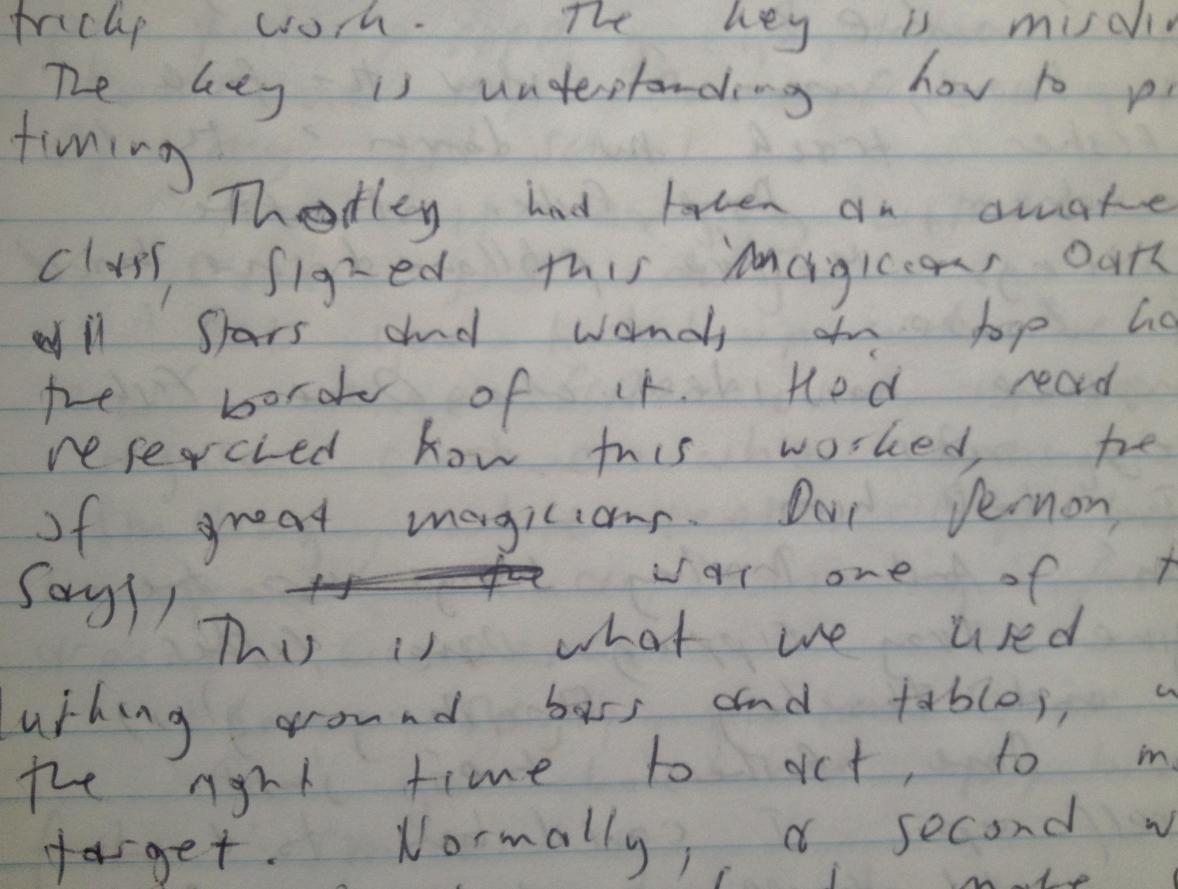
One thing I’ve found to be almost universally true of writers is that we all have terrible handwriting. My theory is that because our heads get rushed with creative ideas, our minds flashing by creating whole worlds from the seed of a single thought, our hands struggle to keep up the pace. As a result, we form a sort of scribble that we can get down fast enough to capture our ideas which is also legible enough to enable us to translate what we’ve put down. I honestly have no concerns about people reading my notes, no self-consciousness about what they might find, because there’s almost no chance they’ll be able to read them. It’s like a cross between cursive and hieroglyphics, the only things missing are a few illustrations of the Eye of Ra and a cat or two (if I were to add these pictures in, it would, if anything, make more sense). It’s even worse when I wake up in the middle of the night with an idea that I just have to get down – I don’t want to wake the kids, so I scribble notes in the dark. In the morning I see these sloping sentences, wilting down the page. It’s generally enough for me to remember what I was on about, but that’s about all it’s good for.
But despite this, despite the fact that my handwriting resembles that of a cliche movie psychopath, I write almost everything by hand as a first draft. My approach is that I write first on inspiration – I play an idea over and over in my head till I start to imagine it in full sentences and it’s almost too much for me to not write it out. Then I get a pen and start putting it down – I find the connection between thought and handwriting more natural than typing it out straight away. This is mostly for fiction work and longer form non-fiction, for many shorter pieces (like this one) I can put down a few notes when they come to me then just type it when I get the chance. But for more involved stuff, it will almost all be done by hand first. I would say 85% of my first novel is scrawled across three or four Spirax notebooks that are now somewhere in my study. Every element of the book started in handwritten form.
The next phase of writing is the logical, where I make sense of the writing, clarify the paragraphs and structures, etc. I find that having a hand written version to start with is conducive to this practice, as you have to re-write every single letter. You can’t pick and choose, you have to go over each part as least once, giving you a more analytical overview of the work. As I go, I’ll add in bits where they fit, I’ll read sentences out loud if they don’t feel right. I’ll re-construct parts entirely if I ever feel myself drifting from the story – that’s the best indicator that what you’ve done isn’t working. The story should hold your attention, even if you’re the one who wrote it. While you’re very familiar with the content, if you feel yourself drifting at all, thinking about the shopping, a TV show, anything other than the piece as you read, it’s worth going back and re-working the section you faded from to ensure it keeps the reader hooked. If you’re drifting, most likely your readers are gonna’ drift too. And again, having a handwritten start point helps highlight things like this because you have to read it all in order to enter it in. It effectively forces you into doing a full second draft before you can do anything else.
I then try to leave my work for as long as possible to get objective distance from it, clear my head of it so I can re-read it more as a reader than a writer. Even when I read novels I always think of ways I would change sentence structures and paragraphs, so editing comes pretty natural for me, particularly with the perspective of leave from the work. And by that stage it’s moved into a full-typed form – I might write hand-written notes down as I think of them, but my reliance on the pen is gone by that third draft stage – and definitely, no one would have read anything I’ve written till after that third draft stage. Even if I think I’ve put down something great, I always resist sending anything out till I’ve had that distance from it – I ALWAYS find things I want to change once I have some perspective.
Over the years I’ve seen experts lament the erosion of handwriting. There’s an idea that handwriting will one day cease to exist, that kids these days barely have any use for it now – just as younger generations are baffled by old school telephones, one day they’ll be scratching their heads as they look at pens end pencils. To some degree I think it’s a valid concern, but more likely, reliance on hand writing will reduce, not cease. I still love the flow of writing from my head and through the pen, I still enjoy the feel of paper, of seeing words indented into the page. Obviously I don’t know, but I don’t get the feeling that hand writing is totally falling away. I sincerely hope it isn’t, as, for me, it’s crucial to the writing process. I can only imagine it will be of benefit to many other writers in future, and if they’re not learning it, maybe they’ll never discover it, and we’ll miss out on great works as a result.
Breaking Down Novel Writing into Achievable Daily Targets
A long time ago, I remember reading an interview with a young author in the paper. She’d just had her first novel published, and she talked about how she’d done an ‘apprenticeship’ in novel writing by writing short stories – writing as many as she could, entering them into competitions, etc. This note stuck with me – at the time I was into short story writing exclusively. I was reading a lot of Amy Hempel, Alice Munro and Lorrie Moore and I was all about being a short story writer. Who needs to write a novel? Short story’s where it’s at. This, at least in part, was because the thought of writing 50,000+ words was way too daunting to contemplate. That word count is a massive mountain to climb. I had attempted a novel, kind of, but it was half way through 30 pages in so not quite long enough.
But this idea of doing an apprenticeship in short story opened my mind to the idea of planning a novel in short story form. I didn’t know that I’d be able to write a novel but I could give you 100 short stories, no problem. I was writing new pieces everyday, coming up with new ideas, it became more conceivable for me to visualise a novel as 50 connected short stories. 50,000 words = scary. 50 short stories = doable.

This is how I planned and wrote my first novel (and planned my second, the writing has been slightly more problematic). I thought of an idea, of a concept that I thought would work. I thought of the key points, played them over and over in my mind and then, once I had a basic skeleton of the story, I sat down and wrote a list of 50 short pieces that would tell the story. Suddenly I could see how it was possible, writing short stories, one by one, was easy, I could knock them over at a rate of one a night. If I could get a solid plan down, I could do it. And with luck, lonely nights, and a lot of persistence, I did.
Of course, there was a lot more that came up along the way – extra planning, re-plotting, adding in chapters to build additional context once the themes were clear (note: the themes of your novel will only be 100% clear once you’ve completed your first draft), getting the voice right – there was more work to be done than one planning session. But it did work, and I do think this is a solid way to go about writing a novel. If you’re dedicated to writing a book but having trouble visualising such a vast amount of content, I’d recommend this as a process to help rationalise the workload, to break it down to an digestable amount. Writing 1000 words a day is something you should commit to, if you can, and if you’re able to do that, you can write a chapter a day. And eventually it will start to take form.
How Important is a Great Opening to a Novel?
I love opening a new novel. I love going through the bookshop – the smell of books – and I love finding that one that is going to take me away, curl round my brain like a cat and warm me into this whole other world. And one of the great things about new books, one of the reasons that I’ll take it to the counter, is the opening line or paragraph. I love a good cover, but more importantly, I love good writing, and that first section, for me, really sets the tone. A good opening will drop you right into the story and make it hard for you to leave. It will capture your imagination and almost force you to read on. It’s also a great learning tool for writers, working out how the great books begin, understanding how that can be applied to your story. There’s so much to learn from those first lines, it’s worth reading as many as you can to ensure you are using the best starting point for your story.
As an example, here are some of my favourite novel openings:
‘Tyler gets me a job as a waiter, after that Tyler’s pushing a gun in my mouth and saying, the first step to eternal life is you have to die. For a long time though, Tyler and I were best friends. People are always asking, did I know about Tyler Durden.
The barrel of the gun pressed against the back of my throat, Tyler says “We really won’t die.”
With my tongue I can feel the silencer holes we drilled into the barrel of the gun. Most of the noise a gunshot makes is expanding gases, and there’s the tiny sonic boom a bullet makes because it travels so fast. To make a silencer, you just drill holes in the barrel of the gun, a lot of holes. This lets the gas escape and slows the bullet to below the speed of sound.
You drill the holes wrong and the gun will blow off your hand.’
– Fight Club by Chuck Palahniuk
It’s so fast-paced and it perfectly sets the tone for the rest of the novel, which all moves at breakneck speed. Palahniuk drops you right into the chaos and lets you work it out from there – a really good opening.
‘Until the telephone rang, the only sound in my office was the scratching of my pen as I made margins notes, corrections and amendments.
I pressed the speaker button.
‘Carl speaking’
‘Carl’
‘Catherine! I meant to send you home hours ago…’
She interrupted me: ‘I am home. I’ve been home, been out to see a film, eaten a pizza, paid the baby-sitter and watched the end of Newsnight.
The clock on my desk read 11:42. I turned in my chair. The window of my office was floor to ceiling. Through the window, I could see the city glitter and the night sky. No stars – a low cloud layer made the sky glow almost red.
Catherine continued: ‘I’m calling because the last train leaves in twenty-five minutes’.
The Coma by Alex Garland
This also sets the scene for the whole novel, the pace, the steady flow of the narrative. But again, Garland drops you right into the story, not pages of him living his normal life, but right here, right in the midst of where the action is about to take place. It’s an important note – you want to start your story at a compelling point, a point where people need to turn the page and find out what happens next. Granted, this scene is still somewhat commonplace, but we know the narrator is now out in the middle of the night and will struggle to make the train home – and we, as the audience, know what a frightening train journey that midnight trip can be.
‘About the accident itself I can say very little. Almost nothing. It involved something falling from the sky. Technology. Parts, bits. That’s it, really: all I can divulge. Not much, I know.
It’s not that I’m being shy. It’s just that – well, for one, I don’t even remember the event. It’s a blank: a white slate, a black hole. I have vague images, half-impressions: of being, or having been – or, more precisely, being about to be – hit; blue light; railings; lights of other colours; being held above some kind of tray or bed. But who’s to say that these are genuine memories? Who’s to say my traumatized mind didn’t just make them up, or pull them out from somewhere else, some other slot, and stick them there to plug the gap – the crater – that the accident had blown? Minds are versatile and wily things. Real chancers.’
Remainder by Tom McCarthy
Remainder is a real mind twister of a novel, looking at psychology and the depths of the human condition. This opening sets the scene really well – you get, from this, that the narrator was involved in accident in which something fell from the sky and damaged his brain. The novel is about how he doesn’t know what’s real anymore, what are memories and what’s imagined, and this opening clearly aligns to that theme. I like this because McCarthy has explained a lot very quickly, very cleverly, almost without you knowing it. But again, it drops you into the story, rather than starting with long-winded context or backstory.
‘He’d cut His throat with the knife. He’d near chopped off His hand with the meat cleaver. He couldn’t object, so I lit a Silk Cut. A sort of wave of something was going across me. There was fright, but I’d daydreamed how I’d be.
He was bare and dead face-down on the scullery lino with blood round. The Christmas tree lights were on then off. You could change the speed those ones flashed at. Over and over you saw Him stretched out then the pitch dark with his computer screen still on.’
Morvern Callar by Alan Warner
The detached, confused emotion of the narrator streams all the way through Morvern Callar, and again, the author has dropped us right into the story, leaving Morvern at home with her deceased boyfriend – what will she do next? I also love the detail in this scene, the image of the Christmas lights flicking on and off gives it a real sense, an authenticity and feeling, through such a small but important detail.
Not every novel starts out by dropping you into the action like this, but the vast majority do. It’s a powerful tool, and an important lesson for writers to learn, that the story starts where the action does. Your readers will work out the details and you can communicate back story through their interactions within the narrative – in that sense, it’s like someone telling you a story in real life. People generally tell you the highlight, the most shocking element up front, then explain the detail of how it got to that point. That peak moment is the hook that will gets the audience in, and it’s important to use that to compel your readers to turn the page.
One other thing I’ve heard when discussing good opening lines is ‘yeah, but those are great novels’ – as if their own work could not, and should not, be compared to works of this calibre. But why shouldn’t it? Why wouldn’t you hold your own work up for comparison against the greats? If you want your book to stand side by side with them in a book store, you have to aspire to being compared with them on quality, on compulsion. It’s important you do compare your work to established authors, you should be as good as them. Every author of every book was once a nobody. They started with nothing behind them. A blank page. The only difference now is that they made it. So your work should be compared to them. Because that’s the way that you can make it too.
Write What You Know
In one of the writer’s groups I’m part of, they were recently having a debate about the old writing adage ‘write what you know’. There was a surprising amount of differing opinions on this, people taking it literally, people suggesting a more abstract meaning. I’ve never really been that tied up about writing what I know in a specific literal sense, but I also don’t think that’s the intended meaning of that statement. Write what you know does not mean, literally, write what you know.
If the intention was to take this in its literal sense, how many great science fiction and fantasy stories would never have taken form? Some things, you can’t know, but again, that’s not the intended meaning of that sentiment. The intention is to highlight the importance of honesty in your work, of writing from the heart – and not necessarily your heart, but the heart of the characters in the story you’ve created. When writing, you are beholden to the honesty of the story you’re presenting. If a character does something, you have to know why he or she did it. It can’t be that you need a plot device, you can’t have things happening at random, that’s simply not real. That is the essence of ‘write what you know’, that you write with honesty and remain true to the characters as you know them. As they would be in the reality of the world you’ve created.
For instance, you need to know all the traits and history of your characters. You need to know that your main character was raised mostly by his mother, that his father never knew how to deal with him, that he took longer than normal to speak clearly because he didn’t feel confident around the other kids. That his first love never even looked at him, that he was intimidated by male teachers because of his absent father, that he was easily lured into trouble by peer pressure. That he didn’t want to go into the abandoned house, but the kids made him do it, then rode off on him, and left him scared and distressed when the police came.
This sort of summary, a basic rundown of the general moments in a character’s life, these details might never come up in your story, but they are the elements that will lead you to knowing and understanding how he will react in all situations. Now you know, no matter where you take the story, that the character is intimidated by older men. Maybe that’s a key plot element, maybe not. The point is, this is something you know, you’ve come to know this through your character development.
Normally I work in the opposite direction – I think of the major plot points then work backwards through the character’s history to understand what would have made him take the actions he/she did in order drive the story – but by doing that, as the story develops, the characters start to take on a life of their own, as you know all the things that have happened to them. You know how they’d react if this or that happened. Because you know them. They’re real, not plot devices. Ideally, you’d have this depth of knowledge with every significant character in your story.
The important thing to note about ‘write what you know’ is it’s not about what you know. It’s about what you need to know. You need to research, plot and learn your characters so you can know the information you need to communicate your story in an authentic and believable way. You need to be honest to the story, honest to each scene and each interaction – because people can sense fake a mile off. If your characters are inconsistent, that will jar in the reader’s mind. You need to be real, to see the scene in its reality, then present it in its truest form.
You can’t know what the scene would be like in the wake of a nuclear bomb blast. But you can research and know the detail of nuclear winter. You know what winter is like, you know what smoke and haze can be like. Based on what you’ve read and learned – on what you know – you can imagine the reality. Now feel it. Now write it down. That’s the essence of ‘write what you know’.
It should probably be slightly extended:
‘Write what you know, learn what you don’t’
And there’s never any limit on what you can learn.
On Dealing with Criticism (and the Pain that Comes with it)
Here’s something that’s true in everything in life – criticism is hard to take. No one wants to hear what they’re doing wrong. Even helpful criticism, like ‘you’re breath stinks’ is generally deflating. In writing, criticism is a required element, a constant that will hurt every time you hear it. But it’s necessary. It gets easier over time as you learn to take in what you need and discard what you don’t, but if being told where you’ve gone wrong is something that cuts you deep, you’re gonna’ find it tough to succeed in the writing world.
I know the pain. When my novel came out I was, of course, incredibly excited. I bought the newspapers every weekend hoping to find a review of my book – and all the feedback I’d had on it to that stage was positive, so I was hoping for more of the same. The first review I read was in The Age – The Age being the most respected newspaper for literary content in my home state. The reviewer, Thuy On, had this to say:
‘Rohypnol tries a bit too hard to impress by following the “boys behaving badly and lashing out at society’s moralistic strictures” template, but we’ve read it all before and it doesn’t offer anything else to this particular sub-genre.’
It hurt – oh, it hurt. My life’s biggest achievement, something I’d been wholly committed to for years, torn down in one sentence. I felt shamed, depressed. People I grew up with would be reading this, all my bragging rights as a published author shrunk down to a passing remark. Maybe I wasn’t good enough, maybe the publisher had got it wrong and I wasn’t talented. I know the pain all too well – and this was in a major newspaper.
And there were others.
From The Australian:
‘When a novel begins with the line “Troy f—ed up”, you can probably guess its ambition will be to shock and that this is unlikely to be carried out successfully. A ready use of expletives, like shape poems and the liberal application of exclamation marks, are devices that quickly lose their effect and purpose.’
Yep. The Australian is a national publication. This is what people were going to read about my pride and joy, Australia-wide.
A commentator on GoodReads had this helpful critique:
‘Wanting to be an author myself I figured I should start supporting Australian fiction, so I bought this as it looked interesting and as though it may have something to say. Even though I wasn’t going into it expecting Heart Of Darkness I still came away majorly disappointed. No wonder Aussie fiction doesn’t get much recognition; the characters are 2-D, unbelieveably stereotypical and bland and the story makes no sense. The characters are like try-hard anarchists, date raping women and turning their backs on their parents and society at large. Having the main character follow these flimsy ideals makes the whole premise seem ridiculous. Plot holes also abound, not the least of which the fact a well known group of date rapists live within the community and are never confronted nor questioned by peers. Picked this up wanting to like it, but for drug induced humour and working class violence and profanity I’ll stick with Irvine Welsh.’
Weak characters? Plot holes? Excuse me? This isn’t something I just chucked together on a weekend, this is the result of hundreds of hours of work, and you’re just taking me down like that? And worse, I’m the reason you’ve lost faith in Australian fiction as a whole? That’s quite the weight to bear.
Compare these to the worst critiques you’ve ever had. I’m guessing they’re worse or, at the least, on par.
Every single criticism hurts, but you have to take it in. You have to absorb the info, process it, then cross-check those comments against what you’re trying to achieve. Were they valid criticisms? Were they accurate to your intentions? Are you confident that your work is as good as it could be? This last one is the key – you have to know you’ve done the work, that you’ve done all you can, and that the finished product is what you want it to be. If you can have faith in that and be true to yourself, you’ll be more resilient to the critical swipes and stings. You have to be strong, trust your instincts, and stick to what you do. Because there is one other aspect of criticism that’s important to keep in perspective, a crucial balancing point to counter the pain of negativity.
Criticism comes trailing behind success. The more successful you are, the more people read your work, and the more people read your work, the higher the chance some people are going to dislike it. Nothing in the world that is universally liked. There are millions, maybe even billions, of people who love Justin Bieber, but I don’t know any of them. And as you or I sit back and scoff at Bieber’s latest antics, there are way more people looking at that same story with wide-eyed adoration. We are not the target audience, but as his popularity expands, we’re exposed to his work. And we don’t like it. We’re haters only because he’s big enough to be within our realm of awareness. The more widely known you are, the more people are going to see your work, which, inevitably, means more people are going to hate it. That’s how it is. So in some ways, criticism can be seen as a measure of how well you’re doing – in order for people to criticise you, they have to be aware of you. And one person’s opinion is never going to define your success. Don’t let it sink you – your stuff isn’t their thing, no problem, there are billions of others who might check it out. A single opinion is not indicative of what you do.
To support that point, and to close out the post on a positive, below are a couple of the notes of praise that the book also received. On balance, I got way more positive comments than negative (the book generally averages 4-star reviews on most book review sites), but like anything, the bad ones stand out. You can’t let negativity get into your heart – read it, go for a walk, think it through, then keep the notes you need and discard the ones you don’t. You need to keep learning, keep improving and keep pursuing what you’re passionate about. And one piece of advice that was given to me very early on: Don’t ever respond to critical reviews of your work. No good ever comes of that.
‘Andrew Hutchinson’s debut novel Rohypnol is a great read. It’s assured, convincingly portrayed and grippingly plotted’ – Andy Murdoch, MX Magazine
‘Hutchinson weaves this plot with fierce authority and it is this that makes it such a standout debut. From the first paragraph you are confident this storyteller knows exactly where he is going to take you and, with such an assured, strong voice, he has the power to take you anywhere. This is no small feat.’ Louise Swinn, Sydney Morning Herald
‘A blistering, almost terrifying novel about social alienation, wrought in stark and pitiless prose, it paints a disturbing portrait of a nameless protagonist whose violence is without social cause or particular reason.’ – Kathleen Mitchell Award 2008 shortlist comments
Pitching Your Novel is the Worst
One thing all writers hate is the pitch. You have to do it – you mention that you’ve written a book and people are going to ask what it’s about. But it’s not an easy thing to answer. This is something you’ve spent months, even years with, characters you know inside and out, created lives you’ve lived. How do you summarize all those story intricacies into one sentence?
When I’d finished my first novel, I submitted it for consideration for an Emerging Writers Festival event called ‘Literary Speed Dating’. The concept was that five unpublished writers would sit across the table from five publishing industry types and get a chance to pitch their novel. This was in a crowded room, on the opening night of the festival. Oh, and also, my novel is about a group of young guys who drug and rape girls (it’s totally not about that, but that’s the standout plot point and… see, the pitch – painful). This wasn’t going to go well.
I remember the night, Christos Tsiolkas did the opening speech. Christos, it goes without saying, was amazing – he ‘s one of the best I’ve seen at capturing emotion in his talks, and his timing is always perfect, elevating the passion as he moves through his words. The crowd were cheering wildly and he came down and walked through, like a rock star, and he saw me and gave me a hug – and I felt like the belle of the ball – ‘he chose me’. Then everyone was looking at me like I was somebody they should be paying attention to, then they went back to what they were doing and I went back to staring at those five empty seats at the front of the stage, one of which I was about to be taking up to pitch my controversial novel at five unsuspecting professionals.
It was nerve wracking.
I kinda’ switched to auto-pilot – you know how sometimes you can be talking but not actually listening to anything you’re saying? It was like that, I was sitting across from these sceptical looking important folk, yelling to be heard over the noise of the room, with random passers-by leaning down to eavesdrop on the conversation, pitching my difficult-to-pitch master work. Honestly, how do you pitch a novel like that? Rohypnol is about a group of guys who drug and rape girls, but it’s a social commentary, it questions modern privilege and the factors that lead people to do horrible things. It’s not, I wouldn’t say, about drugs and/or rape. But how do you pitch it any other way? It was tough.
But something happened.
I was speaking to Michael Williams who, at that time, was a publisher at Text Publishing. Michael listened to what I was saying, my voice raspy from yelling, my mind worn out from trying to think of clever angles to describe the book. Michael leaned forward, his hand over his mouth, and he listened.
‘Do you have any sample chapters?’ He asked.
My God. He was asking to see my work. A real life publisher wanted to see what I’d written. I did have sample chapters that I’d printed off at the local Officeworks, but I also had a complete version with me. I asked Michael if he’d prefer the whole thing or the sample.
‘Give me the whole thing.’ Michael said.
My God. I just handed my book to a publisher. This was happening. I gave it over, I watched him put it in his bag, then our time was up. I think I pitched to two more people, but Michael was the big fish that night, he worked for the most reputable publisher. And he’d taken my book. I was excited. I kept my phone on me at all times.
I never got a call.
Much later, after the book had been published, I spoke to Michael at the Melbourne Writers’ Festival. As much as I was intimidated by him at the speed dating event, he’s actually a really easygoing, friendly guy. I told him how we met at the event, how he might not remember me but…
‘No, I remember you.’ He said. He told me how they wanted to publish the book (they did actually offer me a contract just after I signed with Random House) and that he was disappointed he didn’t get to take it on. I was so glad to know that, such a great compliment – and, also, good to know I didn’t come across as a total idiot at that speed dating event.
This is the story that comes to mind whenever I think about the pitch – but there were plenty more times where I had to try and give a short description of the book and I just couldn’t. Admittedly, my book is probably one of the more difficult titles to pitch, but all writers hate it. The pitch is the worst. My best advice – think of the three key themes of the book, then try to distil those key elements down into one inclusive sentence. So, for Rohypnol it would be:
‘It’s about the influencing factors that can lead a person to becoming the worst kind of criminal’
That might not be quite right, but it gets the message across clearer than: ‘It’s about a group of guys who drug and rape girls’. It’s hard to get it to a one-liner that doesn’t sound too high-brow whilst captures the essence of your work. And ideally, you want it to be a conversation starter, you want people to want to know more. I think this sentence does that.
But ultimately I guess that’s the message of this post – it’s not about how you can do it better, not about the best process to use. The message of this post is more simply empathetic – yeah, I know, you hate trying to do your pitch. Everyone does.
You, my friend, are not alone.
 twenty six