Tagged: Creative Writing
Kinglake
I grew up in a small town called Kinglake where there is no lake. We would often have people drive into town towing boats and they’d stop and ask us where the lake was at. We’d be there, sitting on the wooden bench outside the milk bar, our BMX’s lying down in the dirt and we’d tell them there wasn’t one. ‘Nah, come on mate, don’t be a smart ass, where is it?’ When I tell this story, people think I’m making it up, that no one could be that stupid to tow a boat all the way up to Kinglake (it was a small town on top of a hill, about 45 minutes from any suburban area) looking for a lake that didn’t exist. I don’t know what to say, it happened, regularly. Like, at least once a month. Maybe people confused it for Lake King, and this was in the days before GPS, I don’t know. But it happened, dudes would ask us where the lake was at. Then we’d give them directions to no where – ‘…left at the roundabout, go as far as you can down that road, then turn right and follow that till the bitumen runs out…’ Who knows where they ended up.
I always had to explain where Kinglake was to people. Even people who lived half an hour a way seemed unaware of it’s existence when I told them where I was from. It was a process of elimination from that point – ‘do you know where St Andrews is? Do you know where Whittlesea is? Greensborough?’ moving closer and closer to the city with each example till they had some vague idea of which Kinglake was in. This got worse as I got older and started working in the city. I was working nights for a while and people were amazed, startled even, that I would drive an hour to get to work and back. An hour was normal for me so I never really thought much of it, though it did get long on those drives home at 8am after work. I did fall asleep at the wheel a few times, though not enough to be seriously dangerous. But now, everyone knows Kinglake. Ever since 2009, when half the town burned down in a bushfire. It was a strange dynamic, going from no one knowing anything about the small town I came from to seeing the Prime Minister shaking hands with kids outside the local fire shed. It became something sympathetic, to be from Kinglake, then respected, like you’d been through a traumatic event, even though I hadn’t lived there for years before the 2009 fires.
I was in Canberra when the bushfires struck. I moved out in 2003, my family moved out of Kinglake in 2008. My brother stayed and was one of the senior officers in the local fire brigade. I have several other relatives who also still live there. And it was weird seeing it all unfold from another state. The town I grew up in was all over the TV – I was watching the scenes on Sky News, the blackened streets and horror stories. It was terrible, I wrote about it here. I rushed back down from Canberra and got into town (they had blockades up and were only letting locals in) and caught up with my brother but by that stage there was not much anyone could do. Everyone was just walking around in a daze, weaving between Army and CFA and police officers with news crews roving round between. It was strange, the whole thing felt surreal.
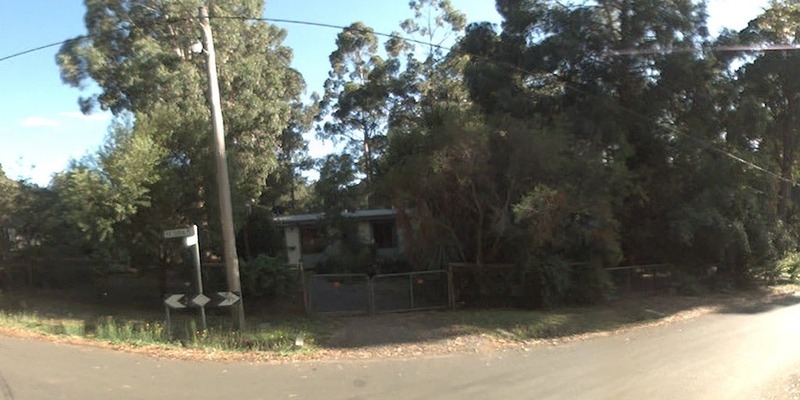
One of the strangest things for me was that after that Kinglake felt a lot less like my home. I’d grown there, running round the paddocks, swimming in dams, playing in fallen gum trees. It was me, and I felt an ownership of the place. I felt like it was mine, in some part. But after the bushfires it all changed. New buildings came in, the landscape changed. Now when I drive around town, it doesn’t feel as familiar anymore. The family house my Dad had built (in the photo above) burned down, my brother’s house burned down (he built a new, better one on the same block and still lives there), everything became newer – better, I guess, for those living there, but one of the side effects of that day for me was losing my home town. I have so many memories of Kinglake and what it was, and I remember how it contributed to me as a writer, to the stories I want to write, so it was sad to feel the connection frayed. I still love Kinglake, I still like going up there, but it’s not the same as it was. It belongs to the people there now, like I can’t claim a part of it anymore, which is fine, and it makes sense, I moved away from there a decade ago, but it always left me a bit sad. That it, through necessity, had to change. I miss the huge trees in our old backyard on Victoria Road, climbing up them to the point where they thinned out and swayed in the wind. I miss playing basketball on my dirt half-court. Of course, people lost way more than a few memories or connection with their home town, it’s trivial of me to whinge about such minor things in the larger scheme. But every now and then I think about my home town and remember that I can’t really ever go back. It’s everything I was and everything I would be.
I remember writing on my Dad’s computer into the night while the rest of my family slept, losing track of time as I got absorbed into whatever story I was putting together. I remember looking out the curtains in the night, the dirt road trailing off beneath the streetlights. No cars, no traffic. Just silence.
That Time When My Book Nearly Got Made Into a Movie
It’s the dream of almost every writer to have a book published. But close behind that is the dream of having your book turned into a Hollywood movie. I got somewhat close to having this, sort of. Here’s what happened:
When my novel ‘Rohypnol’ was published in 2007 we were contacted by a couple of groups interested in the film rights. I had no idea about this stuff, I still had stars in my eyes about having my book in Borders, so I took the advice of my publishers on what to do, who to listen to, etc. There were four groups trying to buy the rights to ‘Rohypnol’, which was awesome, and in my head, it meant it was definitely getting made. But the film world is incredibly complex, there are so many variables when seeking film funding – you’re asking investors (producers) to put up millions of dollars on the promise of a return, I can understand why there are many hoops to jump through.
I met with one producer and director combo in Melbourne. The director was Amiel Courtin-Wilson, who has gone on to do some fantastic short and feature film work in recent years. Amiel was a really cool guy and seemed really into the project, had a good vision, I liked everything about him. But there was one other group who had got in contact with us late in the piece which were pretty much the winner as soon as we heard them mentioned. The group was Seed Productions. Seed Productions was owned by Hugh Jackman, his wife, Deborah Lee Furness and their business partner John Palermo. They were working on a a couple of major films (Deception and X-Men Origins: Wolverine) so they had the contacts – and it was Hugh Jackman, of course he knew people who knew how to get a film made. Seed were the safest bet to go with – they had a clear funding plan, they wanted to get moving on the project straight away. They were the ones. So I signed the film rights over to them.
I started working with John, who had asked me to take a shot at writing the screenplay. I hadn’t written a screenplay before, but I’d read all the books and who’s going to say no to having at writing a Hollywood screenplay? We went through a few drafts, with John giving me regular feedback and sending me reference books and DVDs to help get the story down. By the end of that process I was reasonably happy with the screenplay. I was pretty sure it needed work, but it felt okay as a starting point – it didn’t feel way off. Seed then signed up a director for the project, Kris Moyes. Kris was best known for his music video work, but he’s always working on major art projects, amazing stuff. I was a big fan of his video for ‘Are You The One?’ by The Presets. In fact, when I saw that video had won the ARIA award for best video I thought it would be awesome to get that guy as the director of ‘Rohypnol’. And there he was. Kris is one of those guys who’s way cooler than you. Not in a bad way, he’s one the most down to earth, easy going guys you’ll ever meet, and I really liked him, but he’s cool in that he can, say, wear some outlandish kaftan in public and totally pull it off without looking like a douche. The sort of guy who you’ll run into in the strangest of places and it’ll seem completely normal that he’d be there. ‘Cause he’s cool, he can just do whatever and make it cool. His ideas were great, he was keen, everything was moving in the right direction.
Of course, this is over the course of a year or so by now. John was based in LA wo we’d go back and forth via e-mail and I’d write and re-write and wait for his feedback, like everything in publishing, things take time. After probably a year and a half we got to a point where we needed to get an expert to go over the screenplay and fix it up. Andrew Bovell was one of the names put up as someone who might be able to go over it, which was great – Andrew wrote the screenplay for Christos Tsiolkas’ book ‘Loaded’ (the film was called ‘Head On’) and ‘Lantana’ which was a great film. But that never came about, Andrew was working on something else and wasn’t able to do it. I met with Kris and John at Seed’s offices in Fox Studios in Sydney and we went over where everything was at then things got real quiet for a long time. ‘Wolverine’ was getting close to release so I figured they had a heap on, so no problem. Both Kris and I got VIP tickets to the cast and crew screening of ‘Wolverine’, which was pretty cool then after that nothing. For ages and ages.
Kris and I stayed in contact for a little bit, but he had other projects overseas so that sort of faded out and I’d heard nothing from Seed for months and months. Then one day I read on a news website that Seed Productions had shut down. The guys had decided to part ways, with Wolverine being their only major production credit. After I read this, I sent an e-mail to the Seed guys saying I guess this means the film is no go, and thanking them for their time and efforts and for giving me a chance to be a part of the process. Hugh sent me a polite e-mail back, wishing me all the best and that was it. By now the book was a few years old, no longer in stores – the ‘heat’ of the book was gone and the film offers had died down. It’s been under offer a few times since, but it’s never gone any further. It’s disappointing, but that’s how it is with film stuff, so I’m told. A whole lot of things have to align for you to get the green light, even if you are working with a major company or a company with major contacts. I still hold onto the dream that it might one day get made, but it’s pretty unlikely now. I never met Hugh Jackman. People always ask this, but no, I never met him. I think one time I was in the Seed offices just after he’d left, that’s the closest I got, other than via e-mail.
So despite the disappoinment, I really did enjoy the process. Being able to work with John and Kris and just the excitement of working on the possible film adaptation was amazing. John went on to produce the excellent ‘Drive’ with Ryan Gosling – which was interesting to see because after reading the book of ‘Drive’ I could relate the transition from book to screenplay to some of the advice John had given me as we went through ‘Rohypnol’. Kris is always working on something ridiculously amazing, living a life of creativity we can only dream of – you can see his stuff here. And Hugh Jackman is doing something, somewhere, I don’t know, he faded out a little bit after that.
And that’s the story of how my book nearly, almost got made into a real movie. I’d already imagined myself in a tux on opening night too. That’s how it goes.
Little
There’s this bell that starts ringing when the bucket is nearly full. It’s a huge bucket, massive, and it sits on top of the kids play area at the pool. It fills up then it tips, white water crashing down onto everything below and before it’s full this bell starts ringing, getting faster as it gets closer to tipping point. My daughter’s still too small, so I took her up in my arms and went to the spot just beneath the bucket, a point where the water won’t hit you, and I told her to get ready – Are you ready? Yeah. Are you sure? Yeah. Then the water crashed down all around us, a cone of liquid, just her and I inside. She flinched and ducked into me, then peeked out and watched the walls flowing down around us. Smiled those little white teeth.
Be True
There’s one certainty in writing, or in doing anything creative for that matter – not everyone is going to like your stuff. In fact, there’s always going to be people who hate what you do. It’s just not their thing, they’re not going to like it no matter how you go about it. You can’t expect everyone to be supportive or positive about your work, because it won’t happen. Same as you, people like some things, don’t like others, that’s going to be the case with editors, publishers, judges – sometimes your stuff just won’t be their thing. You can’t take it personal.
The best way to combat this is to know who you are and what you want. I was listening to a podcast by artist David Choe once, where he was talking about his life and how he became an artist. Choe was basically a juvenile delinquent, vandalising whatever he could. He talked about how he grew up doing stupid drawings of G.I. Joe figures and his early drawings that you can find online are just that, scribbles no better than anything you could do (Choe notes this himself in one of his books). But he stuck with it, and over time he developed his own personal style. His work (in my opinion) is amazing, but as impressive is his persistence and dedication to his art. It wasn’t created for anyone else, it wasn’t designed with a commercial strategy in mind – Choe has said his options were become an artist or end up in prison (he ended up doing both, but that’s another story).
What David Choe’s story highlighted to me was that you need to do your art for you. You need to know what you want and be happy with what you’re doing. And to a large degree it doesn’t matter what anyone else thinks, you stick with what you want to create, what you feel passionately about doing, and you can create something that will be wholly fulfilling. Anything can be art, any means of communication you choose for what you want to create can work, can come together, you just need to be true to yourself and be able to envision want from your work. It doesn’t matter what anyone else wants, you put your heart into something and that is something that cannot be replicated. You are putting your individuality into your work, no one else can do that. As long as you can feel happy with what you’ve created, feel that it is all it can be, then it’s right.
And that’s an important note to keep in mind – that it’s all it can be. Most times you’ll know when something’s done right, it will feel complete. You’ll also know when it’s not complete, when you haven’t given it your all. If you put out work that you know isn’t complete, that’s likely to come across, that’s the feedback you’ll get, and you have to be honest with yourself. If someone criticises something you’ve done, you have to think ‘is this the best I could do?’ Sometimes you need to be confronted with tough feedback to get the best out of your work – it’s not a stop sign, not a signal for you to give up. You need to take feedback on and use it. Keep in mind what it is you want to achieve.
My approach with my writing is that I will listen to any and all feedback from readers who want to give it to me, good or bad. If one person says they didn’t like a section, I won’t necessarily go back and re-do it (it would depend on their reasons for disliking it). But if that same section is highlighted by more than one reader, I will definitely go back and re-read it and make sure it’s communicating the story I want to tell. If I can read my work back and feel happy with it, especially if I’m reading it back months after first writing it, then I know it has something. It may need more work to polish it, but I know there’s something there and I’ll stick with it.
You, as a writer, as an artist, should never be afraid of criticism or feedback. You need to get your work out there. But you need to know your work is, at it’s core, the best it can be from your perspective. New perspectives will help you enhance it, but you need to be the one who feels confident – it’s your work. It needs to be you, not what you think someone else might want. You’re going to get rejected and criticised, but that’s how it is. All writers get rejected. All of them. Don’t let rejection get in the way of what you want. If you know that you have done all you can, that your work is the best it can be, in alignment with what you want to achieve, then you should stick with it. Keep working, keep developing your own style. You only fail as an artist when you give up.
Reading Out Loud
One of the methods Christos Tsiolkas passed onto me when editing was to read my work out loud. Christos would take a scene I’d written and read it out loud to me, showing me what he, as a reader, would get from it. And what I found was he’d often put a different intonation or emphasis than I’d intended, highlighting how sections were not as clear as I might have thought they were. But then I too would read out a section, and I’d find the same thing. Sometimes the story flow, in your head and as you’ve written it, will not come across that way in the mind of someone else. But reading it out loud helps detect this, helps you see the flaws and iron them out, re-wording and re-working them to ensure the message is clear.
It’s been a massive help to me as I go through, particularly when I’m stuck on a scene or section. It can be embarrassing and you need to find a space to do it, but reading your work out loud can be extremely valuable when editing and re-writing.
Kevin Smith
I’ve been following with interest the production of Kevin Smith’s latest film ‘Tusk’. As you may be aware, Smith’s first steps into this project began on his weekly podcast ‘SModcast’, which he hosts with producer Scott Mosier. The idea came from an article about a man who posted a hoax ad online seeking a room-mate. The ad told the tale of a man who’d been isolated on an island for many years, whose only friend in that time was a walrus, and went on to say that the room was available rent free, provided the new tenant be prepared to wear a walrus costume on demand to remind the owner of the time he’d spent with the walrus, which he considered his true friend.
Along with the many thousands of SModcast listeners, I was witness to this first conversation Smith and Mosier had about the project. That conversation evolved into a ‘what if?’ discussion about a possible horror film, and that has now progressed into an actual Hollywood feature, ‘Tusk’, which Smith is currently editing. The progression has been amazing, not only because of how fast it’s evolved into a living, breathing thing, but that we, as the audience, have been there for every step of the ride.
Kevin Smith is a truly inspirational character. Whether you like his work or not, you have to acknowledge his place as a pop-culture icon. Smith stands as a beacon for all the would-be film-makers out there – a guy who came from nothing and made his own way to major success. Many film-makers working today quote Kevin Smith as an inspiration, and his speaking tours always sell out around the world. Smith has succeeded as a film-maker, but more importantly, Smith has succeeded as an inspirational figure.
I’m not a fan of everything Smith does – even Smith discusses his dislike of some of the films he’s made – but I am a fan of Kevin Smith as a person. He genuinely cares about his fans and about providing them with authentic content and experiences. He looks to provide opportunities and support for others (including his high-school friends who still feature in his projects). He regularly calls for his fans to start doing podcasts, start making films, spruiking the freedoms and opportunities we all have available to us in the digital age. With the progression of ‘Tusk’, he has once again shown how an idea can be realised – no, we don’t all have Smith’s connections, but the process is very similar, albeit with more hoops to jump through.
Smith has been saying for sometime that he is retiring from film-making. That he wants to make way for the next generation, that he doesn’t have anything more to say in film. He said this about ‘Clerks 3’, which is still going through the pre-production process. He said it about another film before that (‘Hit Somebody’), then ‘Tusk’ came out of nowhere. I sincerely hope Smith doesn’t retire from film-making. I hope Smith continues to go with the flow, see what opportunities come up, flow with them right through. Maybe he makes ten more films, maybe none, but just having Smith out there working, showing the next generation how things can be done, how you need to follow your heart and ideas and produce content, whether it goes somewhere or not, is something, I think, many people need. Just having Smith as an example of what can be done if you give it a shot provides so much benefit to not only his fans, but anyone working in a creative field. Just try it. Just send it out. Just have a shot, get your work out there. If you feel passionately about something, if you really want to do it, then you should do it.
One of the things Smith always says is you should be a ‘Why not?’ person, not a ‘Why?’ person. You need to surround yourself with ‘Why not?’ people. You say you want to make a film – why not? You want to write a book – why not? Why not you? Why can’t you be successful? Why can’t this thing you’re working on now be the thing. This is excellent advice and one I think we should all try to apply to our day to day lives, and not just in creative work. Anything is possible, but it has to start somewhere. Why not with you, right now?
Kevin Smith shows us that following your heart and sticking with what you love can lead to success. Working with the people you want, being true to yourself, expressing your own voice – sure, not everyone can make a career out of this, but Kevin Smith is a living example what is possible. I sincerely hope he continues to create and shine light on the path for generations to come.
Brevity
Brevity – keeping things simple, keeping the story moving – is something I always try to keep front of mind in my writing. Is the information necessary? Does it impede the story flow, rather than enrich it? Is it adding anything to the reader’s view? I generally write in a minimalist style, so brevity is important, getting in those key details and trying to find more creative, intelligent and engaging ways to communicate the story.
In an article by Chuck Palahniuk, he broke down minimalist storytelling, based on the work of the amazing Amy Hempel and her story ‘The Harvest’. The rules of minimalism Chuck notes are:
• The first thing you study is “horses.” The metaphor is – if you drive a wagon from Utah to California, you use the same horses the whole way. Substitute the word “themes” or “choruses” and you get the idea. In minimalism, a story is a symphony, building and building, but never losing the original melody line. All characters and scenes, things that seem dissimilar, they all illustrate some aspect of the story’s theme.
• The next aspect, Spanbauer calls “burnt tongue.” A way of saying something, but saying it wrong, twisting it to slow down the reader. Forcing the reader to read close, maybe read twice, not just skim along a surface of abstract images, short-cut adverbs, and clichés. In minimalism, clichés are called “received text.”
In The Harvest, Hempel writes, “I moved through the days like a severed head that finishes a sentence.” Right here, you have her “horses” of death and dissolution and her writing a sentence that slows you to a more deliberate, attentive speed.
• No abstracts. No adverbs like sleepily, irritably, sadly. And no measurements, no feet, yards, degrees or years-old.
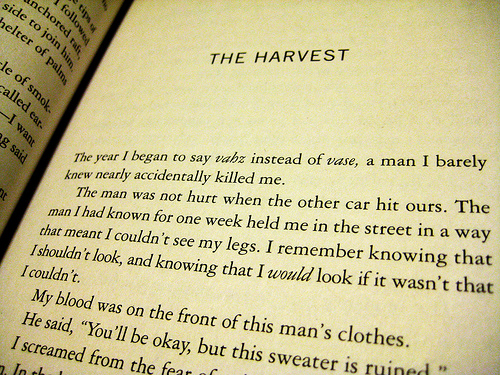
In The Harvest, Hempel writes, “The year I began to say vahz instead of vase, a man I barely knew nearly accidentally killed me.”
• What else you learn about minimalism includes “recording angel.” This means writing without passing any judgments. Nothing is fed to the reader as fat or happy. You can only describe actions and appearances in a way that makes a judgment occur in the reader’s mind. Whatever it is, you unpack it into the details that will re-assemble themselves within the reader.
Amy Hempel does this. Instead of telling us the boyfriend in The Harvest is an asshole, we see him holding a sweater soaked with his girlfriend’s blood and telling her, “You’ll be okay, but this sweater is ruined.”
• Last point – “on the body.” Hempel shows how a story doesn’t have to be some constant stream of blah-blah-blah to bully the reader into paying attention. You don’t have to hold readers by both ears and ram every moment down their throats. Instead, a story can be a succession of tasty, smelly, touchable details. What Spanbauer and Lish call “going on the body,” to give the reader a sympathetic physical reaction, to involve the reader on a gut level.
These rules obviously can’t be applied to everyone’s work, but knowing them, thinking about them, will help you in being more creative and cerebral in how you communicate story. I especially like the ‘no adverbs’ rule, and I believe applying this, or at least thinking of options whenever you do use an adverb, makes you re-think what you’re saying and come up with creative solutions. I’ve noted this before, but it’s like Twitter, where you’re restricted by a certain number of characters, forcing you re-think what you want to say, abbreviate, and often you’ll find a smarter, more succinct way of wording it because you have to. You should also apply this to your writing, try to think through the best way to say what you want that is the most evocative and, as Chuck says, the most ‘on the body’, eliciting a physical and mental reaction with the reader that will better engage them with your scenes and characters.
Fifty Feet
If you saw fifty feet, you’d think differently,
Two hundred and fifty toes pointing up to the sun,
Ankles attached to stiffened legs,
Fifty feet of pale soles, worn and calloused from life,
Fifty feet that felt socks and touched water and danced,
Two hundred and fifty toenails degrading in the sunlight,
If you saw it, your perspective would be different,
Feet of twenty five children,
Poking from underneath the plastic,
Charred black, chilled blue,
The feet of twenty five people you know,
Their skin, their touch,
Hearts no longer pumping,
Fifty feet, lying dead still in the gusts,
Waiting for the next world,
Please don’t,
Don’t tell me they are just ‘bodies’,
If you saw fifty feet, you’d see things differently.
New Short Fiction – Tincture Journal
The good people at Tincture Journal are publishing one of my short stories in their latest journal to be released shortly. For more info:
http://tincture-journal.com/2013/11/27/issue-four-table-of-contents/
The Hero’s Journey

There’s a book I read many years ago called ‘The Writer’s Journey’ by Christopher Vogler. In it, Vogler has studied the work of mythologist Joseph Campbell and how it has been applied to storytelling throughout the years. Campbell studied story telling through cultures and generations and found similar elements existed in all tales, more complex than just a beginning, middle and end. Campbell called this ‘The hero’s Journey’ and detailed how the hero would always be faced with certain challenges and hurdles. Vogler took this research and applied it to a more modern medium, film, making it much easier to comprehend and apply, as you have all the reference points in your head already. Vogler’s contention is that all films have The Hero’s Journey at their heart, and he goes on to give example and example of this applied to modern films. And it’s amazing.
If you don’t have this book, you need to get it, in my opinion it is essential reading for all writers. For example, George Lucas used Joseph Campbell’s research to write ‘Star Wars’, plotting out all the key notes based on The hero’s Journey – Vogler discusses this in intricate detail. Interestingly, Lucas used The Hero’s Journey again for ‘Willow’, applying the rules and plot points exactly as noted in Campbell’s research as something of a test to see if following them exactly would be a ticket to success (which, it alone, wasn’t, based on ‘Willow’’s box office performance). Vogler even breaks down ‘Pulp Fiction’ as a challenge in the book.
The thing is, when you read it you’ll note that most of the elements are already evident in your writing. You instinctively know story structure and pace from watching films and reading books, so a lot of it, you’ll fine, is already present in your work. But having the knowledge of how story structure works, understanding why each step happens when it does, all this is invaluable information to have and will help you solidify and strengthen your writing.
The below image breaks down the steps of The Hero’s Journey – some, if not most, of it won’t make any sense without the further context of the book, but these are the elements that occur, or should occur, in all stories in some form. I highly recommend all writer’s obtain a copy and go through it. Essential reading.

 twenty six