My mum grew up in harder times. Everyone’s did, I guess. My mum was one of seven kids, but she was different to the others. Where her sisters were into horse riding and were more outgoing, my Mum was quieter, liked books and reading, more solitary activities. Her Dad left when she was young, but Mum never really talked about this, never complained or lamented the loss. It was just something that happened, then they got on with life. Mum loved writing as a young girl, and that lead her towards a career in admin – Mum did a course at secretarial college and started work, but that job was short lived. She met my Dad soon after that, just after he’d returned from Vietnam, then they had my brother. This was a natural progression – she left her job, took on the role of full-time Mum and continued on as she had to. Mum’s career took a backseat and all her ambitions and dreams transferred to us, me and my brother. A few years later she had my younger brother, then my sister, setting her up to spend the majority of her active years changing nappies, washing clothes, driving to school, driving to sports, picking us up from friends’ places and making us meals. Mum never complained, never lamented what her life had become. She just did it. That’s what you do.
As we grew up and started moving on, my Dad got sick. After serving in Vietnam he became a transit security officer, kicking drunks off trains and such. After a particularly violent incident Mum told him enough was enough and he became an ambulance officer. And now, many years later, too much exposure to the worst of life had taken it’s toll. He couldn’t sleep, he was prone to fits of rage. He’d hit the lowest of lows. He was diagnosed with post traumatic stress disorder. This meant he couldn’t work, he’d be living on a pension for the rest of his life. And he’d need a carer. Mum took on this role, an extension, to some degree, of being a parent – as her kids grew up and moved on, Mum took on similar responsibilities for Dad. Mum never complained, just continued on. This was the hand she’d been dealt, this was how things were. You just get on with it.
My Mum is one of the most selfless, caring, understanding, tolerant and beautiful people you will ever meet. She rarely has a bad word to say about anyone (if she does, you must’ve really annoyed her) and she takes whetever life deals her and just gets on with it. No complaints. She has given her life to her family, and I have no doubt, she’d do exactly the same again in a heartbeat.
Mum loved writing. While she never had the opportunity to realise her dreams of becoming a writer, I did. And every time I have something published or I win an award – every time I have any sort of writing success, I feel like she has too. It’s not just me that’s succeeded, I carry her dreams with me – my achievements are hers. Mum followed the path that was set out for her based on her gender and ambition at the time, and she never had the chance to be all she might have wanted to be. But through me, with me, I hope I’ve been able to make her proud. And I hope I’ve been able to realise some of her ambitions, the dreams she might have had – those ones that took a backseat to her giving up everything for her family.
Have you heard of Iggy Azalea? She’s a statuesque rapper who’s album recently debuted at number three on the US Billboard charts. She’s also Australian, though she’s not as well known here as she is in the US. Azalea (who’s real name is Amethyst Kelly) made her name in America after moving there to pursue her rap dreams at age 16. Azalea grew up in Mullumbimby in New South Wales but saw that her opportunities were limited in her home town, and home country as a whole. She decided that if she was ever going to make it, she’d need to head overseas – and the story of her success flows from there.
Azalea caught my attention recently when I read her story about leaving Australia. I could see what she was saying, could sympathise with the situation she faced. Here she was, obsessed with Tupac and desperate to be a female rap superstar, but living in a country town where others didn’t take her seriously and her opportunities for exposure were limited. While Azalea was referring to the music industry, the same can be said about writing to some degree, in that our creative culture, particularly our creative diversity, is not overly strong. In my conversations with international writers, and in the brief times I’ve spent in foreign cities, I’ve definitely felt that there’s a much bigger emphasis on creative arts and culture in other nations. Not everywhere, but in some places there is a distinct artistic undercurrent, a feel to it, and those creative communities are strong, visible and well supported. The sad reality of not having such a strong culture is that many writers end up in isolation, unsure if there’s an audience for their work or how to find it. What’s more, writers’ groups are often hard to locate and some writers are hesitant to join if they feel they’ve done nothing, like they won’t fit in.
This is not the fault of any person or group, I realise many arts organisations work very hard (and have done so for a long time) to create communities and provide writers with opportunities to join like-minded folk, but definitely my experience of larger cultural centres like London, New York, Seattle, even Vancouver, is that there’s a much bigger creative pulse, or at least, a more present one. Things like spoken word poetry have a real sense of purpose in these cities, a real pride of place, and while we do have similar communities in Melbourne, they’re much smaller, more underground – you have to be more active in seeking them out.
So what do we do about it? What can we do to foster a better literary culture and highlight opportunities for writers of all genres and styles? The answer is we all have to get involved. Joining a writers’ group is not just for your own benefit, it’s for the benefit of the wider writing community. Attending book launches, readings, spoken word events, joining discussions at your local writers’ centre – just being present and supporting these projects helps build that literary community and enhances recognition, making them easier to find. By taking part, you’re not only participating in something you’re interested in, you’re also endorsing that community, building it, helping create a wider network. This promotes more opportunities for writers to connect, which then leads to more niche writers finding others who feel the same. The rise of social media helps in this respect, as it enables people to find communities outside their geographic limitations, but it’s also important that we establish these groups locally, that we build support and acceptance for the various forms of written expression in order to create our own networks and our own localised culture.
We also need to recognise the passion and dedication that goes into all forms of writing. I’ve got little interest in the work of Matthew Reilly, but I respect the man greatly. I could go and hear him speak and get a heap out of it, regardless of whether I’ve read a line of his work. All writers have made a commitment, an effort that’s above and beyond what they have to do. We’re all in it together – we need to support each other in order to create a stronger literary eco-system, a stronger community that gives voice to more writers who might not have the confidence to ever release their efforts from their notebooks. Maybe we have writers who, like Iggy Azalea, are very talented at what they do, but they feel like there’s no chance for them – there’s no chance a female rapper could achieve significant success in Australia. That was a really sad sentiment for me to hear, and most teenagers in the same boat won’t have the tenacity to move to another nation to chase it. They’ll just give up. We have to do whatever we can to stop that, to embolden more voices and give them the confidence to chase their creative dreams, whatever they may be.
Writing events are about more than people trying to sell their books and in-crowd meet-ups. It’s about community, being part of something bigger. You have to go along to events and get involved wherever you can. Talk to people, tweet about it, tell others where you are and what you’re doing, introduce yourself – and I know it can be hard sometimes to go and get involved (my default position in such situations is ‘wall flower’) but it’s what you need to do, not only so we get to hear your voice as a writer, but so other writers, young writers especially, see what you’re doing and know they can get involved too. Writers are welcoming types, we all want to know more about the world and the people in it. We need to ensure that that openness remains part of our culture so we can encourage a stronger literary bonds and continue to see great writing emerge. So our stories remain as diverse as our society and an accurate reflection of our full creative capacity.
twenty six has taken out the ‘Words and Writing’ category in the Australian Writers’ Centre Best Australian Blogs 2014 Competition. Massive news, seriously humbled, overwhelmed, excited. Really great – it was a solid list of nominees in the category and I would’ve been happy to lose out to any of them. Glad the judges saw merit in my work, and also, want to take the opportunity to thank the subscribers and others who’ve read my posts – writing is always pretty solitary, and you never know for sure if you’re getting it right. Recognition like this is always a massive boost – thanks so much, all.
At one stage, I was a really big fan of The Streets. For those unfamiliar, ‘The Streets’ was the stage name of British cockney rapper Mike Skinner. Skinner became known on the back of his excellent debut album ‘Original Pirate Material’ and the single ‘Weak Become Heroes’.
There was nothing technically amazing about The Streets’ music – the beats are somewhat generic, the almost spoken word vocal delivery is not immediately stand-out. What Skinner was able to do better than most was capture a moment in time. Every song on Original Pirate Material had a feel to it, a vivid sense of time and place. You could smell the rain soaked concrete, feel the breeze pushing past along the London streets. Skinner was more storyteller than rapper, and no one could tell a story in quite the same way.
He reinforced this with his second, and by far most popular, album, ‘A Grand Don’t Come for Free’. If you’ve not heard this album, I highly recommend you go check it out, particularly if you’re a writer. A Grand Don’t Come for Free is a concept album – Skinner documents his entire relationship with his ex-girlfriend from start to finish, stretching from track to track. We share the elation and excitement of the beginning, the complacent beauty of normality, then the sadness of the eventual end. Every element is so familiar, so real, and each track carries an emotional depth and resonance, made all the better by Skinner’s knack for capturing the moment. There’s a section in one track, when his girlfriend is breaking up with him, that just hurts so much:
I can change and I can grow or we could adjust The wicked thing about us is we always have trust We can even have an open relationship, if you must I look at her she stares almost straight back at me But her eyes glaze over like she’s lookin’ straight through me Then her eyes must have closed for what seems an eternity When they open up she’s lookin’ down at her feet
There’s the desperation – we can have an open relationship if that will keep you with me – then the realisation that it’s all over, told in Skinner’s unique, simple style. A Grand Don’t Come for Free is more akin to reading a novel than listening to an album, it needs to be experienced from beginning to end to fully appreciate it’s excellence.
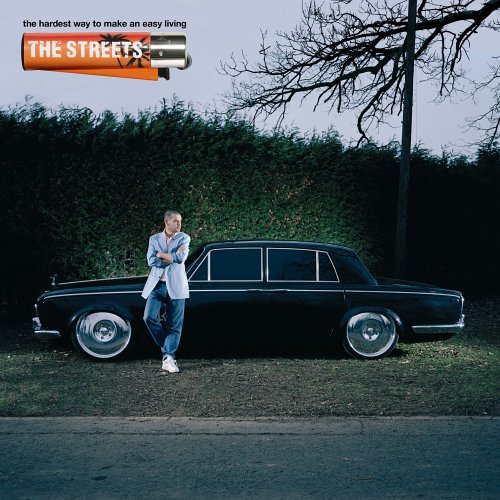
Things changed by the third album. While his clear strength was in telling stories to which we could all relate, the success of A Grand Don’t Come for Free meant his life totally changed. He’d become a full fledged celebrity, regularly appearing in tabloids and gossip mags, holding hands with this or that pop starlet, hanging out at VIP events. His success ultimately turned his strength into weakness – he was still writing about his life like always, we could just no longer relate. The album ‘The Hardest Way to Make an Easy Living’ had some classic Streets moments, but it wasn’t the same. The title track had Skinner lamenting the many downsides of fame, like the costs of making music videos and complications of putting on stage shows. These were real things, real issues that he was experiencing, but it was pretty hard for listeners to align with the view that his career, which had granted him massive amounts of cash and seen him invited to perform all over the world – all while doing what he loved – that the downsides to that lifestyle could be all that bad. Another track looks at the difficulties of picking up famous women – again, something he’d experienced, but the difference between his reality and the listener’s created a gap, a distance from the material. It once again highlighted that The Streets’s appeal was more in story than in music, and Skinner experienced a significant drop-off in fan support as a result.
He was never able to fully recover after that – Skinner released two more albums under The Streets’ moniker, ‘Everything is Borrowed’ (on which, Skinner pledged not to reference modern life on any of the tracks, a response to criticism of the previous album) and ‘Computers and Blues’. As with The Hardest Way to Make and Easy Living, there are some great moments on both of these albums (and Skinner’s musical ability increases markedly through each), but he’d lost that edge, that storytelling dynamic that made his work so great. A mixture of life changes and criticism seemed to pretty much kill off The Streets as a project, which Skinner acknowledged by retiring the name after his fifth full-length release.
The story of The Streets highlights one of the inherent dangers of fame – the more successful you are, the higher the risk you can lose touch with your audience. But above that, Skinner’s story highlights one very important element for writers that can often be overlooked. The strength of The Streets was that it told Skinner’s story, from his perspective. And that was perfect, it was real, something with which we could all relate. The rise of Mike Skinner highlights the fact that you don’t need explosions or car chases to gain an audience. Your experience, your viewpoint on life, no one has that but you – that unique insight is interesting. A story doesn’t have to be exciting or amazing to be resonant. A key strength of storytelling is honesty, capturing the feeling of the moment in an honest and real way. In Skinner’s case, those common life experiences were far more resonant than the fast-paced world of being a rock star – that’s not to say his experiences with fame were any less honest, but his story was so much stronger when we could be part of it, when we could all relate and share in the familiarity of those moments.
People relate to what they know and understand, they need a way into the narrative. Even if your story is sci-fi or fantasy, we still need to be able to connect with the stakes, understand the emotion of each scene. The development of flesh and bone characters is critical, and those characters are borne from your knowledge of real people, real situations. Writing is about exposing yourself, sharing what you’ve felt in similar circumstance, creating the experience of being there, in the moment. You need real relationships with your characters, real emotions, those are the details that fuel the connections in the reader’s mind – the more readers can relate, the more they’ll be drawn in. Keeping it real, keeping it familiar, capturing experiences based on your unique perspective, this is how you develop fully rounded characters. This is how you share not just words with your readers, but experiences and create real life within the confines of the fictional page.
There are three things in life that always seem to be the source of conflict and misery, three things that I see happening on a daily basis that irk me and cause much shaking of the head. These are things that I can’t sympathise with or reconcile, and, coincidentally, these three can also be the killers of great writing.
The three things that always carry with them the potential for issue and angst are laziness, ignorance and selfishness. Here’s how they relate in a writing context:
Laziness is pretty self-explanatory, you have to get yourself moving, you have to do the work to see the results. You can’t expect to sit down at your PC, write a few thousand words, then send it off and let the publisher bidding war to begin – this happens to no one. As noted in a previous post, writing is work, and you have to do it everyday. You have to read, you have to learn how to communicate your story, it takes time to get it right. If you’re truly committed and the story is something you have to get out, you’ll always find the time. You’ll make the time. That’s not to say the cause of incomplete work is always laziness, I realise people have a lot going on in their lives, but laziness is indeed a killer for writers. If you’re lazy, you won’t start the work. If you’re lazy, you won’t finish. If you’re lazy, you won’t do the required research and editing and re-writing. Laziness is not an option for writers, you just have to get it done. No one’s going to make you sit down and write, you’re the one who has to push yourself. Without the effort, you can’t achieve the result.
Ignorance is something we all see everyday, people ignorant of their impact on others, ignorant of how their actions affect other people. Ignorance is a killer in writing because you have to be aware. You have to understand what works and doesn’t work in your writing, you have to take on board feedback and asses your work to ensure it aligns with your goals. I’ve seen a heap of writers who’ll get feedback, totally ignore it, then hand their work to someone else, hoping they’ll get a result more to their liking from them. You can’t flat out ignore feedback. Maybe someone tells you something you don’t agree with, maybe someone criticises you unfairly – my general rule is that anytime something is raised I’ll re-read it. If it communicates what I wanted it to, then it’s fine. But if more than one person highlights the same issue, then it needs to be re-worked. If you want to improve as a writer, you have to listen to the feedback, you have to hear what people are saying. Your aim is to create something undeniable, something so great that even your biggest critics will have to concede that it’s well done. To do that, you have to listen, you have to read, and you have to know what works.
Selfishness in a writing context is getting too caught up in your own world. Writing is solitary, self-involved for the most part, and sometimes we can get so tied up in it that it’s all we want to talk about and all we want others to talk about in our presence. Sometimes it leads to you dominating conversation in order to keep it tied to what you need, pushing people for feedback on your work. The risk of being selfish is you can get stuck on other people’s opinions, you can procrastinate, waiting for feedback, and you can turn helpful readers away by pushing too hard for commentary. And the essential point here is, you need to know your work. You definitely need readers, you need that feedback from as many sources as you can get, but you need to know what you’re trying to achieve first. Once you’ve written, re-read, edited, re-written – once you’ve done all you can to ensure your story is as close as you’re able to achieve by yourself to what you want to communicate, then you can seek readers – but always understand, having anyone read your work is something you should be grateful for. They are taking time out of their day for you, for your story. Even the worst feedback is worth hearing, worth taking in – maybe it gives you nothing, but maybe it makes you re-read a section and you find a way to improve the way it’s written. All your readers are valuable, and you need to be careful not to push them away or argue with their perspective. Let them read it in their own time, let them say what they want to say – some will have alot of comments, some nothing at all, and that’s fine, so long as you know what it is you’re trying to achieve. Their opinions serve as a guide, a reminder, a new perspective on your work. You need to let them read and think it over, then come back to you when they’re ready – hopefully, your story is so compelling that they can’t help but respond, but not everyone will see it that way. Don’t be selfish, don’t get caught up in the need for response. You are your chief motivator.
The one other thing that always stands out in day to day life is people being unkind. This doesn’t have a writing application, as such, but something worth noting in your regular interactions. Don’t be unkind, don’t be mean for the sake of it. Every evil action in the world is caused by some level of unkindness, moments in people’s lives that could have been avoided. There’s no need to be unkind, everyone’s got their reasons for doing what they do. There’s no reason to contribute to negativity any further.
In news that came as a huge surprise, twenty six has been listed as a finalist in the Australian Writers’s Centre ‘Best Australian Blogs 2014‘ competition. This is a massive honour – I entered my blog with the faintest hope that it might be good enough. To make the final list is huge, and I give my many thanks to the judges.
Good luck to all the finalists in the ‘Words and Writing’ category, honoured to be named amongst you.
I recently watched the film ‘One Chance’, a film based on the life of British mobile phone salesman turned opera star Paul Potts. If you’re not aware of who Potts is, he won the 2007 iteration of ‘Britain’s Got Talent’ after he blew everyone away with his pitch perfect performances on the show, the first one, in particular, gathering him worldwide attention.
Like Susan Boyle, Potts is a poster-child for the talent show format – an unknown, unrecognised talent plucked from obscurity and given a chance to shine on TV’s biggest stage. There seems to be one of these stories in every season of these shows, and they are great – I challenge anyone to remain unmoved by Potts’ initial performance (above), where the judges had clearly expected way less from this unconfident, overweight and plain-looking gent standing before them. Potts’ rise to fame is probably the most successful transition of it’s kind, given Boyle’s challenges with fame ever since. It’s a great story that deserves to be told, and ‘One Chance’ is a solid film, though not quite as good as it had the potential to be.
The main issue I had with the film was the portrayal was a little too light. That was intended, they wanted to hit as wide a demographic as possible, so it needed to be a feelgood film, but the greatest aspect of Potts’ rise was encapsulated in that first performance – you could see in his body language and the expression on his face, this was a man who’d been kicked one too many times. He’d lost faith in himself, in everything, you could see that he was bracing himself for more anguish. I didn’t feel the film truly captured this, the defeated nature that Potts exhibited – James Corden, who plays Potts, was very good, but he couldn’t quite capture that uncomfortable nature exhibited by Potts in real life. This was the key reason why Potts’ story was so great, because you could see that he’d almost given up – but then he won. It’s a great example of persistence in doing what you love in the face of constant opposition.
But the key message I took from the film was the importance of having support from your loved ones in what you do. All through the film, Potts’ dad is telling him to give up on his dreams of being a singer, to face reality and get on with life like everyone else. There’s a scene where he’s really down, where nothing’s going his way and his wife realises that if he can no longer hold onto the dream of being a performer, that he really sees no point to his life. It’s part of who he is, he needs to do it, needs to hold onto it in some way or he just falls flat, lays on the couch, gives up. I think that’s true in everything – if you’re not true to yourself and not pursuing what you’re passionate about, at least in some form, your life purpose can be eclipsed, and you face a dreary reality of just being, just doing what you have to do. A life of obligation more than exploration of being alive. That’s no way to be, you always need to keep searching for what makes you happy, what drives you as a person, and you need to keep chasing it – sure, there’s certain things you have to accept, and yes, you’ll probably have to work a job that’s not exactly aligned with your dream path, but as long as you continue to pursue your passions in some form, as long as you have the support of people close to you to do that, that’s a big key to maintaining balance. And the moments of clarity you can get from pursuing your dreams make all the effort worthwhile. People should never give up on chasing what it is they’re most passionate about. Everyone has something.
And as a parent, it also underlined to me the need to support your kids in everything they do. If they feel strongly about something, parents need to be supportive, foster it as much as they can. Your mother and father have a profound influence on your psychological make-up, just having them back you, being aware that they’ll be behind you no matter what, it’s such a huge pillar of strength. It can change your life. My parents have always been supportive of me, and while there are certain realities we have to face, I’ve always known they’re behind me and they’ll be there for me, no matter how unrealistic my goals. Knowing that I’ve made them proud at certain times has been one of the most emotionally moving experiences of my life.
Stick with what you love, find that thing that makes you happy, and surround yourself with people who won’t ask ‘why?’, but ‘why not?’. It’s one of the keys to maintaining happiness in life and feeling complete in everything you do.
I was once asked for my thoughts on writing controversial content, where you balance between ‘confronting’ and ‘gratuitous’. My novel ‘Rohypnol’ has a lot of graphic scenes, and it’s something I was criticised for in a few reviews, that it was gratuitous, violent for the sake of it. Some felt there was no need to go into that level of detail, that much of the horror could’ve been implied and left to the imagination. But I disagree. There was a definitive purpose to what I wrote, and there is, I believe, a reason why people need to include such detail, where warranted, within the context of their work.
One of the inspirations behind ‘Rohypnol’ was a French film called ‘Irreversible’, directed by Gaspar Noe. Noe is well-known for his controversial films and has received much the same criticism, that he glorifies violence, rather than exposes us to it. This is most evident in the extreme violence of ‘Irreversible’. In the opening scenes, there are two guys looking for another man, called La Tenia. They’re in a nightclub, looking for Le Tenia and (if you ever want to watch the film, stop reading now) when they do locate him, they get into a fight and kill him. More specifically, they kill him by beating his head in with a fire extinguisher. And you see every single hit, every detail. You feel everything in this scene. There is no escaping the violence – it’s sickening, it’s so bad you have to look away. It’s horrific and it just gets worse and worse. The viewer has no context for this scene, it’s two guys getting in a fight with another. There’s no lead-up or backstory, you’re just thrown in. The violence is the most extreme you’ll ever see on film, everything about the scene is horrific – the camera moves and swirls round amidst strobing nightclub lights and grinding bass music. The whole sequence is designed to make you sick. Not a great way to start a film, right? Why would a director want to make the audience ill, especially so early in the film?
There is method to Noe’s madness. The film is called ‘Irreversible’ because the storyline moves in reverse – we start with the horrific ending to tragic story. The point Noe’s making is that violence cannot be justified. Responding to violence with violence is not an answer, in any context – but that is exactly what Hollywood films glorify. We’ve grown up seeing revenge films, feeling for the wronged man, siding with him and hoping he’ll make the bad guys pay in the end. That’s justice, that’s what we want to see – that’s what we want to do when we’re wronged. And that’s wrong. That shouldn’t be the way violence is presented. It’s not an answer, it doesn’t solve problems. Noe’s mission with ‘Irreversible’ was to display, in graphic form, what’s wrong with Hollywood action films. Had the movie played in chronological order, you’d have seen that La Tenia had brutally raped and murdered the wife of one of the men. You’d see this, and you’d side with the man, then when they did finally catch up with La Tenia in the nightclub, you’d want him to get killed. You’d want to see him pay. But there’s no right in responding with further violence.
Noe set out to make the film as uncomfortable and violent as he could to show what violence is really like – in that scene, where you want to look away, where many people walked out of the cinema – that’s how you would feel if that situation where to happen in real life. Violence is not ‘cool’, there’s no shotgun-like sound when someone punches someone in the face. There’s no good guys and bad guys in real life. Violence is horrific and frightening – it’s something everyone wants to avoid at all costs. That’s the point of the scene. You don’t want to see this. You don’t want to condone this. We should do all we can to avoid this sort of thing happening. Seeing someone get their head beat in would affect you in ways you can’t even imagine, it would traumatise you for life – yet in most films, people get revenge, blow people up, shoot them in the head and we get nothing. It’s left to our imaginations, and we don’t picture the extreme violence that actually occurred. We just note that the bad guy got killed. Case closed. Hollywood films should not portray violence as a light, humourous, nothing event that just happens. Because that, by extension, is what we’re teaching kids. If more films portrayed violence as Noe does in ‘Irreversible’, I’ll bet you see such acts of violence reduce. Everytime I see another report of violence in nightclubs, of stabbings and glassings and beating. When I read reports of attacks getting more brutal, kids more devoid of consequence, I always think of ‘Irreversible’. Honestly, it should be on the high school curriculum.
‘Irreversible’ played a big part in the way I portrayed violence in my book. My intent was not to be gratuitous – and I absolutely don’t believe it ever crosses over that line – my goal was to be honest to the story and scenes within it. If you would feel horror, dread, happiness, joy – your responsibility as the author is to communicate that, translate those emotions into the body of the reader. Definitely, I could have left the action out, left the violence implied, but that’s not the point. If monsters like the characters I’d created actually did exist, if they committed horrendous acts like the ones presented, then feeling the detail is important. Yes, it’s confronting, yes it’s shocking, but we need to be confronted and shocked sometimes, we need to face the reality of violence as it is. This is the only way people will ever understand the impacts, the horrific nature of such crimes. And by making people aware, hopefully that inspires more people to avoid it in real life. We shouldn’t, as writers, play down violence, leave it as something that just happens, then move on with the rest of the story. If something terrible occurs, it’s important to be honest, show the necessary detail in order to make the reader feel what you felt when you wrote it. This remains true in all writing – be honest to the story you’ve created, express the reality of your world. What’s happening needs to be real – so be real, be honest with the detail, and never shy away from saying what needs to be said. Don’t be constrained by how people might respond, how people might feel, just get it down, write fuelled by your emotion, and let the story dictate the detail necessary to communicate each scene.
Have you ever noticed how many authors list ‘New York Times Bestselling Author’ in their bio? It’s alot. I started noticing it recently, when coming across people I’d never heard of on Twitter and seeing it in their profile. Of course, my not knowing who they are doesn’t mean much in context – many of them are writing about subjects I’ve no interest in, so I wouldn’t have heard of them, unless they were, say, a New York Times Bestselling Author, then I’d have heard of them, right? You have to sell a million copies, or something, to make that list. Right?
Apparently not. To make the prestigious New York Times Bestseller list you need to sell around nine thousand copies of your book in a week. So in that first week, if you push hard enough and get your book out to as many outlets as possible and spread the word as wide as you can, you only need to sell your book to about 0.003% of the American population to lay claim to the title of ‘New York Times Bestselling Author’. That’s pretty amazing, right? I’d always had this idea in my head that a New York Times Bestselling author had to have sold so many copies, that their book had to be this amazing tome, held aloft by the populous and praised by booksellers and critics alike. Turns out that’s not true. In fact, it’s even less true than that, as a lot of publishers and authors game the system to make the top of the bestseller lists – the New York Times listings take into account bulk orders, and there are services that will help distribute those bulk orders to pre-arranged buyers in order to boost the numbers in any given measurement period. Businessmen, too, will include copies in their service fees, then send them out when the book is published, again inflating their figures.
There’s obviously solid logic behind this – as noted, I’ve always been under the impression that sales required to make the list were much higher, so definitely, I’d have factored ‘New York Times Bestseller’ into my purchase decision – if it’s made that list, it must have something to it. I would think inflating the figures would definitely be of benefit and would increase your natural sales in the long run, but it was a little disappointing to discover that that claim doesn’t hold as much weight as much as I had thought.
But it still means something. If I were a New York Times Bestselling author. I’d claim it if I could, for sure, and it’s an attribution you can list forevermore in every bio and on the front of every book you write. And, of course, there are a great many authors who have made the list purely on the quality of their work alone leading to those sales figures. But it definitely made me think, and I’ll be looking a little deeper for info on books and authors that claim that title in future.