Category: Writing
Release

Today is the culmination of an eleven-year journey in writing my second novel ‘One’. It’s been a massive challenge – as all major writing projects are – but this one has also made me question myself, my ability, and my capacity to reach the levels to which I aspire.
I’ve had to question not only how I write, but why; not only my physical process, but my mental one as well. And most importantly, I’ve had to establish what it is I’m trying to achieve with my writing.
I feel like I’ve moved closer to all these things – whether you can ever meet, or exceed such, is probably an unanswerable question. But I’m very happy with the result, and I hope it connects with readers.
I’m so happy to be finally sharing ‘One’ with a wider audience, and happy to be contributing to the greater literary landscape once again. And I do feel that ‘One’ does that, it contributes something different, something to consider, to entertain as well as provide a point of contemplation and perspective.
Thanks to everyone who’s supported me along the way – and if I can ever answer any questions, drop me an e-mail (details on the ‘About’ page).
You can find more details about ‘One’, including ordering info, here, or check out your local bookstore (in Australia and New Zealand)
[musical interlude]

I’ve heard and read a lot of different theories about the relationship between writing and music. Some people say they write better when listening to specific songs or styles, while others (myself included) need general silence to concentrate on the job at hand, and build the scene in their head.
But even then, there are various ways that music informs my writing, and there are specific albums and tracks that have helped spark my imagination.
Of course, it’s not just the music itself in such cases, it’s often the situation you were in when you found it, where you were in life, in your creative process, etc. For me, there are some albums that always awaken a level of recognition, which trigger something in my mind, and can often help kick-start my imagination.
Here are four albums which do that for me – you’ll no doubt have your own list of inspirations, but if you’re looking for a new source, these may be worth a listen.
- “Mezzanine” by Massive Attack
Okay, so most of my picks are going to be a little older because – well, I’m old. “Mezzanine” was released in 1998, and it’s the perfect mix of musical creativity and mood-setting pieces, which, for me, is a great combination. I wouldn’t say Mezzanine has inspired so much of my writing directly, but it helps open up my mind by showcasing what can be done with subtle shifts and changes, and what art – even in a more popular form like music – can be. For me, Mezzanine reminds me that you can do different things, you can adapt different styles and you can make them your own, and that attention to detail is the difference between ‘good’ and ‘great’.
- “OK Computer” by Radiohead
I imagine almost every late-nineties teen would have some recollection of “OK Computer”, the genius of the album simply can’t be overlooked. And while it’s not for everyone, much like Mezzanine, OK Computer showcases the depths of creativity within an established art form, looking at pop music from an entirely different angle. I think what really inspires me the most about both albums is that they’re so different, that a group of creative people have got together and just let themselves go, thrown everything out there and moulded it into something amazing. It’s the fine-tuning, the editing, the refinements that make OK Computer so special – which, in a writing sense, comes back to editing, and polishing your experimentation to capture the mood of your work.
- “Untrue” by Burial
And speaking of mood, nothing sets the scene better than Burial’s ‘Untrue’. Burial – a one-man band from the UK (in fact, all of these picks are from the UK – wonder what that says about me?) – records his tracks in the dead of night, and he has an uncanny knack for capturing the feel of those moments when the rest of the world is asleep. Again, this is not a direct influence on my writing, I don’t think, but it’s another album that opens my creative thinking and leaves me pondering the stories I want to tell.
- “A Grand Don’t Come for Free” by The Streets
And then there’s The Streets. Mike Skinner, who is himself, ‘The Streets’ came to prominence with his first album ‘Original Pirate Material’, but it was his second, ‘A Grand Don’t Come For Free’ which both made, and in many ways, destroyed him. A Grand Don’t Come for Free is a concept album – it tells the story, track-by-track, of Skinner’s developing relationship, eventual end, and hints at what’s to come next. The great thing about this album is that it showcases just how powerful and resonant a simple story can be. Skinner’s tale is entirely relatable, it’s run of the mill stuff that almost everyone has experienced. The album shows that you don’t need an elaborate plotline or a complex idea for it to be powerful.
As noted, everyone will have their own musical touchpoints, but these ones speak to me, and always help me get my mind moving if I need.
Thematic inspiration

With One set for release very shortly, I’ve been working on my third novel, ‘Control’, and it’s reminded me of the input/output of the creative process – i.e. what you create is a result of the content you consume, and will be influenced by what you read, hear and see.
This is why most writers will say you should read as much as you can if you want to write, because it informs your stylistic choices – the more you learn about the flow of words and different ways in which you can communicate through prose, the better off you’ll be.
But that’s not all you need to know. In my experience, it’s not so much that you need to read everything, but it’s important to fill yourself with the inspirations and styles that you want to re-create, or are within the themes of the story you’re trying to tell.
For me, I can remember specific writers – prose and poetry – songs, films, even images that have inspired each scene in my stories. When I’m writing, I have them up around me – I have photos and printed out pages of text from certain novels and quotes all around my desk and computer screen to help keep me focused. I’ll watch the same things over and over, listen to the same music – in this sense, it’s not so much that I’ve read everything, but I’ve latched onto the themes and ideas that have resonated with me, and having them present keeps the story fresh and active in my head.
Of course, in order to do this, you have to have read enough in the first place to find the right inspirations, so in that sense, you do need to read as much as you can. But I do think it’s worth clarifying that while reading a lot is important, holding your inspirations closer, the things that speak to you on a deeper level, is what helps me better explore the ideas and elements I want in my work.
Everyone’s different, there’s no prescriptive formula for writing. But I find that staying on theme greatly helps provide more consistent inspiration and drive.
(FYI the top image is from the film clip for Massive Attack’s ‘Come Near Me’, which serves as an inspiration point, of sorts, for elements of ‘Control’).
In reality

Years of mental energy, months of keyboard tapping, countless hours of introspection, self-assessment and research. And there it is.
Available April 2nd – more info here.
Nick Flynn
 The following is an excerpt from Nick Flynn’s ‘Another Bullshit Night in Suck City‘, which is an intriguing memoir about his search, and subsequent discovery, of his long-absent father.
This piece has been analyzed by many others, but I think’s it’s worth highlighting as a relevant example of how to capture something so obvious, yet so easily overlooked.
—————————————————————————-
Same Again
The usual I say. Blood of Christ I say. Essence. Spirit. Medicine. A hint. A taste. A bump. A snort. A sip. A nip. I say another round. I say brace yourself. Lift a few. Hoist a few. Work the elbow. Bottoms up. Belly up. Leg up. What’ll it be. Name your poison. Mud in your eye. A jar. A jug. A pony. I say a glass. I say same again. I say all around. I say my good man. I say my drinking buddy. I say git that in ya. Then an ice-breaker. Then a quick one. Then a couple of pops. Then a nightcap. Then throw one back. Then knock one down. Working on a scotch and soda I say. Fast and furious I say. Could savage a drink I say. Guzzle I say. Chug. Home brew. Everclear. Moonshine. White lightening. Firewater. Antifreeze. Wallbanger. Zombie. Rotgut. Hooch. Relief. Now you’re talking I say. Live a little I say. Drain it I say. Kill it I say. Feeling it I say. Slightly crocked. Wobbly. Another dead sailor I say. Breakfast of champions I say. I say candy is dandy but liquor is quicker. I say the beer that made Milwaukee famous. I say Houston, we have a drinking problem. I say the cause of, and solution to all of life’s problems. I say ain’t no devil only god when he’s drunk. I say god only knows what I’d be without you. I say thirsty. I say parched. I say wet my whistle. I say awful thirst. Dying of thirst. Lap it up. Hook me up. Beam me up. Watering hole. Hole. Knock a few back. Pound a few down. Corner stool. My office. Out with the boys I say. Unwind I say. Nurse one I say. Apply myself I say. Tie one on I say. Make a night of it I say. Dive. Toasted. Glow. A cold one a tall one a frosty one I say. One for the road I say. A drinker I say. Two-fisted I say. Never trust a man who doesn’t drink I say. A good man’s failing I say. Then a binge then a spree then a jag then a bout. Coming home on all fours. Rousted. Roustabout. Could use a drink I say. A shot of confidence I say. Steady my nerves I say. Drown my sorrows. I say kill for a drink. I say keep ‘em coming. I say a stiff one. I say as fast as possible. I say the long haul. Drink deep drink hard hit the bottle. Two sheets to the wind then. Half-coked then. Knackered then. Showing it then. Holding the wall up then. Under the influence then. Half in the bag then. A toot. A tear. A blowout. Out of my skull I say. Liquored up. Rip-roaring. Slammed. Fucking jacked. The booze talking. The room Spinning. Primed. Feeling no pain. Buzzed. Giddy. Silly. Glazed. Impaired. Intoxicated. Lubricated. Stewed. Tight. Tiddly. Juiced. Plotzed. Potted. Pixilated. Pie-eyed. Cock-eyed. Inebriated. Laminated. Stoned. High. Swimming. Elated. Exalted. Debauched. Rock on. Drunk on. Shine on. Bring it on. Pissed. Then bleary. Then bloodshot. Glassy-eyed. Mud-eyed. Red-nosed. Thick-tongued. Addled. Dizzy then. Groggy. On a bender I say. On a spree. On a drunk. I say off the wagon. I say gone out. I say on a slip. I say in my cups. I say riding the night train. I say the drink. I say the bottle. I say the blood bank. I say drinkie-poo. I say a drink drink. A drink a drunk a drunkard. Swill Swig. Faced. Shitfaced. Fucked up. Stupefied. Incapacitated. Raging. Seeing double. Shitty. Take the edge off I say. That’s better I say. Loaded I say. Wasted. Looped. Lit. Off my ass. Befuddled. Reeling. Tanked. Punch-drunk. Mean drunk. Maintenance drunk. Sloppy drunk happy drunk weepy drunk blind drunk dead drunk. Serious drinker. Hard drinker. Lush. Drink like a fish. Boozer. Booze hound. Absorb. Rummy. Alkie. Sponge. Sip. Sot. Sop. Then muddled. Then maudlin. Then woozy. Then clouded. What day is it? Do you know me? Have you seen me? When did I start? Did I everstop? Slurring. Reeling. Staggering. Overserved they say. Drunk as a skunk they say. Falling down drunk. Crawling down drunk. Drunk and disorderly. I say high tolerance. I say high capacity. I say social lubricant. They say protective custody. Sozzled soused sloshed. Polluted. Blitzed. Shattered. Zonked. Ossified. Annihilated. Fossilized. Stinko. Blotto. Legless. Smashed. Soaked. Screwed. Pickled. Bombed. Stiff. Fried. Oiled. Boiled. Frazzled. Blasted. Plastered. Hammered. Tore up. Ripped up. Ripped. Destroyed. Whittled. Plowed. Overcome. Overtaken. Comatose. Dead to the world. Beyond the beyond. The old K.O. The horrors I say. The heebie-jeebies I say. The beast I say. The dt’s. B’jesus and pink elephants. A hummer. A run. A mindbender. Hittin’ it kinda hard they say. Go easy they say. Last call they say. Quitting time they say. They say shut off. They say ruckus. They say dry out. Pass out. Lights out. Blackout. Headlong. The bottom. The walking wounded. Saturday night paralysis. Cross-eyed and painless. Petroleum dark. Gone to the world. Gone. Gonzo. Wrecked. Out. Sleep it off. Wake up on the floor. End up in the gutter. Off the stuff. Dry. Dry heaves. Gag. White knuckle. Lightweight I say. Hair of the dog I say. Eye-opener I say. A drop I say. A slug. A taste. A swallow. A pull. Sadder Budweiser I say. Down the hatch I say. I wouldn’t say no I say. I say whatever he’s having. I say next one’s on me. I say match you. I say bottoms up. Put it on my Tab. I say one more. I say same again.
One cover and new review
Here’s the full cover of my upcoming novel ‘One’ – looking pretty good if I do say.
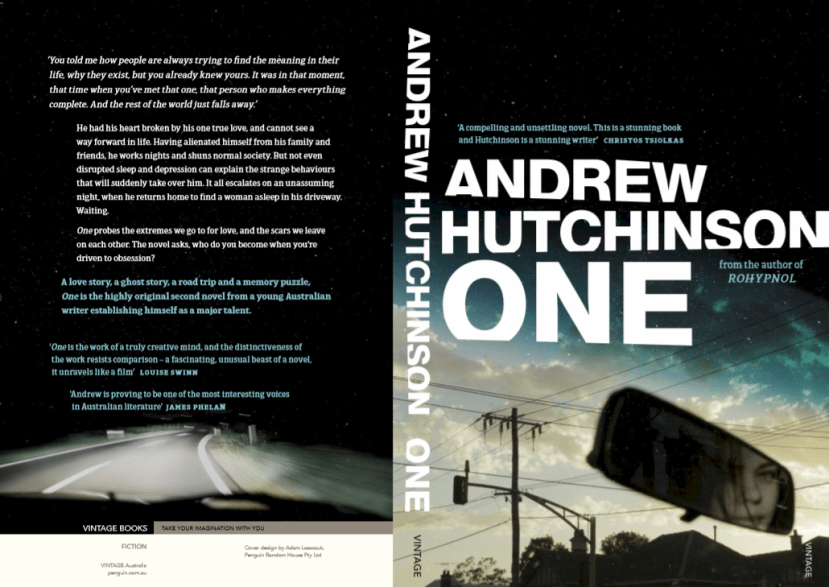
And holy shit, this is what Christos Tsiolkas, author of The Slap, Loaded, Barracuda and many others had to say about ‘One’:
“Andrew Hutchinson’s One is a compelling and unsettling novel. The control and the lucidity of the writing are formidable, and Hutchinson never once lets the narrative force lessen: the directness of the prose keeps us riveted and keeps us frightened. And we are always aware that beyond the engrossing story that the novel is opening up crucial and complex questions about memory, obsession, grief and love. This is a stunning book and Hutchinson is a stunning writer.”
It’s getting real now.
My Top 5 Films of 2017

With the first hours of 2018 almost upon us, it seems like a good time to take a moment to reflect on the year that was in cinema, and the best things that I got a chance to see over the last 12 months.
It’s an interesting time for movies. Advances in TVs and home cinema have somewhat lessened the value of the big screen experience – why pay to go to the movies when you can get much the same experience by staying in the comfort of your own home?
This is not a new phenomenon, of course, it’s been this way for the last five or so years, but it seems like 2017, more than any other year, saw studios putting all of their focus on big budget movies – those which are able to provide an experience that you can’t re-create at home. Which has seen arthouse films losing out.
Many of those directors who would be making more niche hits are now shifting across to Netflix and other providers, giving us TV shows like Stranger Things, which may once have been a breakthrough indie film. Yet at the same time, while smaller productions seem have been getting less exposure, a recent raft of disappointing big-budget films may herald a new wave of creative, inventive cinema, and force production houses to re-think their creative process.
That, I think, has been somewhat exemplified in the top films I’ve seen. Here’s my top five from the past year.
Arrival
Directed by Denis Villeneuve
Technically, Arrival came out in 2016, but I only caught it early in January, and even now, it stands out as one of the best films I’ve seen in recent times.
I’ve written about how much I love Denis Villeneuve’s work before, with both Enemy and Prisoners being stand outs (Enemy is far more divisive, but it’s one my favourite movies ever). Arrival showcases the best of his abilities, with an intriguing story (based on a short story called ‘Story of Your Life’ by Ted Chiang) which enables Villeneuve to shift his narrative structure for the biggest emotional impact.
Lady Bird
Directed by Greta Gerwig
There’s a lot of hype around this film, and it’s totally justified. Lady Bird is a reminder of how great cinema can be, of the emotional impact of the medium.
The film tells a simple story, but captures each key moment in a relatable, intimate, and affectionate way, which invites the audience in to share the experience – an experience which everyone can relate to on some level. A must-see that likely won’t be playing in your local Hoyts.
I, Tonya
Directed by Craig Gillespie
I have to admit, I would not have picked Margot Robbie to become the force she has developed into. Not only is her performance stand out in this film, but she also co-produced, further building her brand.
Everyone knows the story of Tonya Harding on some level, which, if anything, makes it more difficult for I, Tonya to succeed, because you know where it’s headed. But Gillespie’s direction – which reminded me of how Andrew Dominik approached ‘Chopper’ in many ways – elevates it, and along with Robbie’s performance, makes it a stand out.
Wonder Woman
Directed by Patty Jenkins
After seeing Wonder Woman, my first response was that they should give all the superhero movies to Jenkins. The pacing, story and development is exactly what a big-budget blockbuster should be.
Sure, it’s a Hollywood movie, so it sticks to familiar beats, but Wonder Woman has succeeded where so many other Marvel/DC movies have fallen short. In a year of major disappointments on this front, Wonder Woman stands out – the major producers should be taking notes.
Coco
Directed by Lee Unkrich and Adrian Molina
Again, with so many big studios falling short in the narrative elements of their films, Pixar shows us what good storytelling is all about.
In fact, Pixar have got the process so down-pat that you pretty much expect it, but still, Coco manages to remain fresh, and highly relevant, despite following the familiar Hero’s Journey structure which has been Disney’s staple.
Those are the ones that stood out most for me this year – though admittedly I haven’t caught everything I would have liked (I haven’t seen ‘The Shape of Water’, ‘Call Me By Your Name’ or ‘Get Out’, all of which have been highly praised and I have been meaning to check out). But even so, the films I have seen have highlighted to me that there are new sparks of life within the cinema landscape, that deserve attention beyond the mainstream sequels and prequels and adaptations. The positive to those films falling short is that it’ll provide more opportunity for new voices, while the expansion of alternative platforms will also enable greater opportunities for good, original stories.
Story vs Purpose
Is your writing story-driven or purpose-based? Do you start with a story in mind or a message, a topic or idea you want to explore?
I guess, both can come concurrently, but when I write, I’m always first driven by a question – ‘how does that happen?’ – then the story develops from that initial seed.
For example, my first novel Rohypnol is about a group of guys who drug and rape girls at nightclubs – that idea came about because I’d heard and read reports of an increasing number of drink-spiking cases in Melbourne, where I lived, and I couldn’t understand why someone would want to do that. Adding to this, there was a notorious case of a group of gang rapists in Sydney, which I was even more confused about – that one person would do such a thing was horrendous, but that a group could do the same together, and not one of them stopped it, that was even more confounding.
That then lead to me trying to imagine a possible scenario where something like this could occur, to try and understand what was happening, why it would happen. Now, there’s always going to be nuance and variability within any story, you can’t possibly explore every element, particularly of such a terrible crime, as it’s beyond the realm of most people’s understanding. But what could lead to that thing occurring?
A simple newspaper headline is never the story, and the only way make sense of anything, even something you might find horrific, is to contemplate it. For me, writing is thinking, clarifying my thoughts, trying to understand more of the world and the people within it.
For my second novel, One, I wanted to explore the extremes people go to when they’re in love, the fact that some people will destroy their own lives, will risk everything for even the basic acknowledgment of another.
In another, in progress, story, I’m looking at the illusion of control, how things can change in a moment, and how your past defines your future more than you think.
For me, it’s important to have these defining purpose objectives to keep my story on track. While you might want to explore certain developments or character shifts, it’s also important to remember what it is you’re trying to achieve, when you’re trying to say, and what you want to leave your reader with. Story is still absolutely crucial – you’re not going to be able to deliver any message without a compelling narrative – as is the writing itself, ensuring each sentence works within itself, and maintains the flow of the character voice, or voices.
This also helps when you find yourself stuck and/or struggling to resolve plot points – going back to the core message can help you re-frame your work and see it in terms of what you want to communicate.
That’s not to say this is the only way to write – everyone has a different approach, and different objectives with their work – but I think most authors will find, at some stage, that there’s a clear message they want to explore, an idea that best captures the core of what the story is about, even if that’s not how they initially started out working on it.
And once you do find it, that core, driving element, it can greatly help clarify and solidify your work.
Exhausted/Excited
Looking forward to 2018.

Personal Details
One of the hardest things about writing, and creating an honest, true to life story, is that you have to include personal details. But how much personal info is too much – and what happens when people recognize themselves in your work?
Personally, I’ve never had anyone say they recognize themselves in my stories – or at least, not accurately. Some people have suggested that ‘character X is John’ and they’ve been wrong, but definitely there are some characters in my work who are based on real people that I had in mind when writing.
The tricky part is, how can you create an authentic character – who, ideally, lives and breathes beyond the page – without referencing your own experience? And really, you can’t. Your perspective is what makes your writing what it is, so you need to establish the balance of knowing what the character would do in a situation, and not what you, or someone you know, would do, or has done. And you can only do that through your understanding of people, which is informed by your experience.
This was more of a consideration with ‘One’, as it explores relationships, and how the character has responded to them. None of his responses were my own (I don’t think), but I can see how people might have got to certain points in their relationships, so it is, in part, built around the framework of my own history.
That’s concerning because people will read it, people will read into it, friends and ex-partners will see themselves, whether it’s there or not.
But the thing is, you have to be honest. You have to put your heart on the line, to a degree, and go with the pull of the story. At times, that’s going to be uncomfortable, but shared experience is what all good writing is. Even science fiction and fantasy stories work based on mutual understanding, on being able to capture a mood and re-create the emotion of the scene within the reader. They can only do that because you’ve shared something real through your words – and often, that ‘realness’ will be based in your own perspective.
It’s always a delicate balance, but you have to be honest, and put that out there, to create truly resonant work.
 twenty six