Tagged: Publishing
Meanjin
It’s pretty sad to see Meaniin being shut down, given the significance that it holds within the Australian literary landscape.
Meanjin, for those unaware, is arguably the peak literary journal in Australia, and has presented a long-running showcase of some of the top talent in the region. Founded in 1940, Meanjin has been the kicking off point for many great writers, and has helped them connect with an array of new readers. And for many authors, it has also provided ballast within the ever-challenging literary waters, in giving them a means to find community, find voice, and set the standard for literary exploration.
But now, its publishers, the (indirectly) government-funded Melbourne University Press (MUP), have decided to end Meanjin, due to poor sales.
Or more specifically (as per MUP Chair Professor Warren Bebbington):
“The decision was made on purely financial grounds, the board having found it no longer viable to produce the magazine ongoing.”
So low sales, which no longer justify MUP’s investment in the publication. Which, given that it’s funded by Melbourne University, which recieves significant government funding, is questionable, particularly when measured against its broader cultural impact, while it’s also notable that the Australian government’s currently seeking new ways to better fund arts projects through its Creative Australia initiative, which has a dedicated (yet strikingly bare) writing specific element that, presumably, would be able to assist in supporting key platforms like Meanjin. But to be clear, the call on this did not involve the government, it’s the MUP board that has made the decision.
It’s disappointing, but it’s also not a huge surprise. The Australian literary sector has been decaying for years, with fewer people willing to commit the time and mental energy into more complex, challenging narratives, thus impacting literary sales, and re-shaping the book industry.
Like all forms of entertainment, books are fighting a losing battle against social media for attention, and literary fiction has arguably suffered the most. Which, reflecting market demand, means that many great books are not being published, and many great writers are simply not getting the opportunities they once would have. At the same time, some authors are also reforming their creative approach in order to fit into the modern market, so they can make a career out of the opportunities that remain.
The end result is a less vibrant literary ecosystem, and a less engaging literary community, which ultimately means a smaller audience for all books, and a more limited scope of concepts and ideas. The loss of Meanjin will only compound this, by giving us one less outlet for high quality writing, and one less entry point for emerging writers looking to test their skills, and find a path into book publishing.
For me, Meanjin was always a lofty goal, a benchmark to prove my literary talent. I submitted a few times, never got published (understandable, considering the names I was competing against for space), but I did make it into many other literary journals and magazines, all of which helped to assure me that I did have the talent, and that I could pursue writing as a career.
That’s the role such publications serve. Sure, Meanjin was a showcase of the best published authors of the day, but it was also open to submissions from nobodies, people who hoped to get their name out there, and in front of a knowledgeable audience. It was a badge of honor, a prize in itself, and a lifeline for every writer who’s creating in isolation and hoping for their big break. Meanjin was part of the architecture of what had been a consistently over-performing Australian literary industry. And without it, our writing culture will be worse off, in a significant way.
Which is pretty disheartening, and for aspiring writers, it’s a big blow, in an increasingly challenging writing landscape.
Does that mean that you should abandon your literary dreams, or maybe change what you write for market fit?
Look, there’s always going to be a level of market consideration in any writing, as you need to create stories that are going to resonate with an audience if you ever want to generate sales and make money from your work. But should you abandon literary fiction as a result of the current state?
I would say that you should write what resonates with you, and what best reflects what makes you excited about literature, in the style that you feel best enables you to communicate what you want to say. If you write a story in a style that fits, as you want to tell it, then you’ll feel it as you’re writing. And when you come back to it later, and read what you’ve written, if it then still feels like what you wanted it to be, like something that you’d like to read, then that’s the right voice, the right style, and that’s how you get to the creative expression that best represents your perspective.
Basically, it’s easy to be negative, and if you do choose to take a negative view of things, you’ll find that there’s no end to the indicators that will reinforce that view. That literature is in trouble, that your opportunities are gone, that you have no chance of ever being published. There are far more reasons to avoid a literary career, and if you choose to see things from that perspective, every story like this will underline it even more.
But if you choose to remain true to your passion, to the writing that you love, to the stories that you want to tell, the characters, the settings, etc. If you stay true, then you’ll be on a better path to personal satisfaction and exploration, which, in all probability, is also more likely to reach an audience.
It’s also worth noting that your personal perspective cannot be replicated. The way that you see things, the way you interpret them, no other person will view things the same, which means that they also can’t subsequently communicate things the way that you can. And if you can hit that resonant frequency, where all of these creative elements align, that’s where the truly great works come from. And you can’t do that without creating in the style that speaks to you.
So while the loss of another literary opportunity is disheartening, it’s not the end of all opportunities. And eventually, readers will come back around. Eventually, publishers and producers will once again realize the true value of great writing, which tools like AI can’t replace, and things will shift.
As a writer, I would advise that your job is to find the voice of your story, and explore that until you feel like you’ve got it right.
lit crit
One key piece of advice that my mentor Christos Tsiolkas gave me before the publication of my first novel was this:
‘Don’t ever reply to critics’
Christos said that people are going to say what they say, and definitely, some of it is going to annoy you. But there’s no good outcome if you respond, there’s nothing you can say that hasn’t been said in the novel itself, and you’re best to just let the work have a life of its own, and be happy with what you’ve produced.
I wonder if this still applies in the modern literary landscape, where audience engagement on social media is now such a big consideration, and where publishers actually want authors to have an active presence, and be more than their work.
Because these days, who the author is matters. Where the writer came from, their life and inspirations, what they stand for, what they represent, all of these things matter more than they used to. Topicality will get you more press coverage, or at least more opportunities for interviews and discussion, while taking a definitive stance is a big part of social media resonance more broadly, due to discussion stemming from your opinions, in agreement or not, which can prompt algorithmic boosts. The modern media landscape is much more politically driven, and if you can play into that, you’ll get more coverage and awareness.
So maybe, you should respond to critics, or at least the ones who question who you are, using that as an opportunity to communicate your own stances and opinions. That could actually be a positive, but it is interesting to consider the shift in this respect.
For a lot of my favorite authors, I would have no idea who they are, beyond their work. Amy Hempel is my favorite writer, and I can’t say that I know anything much about her personal life, except that she likes dogs. Cormac McCarthy lived a fairly quiet life, though there are questionable elements of his personal history. But I have no clue what his political stances might be. I assume had he published Blood Meridian in 2025, we’d know much more about him, and that may have even tainted his legacy (if, of course, Blood Meridian would even make it to print these days).
It’s interesting to consider the shift in the way that the media handles people who come to public attention, from writers to actors and everybody else, and how we now know so much more about who they are, and what they care about, than we did in the past.
Is that a better way to approach creative talent? Do we need to know more beyond their work?
In some ways, yes. It’s good to know, for example, that J.K. Rowling has some disagreeable stances, though that does also make me a little more hesitant about supporting her work.
Is that the way that it should be, that external factors sway how we feel about their output?
Ideally, we should probably seek to judge all creative output on its merits alone, and how well the artist has expressed their vision. That would be the most pure assessment of art.
But that would also mean overlooking certain things in favor of the end result, ignoring ugly truths in favor of beautiful creations.
And that’s the way of the past, in the pre-internet era, in which predators could go unchecked for years because of their talent, and it was easier to obscure such from the public.
That’s not a good outcome either, but judging artists on anything other than the work itself also feels unfair, and could mean overlooking merit.
But in the social media era, this is more important than ever.
But if having the “wrong” opinions could kill your career, that also means that we may well be missing out on some of the best, most impactful work.
Either way, it’s another consideration in your broader literary journey, and how you maximize your opportunities.
back to it
Okay. The time has come to write about writing once again.
Why now? Because I miss talking about writing and literary theory, and I don’t get to do it anywhere else.
In terms of published work, I’m currently in a state of semi-forced hiatus, because the publishing industry isn’t really looking for what I write.
That doesn’t mean that it’s bad, necessarily, but right now, thrillers and crime novels (and recipe books) are selling, literary fiction is not. Topical books, books with expanded social commentary, books from people of marginalized backgrounds, these are the types of things that readers, and what remains of the reading audience are seeking out.
Which is good, in many ways, in giving opportunity to a wider scope of writers. But less good for me at present.
So I don’t have anything on the horizon for publishing, but I do have several manuscripts that I’ve completed to first draft, and several ideas that I’m exploring. Indeed, I write a novel a year, because I love writing, but I’m less attached to the literary industry and the scene type stuff that draws many wannabe authors in.
Of course, if someone offered me a publishing contract, I’d take it, don’t get me wrong. But also, I’m an introvert and a quiet person, and I’m happy to not have to do the circuit. So it’s good and bad.
Though that also means making less money from my fiction work, and ideally, that would be a real career path. But it’s not a realistic one, for almost any author in Australia. The average income for a fiction writer in Australia is $18,200 per year, and that’s probably at the higher end of what most writers make for their fiction work alone. So really, it would be considered a hobby, even for the names that you recognize on the bookstore shelves.
Yet, even so, I, like many others, write for the love of it, and the need to get these stories out of my head. And things change, literary trends shift, book popularity ebbs and flows.
Maybe something I write will align with the right trend at the right time at some stage.
But as I say, I still write, I still read as much as I can, and I still like to talk about the craft of writing, and learning how to become a better writer.
So I’m gonna’ go back to writing about that.
In some ways, it feels less impactful at this stage, because if my own writing isn’t selling, what can I offer in terms of valuable writing advice? But I do know writing, and what works, in general terms, versus what doesn’t.
And hopefully, if you read along, we’ll both learn some new things.
Author Interview: James Phelan

In my time at writing and literary events, I’ve had opportunity to meet a lot of authors. Most of them are pretty quiet, all of them have been pretty nice, normal people, but a couple have become genuine close friends. It’s great to have a few writer friends, some people who know what it’s like to commit yourself to such a solitary act. It’s also great to have them to bounce ideas off, talk about your frustrations or concerns, just share with folk who’ve gone through a lot of the same things.
One of those people, for me, is James Phelan. I met James at the Newcastle Writers Fesitval in 2006 and we hit it off straight away. What’s always been really interesting for me is James writes in a completely different style to what I do. James’ novels are action/thrillers, and I’ve never been able to get into them. But hearing such a difference perspective on writing and the writing/publishing process has always fascinated me. James is the guy I go to when I need to ramble about writing and the challenges I’m having, the guy I seek out if I don’t know how this or that works in the industry. He’s also a close friend whose always been willing to listen to my ramblings.
I asked James to answer a few questions on writing and his writing process:
When did you decide to pursue a career as a writer?
I was 15 when I knew I wanted to be a novelist but I thought you had to be an old dude to do it. So, I figured I’d give it a try when I retired from a “real job”. I studied architecture and worked for a couple of firms, and by 20 I knew that I had to give writing a serious try. I wrote my first novel by 21, got a job at a newspaper, did an MA and PhD in Lit, and had my first novel published published at 25.
What’s the most challenging aspect of being a full-time writer?
Deciding what to do next. I’ve written series for adults, young adults, and kids, and each has its pros and cons. The adult stuff has complete freedom, YA slightly less so, and the kids stuff has a whole bunch of things that the publishers tell me I can’t do or say on the page. The YA and kids stuff involves way more PR, on average a day per week, and while that’s great in terms of meeting enthusiastic readers, it sucks time away from writing. Publishing books for adults is more about Crystal, Maybachs, diamonds on your timepiece, jet planes… you know the rest. Publishing books for kids sells about 10x more.
What’s the key to ongoing success?
Working hard. It’s easy for a writer to procrastinate, and there’s creative merit in that, sure. I write every day, starting early in the cafe nearby. Depending on which stage of writing I’m at, I’ll be sitting with my notebook or laptop or print out. Every day. That’s the writing side. The business side – you need good agents (and an accountant) who you trust will give you good advice when you need it, look over your contracts, and support you through the process.
Best tip for keeping ideas flowing and avoiding/beating writers’ block?
It’s my belief that if you write every day you’ll keep things moving along. That, and knowing your ending. Whether I’m writing a short story or a 40,000 word novel for kids or 90,000 for adults, I always know how I want my ending to play out. Not so much beat for beat, but in my ending I need to know the feeling that I want to create in the reader, be it comedic, dramatic, tragic etc. Usually by the time I write the ending, it will play out different to how I envisaged, but that value will stay always the same, and by knowing where I was going I managed to get there. I’ve been a full-time novelist since 2007, and it’s all about working hard.
Best tip for writers starting out?
Don’t ever sign a 13 book deal. Only recently have I finished all my contracts, and the freedom is incredible. So, enjoy your freedom, while it lasts. Write what you want to write. Make it shine through revisions, then decide what you’re going to do with it. I still think that agents are worth their commission, so get one of those. How? By getting published. How do you get published? By having an agent, or already being published. I know, right? Oh, and don’t forget to read as much as you can and as broadly as you can. Good luck.
[Note: Not everyone’s as luck to be offered a 13 book deal, and I’m sure most would jump at the chance, but as noted by James, it can be double-edged]
James Phelan’s latest adult thriller is ‘The Spy‘, and the first books of his YA series ‘The Last Thirteen‘ are also available now. He’s also on Twitter.
Also, this punch really hurt him.

New fiction: ‘Memory’

Been a good week for getting my fiction out there – Tincture Journal have published one my short fiction pieces in their latest edition. The piece is called ‘Memory’ and is one I’m particularly proud of. You can get a copy for $8 here – get one and you’ll not only get some cool, new fiction to read, but you’ll also be supporting the Australian literary community.
Where to Get Published in Australia
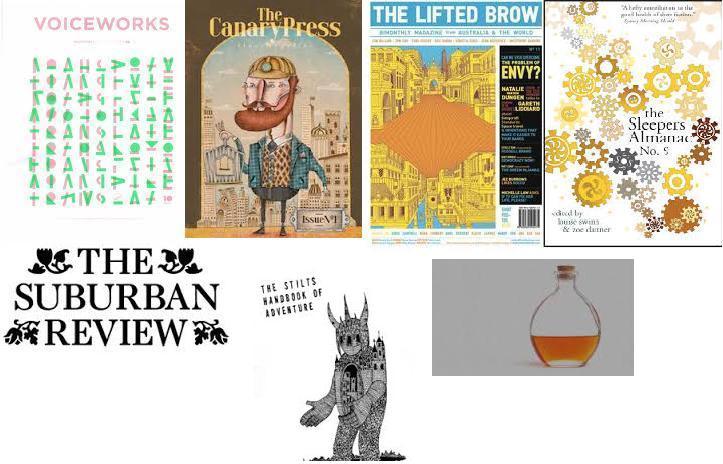
There’s nothing better than having something you’ve written published. There’s no better feeling than to walk into a bookshop and see your words printed on the pages of a book or magazine. It’s surreal, you remember where you wrote them, how you started with that blank computer screen. And now your words are here, for everyone to see. It’s extremely gratifying to have your work out there – whatever comes next, be it criticism or praise, you’ve already reached a level of personal success.
On that note, I thought it would be worth noting a few places fiction writers can get their work published in Australia. I’ve had the opportunity to work with most of these publications at some stage, and have enjoyed being involved, and I highly encourage all writers to have a look at what they publish and submit your own work.
Voiceworks
Voiceworks is produced by Victorian not-for-profit group Express Media and only publishes work by writers under the age of 25. It’s aim is to encourage new voices and provide publishing opportunities – not just for contributors, but for magazine staff also. Express Media has played a part in the development of many published authors and Voiceworks is a respected, quality publication. Writers under 25 should check out their submissions page and send something through – it could be a stepping stone to the next big break (I did a mentorship with Christos Tsiolkas via Express Media, which directly lead to the publication of my novel).
Tincture Journal
Tincture is a quarterly literary journal which is always on the lookout for new poetry and fiction. I’ve worked with the guys a couple of times and have thoroughly enjoyed the experience – they are knowledgeable, approachable and intelligent. They’ve also published some really great stuff and deserve more exposure – if you haven’t checked them out, go to their website and buy a copy – they’re priced between $5 and $8 and you can download and read them straight away (their Winter 2014 issue is also coming out very soon and features a new piece by me).
The Suburban Review
While still establishing itself somewhat, The Suburban Review is a quality publication. The artwork alone is worth checking out, but the content they’ve published so far has been high quality. Each publication is based on a theme, so you need to check out the submissions page to know what they’re after, but the guys are doing some great work and are gaining recognition for their quality and presentation. A group you want to be involved with.
Stilts
And speaking of groups you want to get involved with, Stilts are a literary collective based in Melbourne. They produce an amazing looking themed journal, but they also have regular events, columns and themed writing opportunities to get involved with. I’ve had two pieces published as part of the Stilts Monthlies series, which is a micro-fiction series based around a theme, and my experience working with the guys has been excellent, I highly recommend you check out their website and subscribe to their social media channels to stay up to date with what’s happening. Amongst these guys and The Suburban Review team are the literary leaders of tomorrow, worth getting to know them, and getting them to know you.
The Canary Press
Canary Press is probably the best looking literary journal going around. The guys have a distinct flavour, their own way of seeing things, and that’s also reflected in their content selection, but they’ve definitely made a splash on the local literary scene, and it’s worth checking out their submission guidelines and getting involved if you can. They accept pieces through Submittable, which means it can all be done online – easy, no fuss, why wouldn’t you give them a read and see if your work fits?
The Lifted Brow
The guys from The Lifted Brow have established a pretty good profile in the local literary scene, underlined by them creating a whole issue, from scratch, during the ten days of the Melbourne Writers’ Festival last year. Like Canary Press, they go for a definitive style of work, so you need to grab a previous copy to know how, or if, your work fits, but worth checking out, and a great opportunity if you can get a piece accepted.
Sleepers
The annual ‘Sleepers Almanac’ is one of the most prestigious publications for new writers in Australia. I love what Louise and Zoe do, and I’d get involved with anything of theirs I could – they are both strong supporters of new writers and genuinely love to find new, great stuff. Given the Almanac’s status, it is hard to get in, but their distribution is great and it’ll put your work in front of some of the most influential literary identities in Australia, so worth the effort. I strongly encourage everyone to support Sleepers, not only for your own publishing opportunity, but to help them continue their work in finding and nurturing great local talent.
This is by no means a complete list of the literary opportunities available – there’s also Meanjin, Overland, Best Australian Short Stories – there’s a heap of places you can submit to. It always worth checking out what they publish – if it’s a guest editor, look them up and see what they write or what they’ve edited before to get an understanding of which of your pieces will be a good fit – and always follow the submission guidelines and ensure your work is error-free. It’s important that all writers get involved in their local literary communities and groups – obviously the main aim is to get your work out there, but above and beyond that, you’re contributing to your local literary scene and helping build that local culture. The more we can build it, the more writers will be willing to get involved and the more young writers will want to take up pens and put down their own stories. As a writer, you can play a significant part in the growth of your own local community by getting involved. And the connections you can make, the readers you can reach, these can all have long term benefits for your own writing career.
The Evolution of Publishing and Why Writers Should be Active on Social Media

Here’s a important fact: The publishing industry is changing. What started with Amazon selling books at increasingly lower prices has now extended with e-books – Kindle sales in 2013 were up 26% on the previous year, eBook sales, which accounted for 0.1% of total book sales in 2006, now make up more than 20%. The change in consumer behaviour has lead to the demise of many booksellers, and I’m sure everyone’s felt that glint of sadness at seeing your local bookshop gutted , the words ‘Closing Down’ plastered across the front window. The industry’s making less money than it once was, and the difficult thing for writers is, less money in the industry means less money to put into projects, making it even harder to get your book published by any of the major players.
You can see a similar impact in the film industry – the squeeze on revenue leads to more producers looking to safer bets. In the 90s, there were more arthouse films, more opportunities for up-and-coming film makers. But as tickets sales have declined – whether due to advances in home theatre or the rise in movie piracy – those investing in films have become cautious. That’s why you see so many sequels and big budget remakes being made – they’re safe bets, they know there’s an audience for them. It doesn’t matter if you think Transformers is total crap, it makes the studios alot of money. We’re seeing this happening in publishing also – while there are still great, exciting and fresh new works being produced, the reduction in retail outlets has seen more emphasis on commercial thrillers and romance books, safe bets that make the publishers money. This atmosphere makes it increasingly difficult for unknown writers to cut through and get the majors to take a risk on your work. On one hand, it’s a sad thought, it was hard enough to get attention before, but there is another aspect in the shift in media consumption that can help, a way authors can help themselves, make themselves more enticing and even build an audience all on their own. Social media has changed the way people communicate, changed the approach to marketing and publication. While opportunities in traditional publishing are getting tougher to come by, the opportunity to build your own brand is greater than ever.
Utilising social media is a must for would be authors – here’s a few notes on the why and how of social for writers.
* You need to get yourself a blog. Obviously I’ve got an inclination towards WordPress, but there are a heap of options out there, and a heap of ways to leverage a blog to build your own audience. Writing is what you do, so you should be sharing it, and a blog is a quick, simple way to build awareness of your work and establish a digital showcase for all your projects.
* Join online writers’ communities. As social media facilitates greater connection throughout the world, it also allows every individual to have a voice. As a writer, this means you have more opportunity than ever to get involved in writers’ groups and communities and build a following that’s interested in what you have to say and what you produce. At the very least, being involved in the various social media communities will give you free education on writing and what’s happening in the industry. The amount of insight and info available is staggering, if you know the right places to look.
* All writers should sign up to Google+. Google+ has a heap of highly active communities, particularly for writers. The learning curve can be steep – G+ is different to other social networks – but the platform’s biggest strength is it’s communities. That’s where you can make connections and find like-minded people to learn from and share ideas with. Being on Google+ also allows you to sign up for Google Authorship, which has it’s own benefits for writers of all types.
* Twitter is an amazingly powerful tool. I know a lot of people are not sold on Twitter, not convinced that you can make much of an impact with 140 characters, but Twitter is the best tool for making connections and sharing your content. Use Twitter’s search function to find other authors and writer-types and follow them, as well as literary publications and organisations that hold writing competitions. Use applications like Hashtagify to locate relevant hashtags which you can use to find active literary conversations, as well as using them to gain exposure for your posts (the tags #writing and #amwriting are very popular and will help others locate your content). Find out what sources publishing industry folk are reading and see if you can get content published on the blogs they’re looking at to raise your profile (there’s an application called Twiangulate which can help you locate the main sources that specific users are looking at). Find Twitter chats on writing and take part if you can (great list of Twitter chats here). Twitter is also great for sharing your content – every time you publish a new blog post or announce that you’ve had something published, post it to Twitter, use relevant hashtags, and track any shares of your content with a management tool like HootSuite. From here, you can thank people for sharing your stuff, start conversations, and make connections that will help build your profile and establish your position. Writing the content is only one part of the equation – you need to actively promote and engage with your audience to build your presence.
* Share content on Tumblr, Pinterest and Facebook. Some people have a heavy reliance on Facebook, but I generally only use it for personal purposes these days, so my view on it may differ from yours, but you should always share your blog posts and updates on all these channels. Tumblr provides an opportunity to reach a new audience, with effective and engaging presentation options to use. Pinterest, while it is a visual-based platform, also gives you a way to reach a whole new group of people. Post interesting images and link them back to your blog, pin new blog posts with relevant hashtags (most of the major networks facilitate hashtag use, except LinkedIn). There are unique audiences on each platform, it’s in your interests to maximise opportunities by sharing to more networks, but research what’s working and where to find your target audience on each. All social platforms have different best preactises, best to learn and utilise these as you go.
* Investigate other platforms. Medium is a publishing platform which is focussed on writing over all else – the design is simple, the process is easy, the visual focus is the words. The groups for fiction work are very specific and there’s a lot of writing discussion being had, so long as you can find the right categories for your work. Definitely worth checking out.
These are just a few notes on the possible options for authors, and the ways in which writers can build their brand through social media. Taking these steps can open doors you never thought possible, and at worst, it can’t hurt to build a following. If you can establish a group of engaged followers who’ll share and amplify your message, it can only assist in building your status as a writer. Some people don’t think they have the time, some feel the learning curve is too steep, but as more people conduct an increasing amount of their daily interactions online, having a presence on social media is only going to become more important. Social gives everyone the opportunity to establish their skills and expertise, ways for writers, in particular, to showcase their talents and marketability. It’s worth investing the time to raise your profile and build connections – those actions could help you find new avenues to publishing success – and as the publishing industry evolves, you might just find yourself at the forefront of the next literary frontier.
Commercial Realities
I caught up with a writer friend today and we were talking about the difficult commercial realities of being a writer, particularly in with the current state of the publishing industry. This is an issue that’s being discussed in many writing communities at the moment (including here), and being felt by the media industry in general – with so much content available for free online, it’s harder and harder to afford to make a career out of writing, or indeed, any artistic pursuit.
One of the things we went on to discuss was the state of consumption, and how media consumption may be changing the publishing industry. We generally have an accepted story structure in mind when we view things, based on movies we’ve seen and books we’ve read. We know there’s a beginning, middle and end and we have a good feel for what should happen in between, and this is how it’s always been, according to Joseph Campbell and other academics. But it feels like we may be on the cusp of a change to the way writing and story structure is accepted.
I noted this when my three year old son was watching Superman clips on YouTube. I was watching him as he clicked through, and he got onto some of the old Christopher Reeve Superman clips, and he loved them. This prompted me to get out the orginal Superman movie to show him, thinking he’d be excited by it. But he was totally bored by the storyline. ‘Find Superman’ he said, handing me the remote to fast-forward through. Granted, he’s a three year old, so he’s not really into storylines so much, but maybe his approach is indicative of a shift. He’ll never need to sit through the boring parts, he has YouTube. Maybe he’ll grow up with a different story progression in mind because of this. Maybe, the entire way we view films and books will need to change with the next generation.
I’m sure we’ve already seen examples of this – those Transformers films make almost no sense, but they are constant highlights. It’s possible that that’s what we’ll see more of, highlight reel films and that will inform the next generation.
Now, I don’t think that will mean the death of storytelling – I think there’s actually examples in the past year of a resurgence in film story – but I do think it’s something that will drive the commercial reality of being a writer, and may become another barrier for us to climb over, which is unfortunate. I believe we’re already missing out on some great novels even being produced because writers cant afford to write them. I believe that’s the main reason most authors only ever publish one book. And it’s a shame that we can’t (or haven’t yet been able to) find better structures to ensure literature and the arts are better funded so we don’t miss out on potentially great work.
There are discussions on this, I know, and hopefully they do lead to more opportunities for artists to survive amidst the ever-mounting commercial pressures.
 twenty six