Tagged: Creative Writing
Weekly Writing Challenge – Haiku
I haven’t tried one of these before, but I’m having a shot at the Daily post Writing Challenge this week – which is ‘Haiku Catchoo!‘, writing five haiku poems for the week. Haiku poems, as noted in the challenge post are:
‘A traditional haiku has 17 syllables or “sound units” known as morae. The syllables are broken into three lines, where the first line has five syllables, the second line has seven syllables, and the final line has five syllables (5/7/5).‘
I’ve never done one before, but here goes my five:
Lonely
Lonely, I wait for,
The time when you return to,
Hold my hand again
My Son
My son doesn’t speak,
He reaches forward, eyes closed,
And touches my face.
Rain
I can smell the rain,
Coming over the distance,
Grey clouds flood the sky.
Beach
The beach reminds me,
Of a time when I was young,
And nothing mattered.
Flowers
I don’t get flowers,
They die when not in water,
But they make her smile.
Becoming an ‘Author’

I read this excellent article by author Christopher Currie recently. It raises many of the issues and observations that I’ve found since becoming a published author, and those issues are part of the reason my second novel has been de-railed so many times. Chris is an excellent writer, and he has succinctly put into words many of the downsides of being published in a way that’s not complaining about success, which is one of the things that I’ve been most fearful of when discussing the same things.
I met Chris at the National Young Writers’ Festival in Newcastle several years ago, though Chris, I’m sure, either thinks I’m a total douche or an incoherent idiot – I treated Newcastle like a weekend off and was several beers into the night when we met. I’ve always felt bad about this, because I really like Chris’ work and his observations on writing – but this article in particular stands out to me because it’s talking of the negatives of the other side of publishing, of being an actual, published author.
As Chris notes, he is not complaining about success – and I too would never complain about being published. It’s a massive achievement and the people I’ve come into contact with have been amazing, and it’s the only thing I’ve ever really wanted to do. Writing, also, is almost an instinctive process for writers, it’s something we have to do. I can ignore it for periods, but it’s always there, stories being written in the back of my mind. Being published has opened up a heap of opportunities and it remains my dream to be a full-time author. But that’s where things get a little more complicated, and this is what Chris discusses in his article.
I guess the first, and main, point, is that becoming a published author will not necessarily change your life. When I first signed a book contract, the company I was working for was undergoing a takeover. People all about the place were stressing about losing their jobs, doing all they could to make good with the incoming managers. It was a pretty sad situation, a lot of good people, good employees, stressed because of something beyond their control. Me, I had a publishing contract. I thought I was going to have to leave work soon either way, heading off on book tours, doing talks. I was about to become a full-time author, so losing my job didn’t really matter to me too much. The idea in my head was ‘book gets published, you become full-time author’ – that becomes your job, your career. But I never really thought through how that might work.
The reality is not much changed. I was lucky enough to be retained at work and when the book was released I did a few launches and talks and interviews and then, about a month later, all was quiet again. It was back to normal life. The amount of money I made from my book was actually pretty good – I won $15,000 in the Victorian Premier’s Literary Awards on top of my book contract – but it was not enough to quit my job. I then sold the film rights, and that was massively exciting, and they signed up a director and we had meetings, wrote a screenplay, all was moving along. Then that production company folded. And by now it was several months after the book’s release so the ‘hype’ around it was gone and no other film companies were looking to pick it up (several have been interested ever since but it’s never been picked up). And life was back to normal. I wasn’t a full-time writer. Chris notes this, that you’ve only got a limited shelf life, and it’s totally true, then you’re back to where you were. I’ve seen lots of discussions and articles on this, and it’s hard to know if there is a way to fix it, but for me, I just couldn’t see how I was going to generate enough money from writing alone to be a full-time author, which was difficult to take, but that’s how it is.
The second down side, I found, was the publicity. Most of it was great, great people, good to get your name out there, have people discuss your work. But the negative reviews hurt. Bad. I only had a few, but they were in major publications. I’m pretty thick skinned with my writing, I can take people having a go at me and my work, no problem. But this was something I was immensely proud of, that not only me, but my editor, my publisher, other people had believed in and put their own hard work into. And then someone can totally trash it with a few paragraphs. It hurts, but again, that’s how it is. Not everyone’s going to like your stuff, you can’t write for every person. I’m much more comfortable with that now, but it was a learning curve.
The third issue I had was with the next book. For months after the book came out people always asked what I was working on next, and it was great, people were interested. Then the second novel got bogged down and it wasn’t working and people kept asking and in my head I was like ‘stop asking about it, it’s killing me’. This is no-one’s fault but my own, but Chris made an interesting note in his article – that he, in some ways, liked it more when he was unpublished. When there was no expectation. I can totally see where he’s coming from. I had an okay manuscript on the way by the time my first book was published. I signed a new contract as soon as it was offered, with the publication date set for a year or so later. This was what I’d always wanted, I was on my way, I could do this. I completed a first draft, had it all down, the story, everything was there. But it wasn’t great. I knew it. My publisher knew it. I went back to it, tried to fix it, but started getting myself in knots. Nothing was coming together, nothing was flowing, it wasn’t what I wanted it to be. And the most frustrating part – I knew exactly what I wanted it to be, I just couldn’t get it to work. I am still working on it, still writing that second book (among other projects), and I remain absolutely confident it’s going to be great, it’s getting closer each day. But the pressure I put on myself is what has blocked me up. I was no longer just writing something that maybe someone might read some day, maybe my friends would read – I was writing something that would be seen by a publisher. This had to be amazing. Not good, this had to be great. That expectation, my own expectation, has set such a high bar that it’s made it much more difficult to be free and flow with the story.
As I say, these are not complaints or not negative enough to ever want me to stop writing. They are more observations from the other side, which I don’t see a heap of. I can’t help but love writing. I do it every day, and I love getting that flow right, having a story form in my head, the sentences stringing together. I love having to get up and scratch around to find a pen in the middle of the night to get down some crucial sentence or note. I love everything about being a writer. And yeah, it’s hard, these points just attest to the fact that it remains hard as you go. I have no doubt that big name authors have the same challenges and issues. But it’s worth it. Nothing’s better than when everything feels right with a piece and you can’t wait for someone, anyone, to read it. When you know that you’ve been able to re-create the feeling you had when writing it in the body of another person. That communication is amazing. Nothing else comes close, for me.
And nothing beats the smell as you flick the pages of your own book.
As I work my way back into writing, getting more ideas and notes down, trying different ways to remain creative and create better work, this is what I keep in my mind. It’s tough, but you’ll get it right, it’s hard, but it’s always close to that perfect stream of a story.
Commercial Realities
I caught up with a writer friend today and we were talking about the difficult commercial realities of being a writer, particularly in with the current state of the publishing industry. This is an issue that’s being discussed in many writing communities at the moment (including here), and being felt by the media industry in general – with so much content available for free online, it’s harder and harder to afford to make a career out of writing, or indeed, any artistic pursuit.
One of the things we went on to discuss was the state of consumption, and how media consumption may be changing the publishing industry. We generally have an accepted story structure in mind when we view things, based on movies we’ve seen and books we’ve read. We know there’s a beginning, middle and end and we have a good feel for what should happen in between, and this is how it’s always been, according to Joseph Campbell and other academics. But it feels like we may be on the cusp of a change to the way writing and story structure is accepted.
I noted this when my three year old son was watching Superman clips on YouTube. I was watching him as he clicked through, and he got onto some of the old Christopher Reeve Superman clips, and he loved them. This prompted me to get out the orginal Superman movie to show him, thinking he’d be excited by it. But he was totally bored by the storyline. ‘Find Superman’ he said, handing me the remote to fast-forward through. Granted, he’s a three year old, so he’s not really into storylines so much, but maybe his approach is indicative of a shift. He’ll never need to sit through the boring parts, he has YouTube. Maybe he’ll grow up with a different story progression in mind because of this. Maybe, the entire way we view films and books will need to change with the next generation.
I’m sure we’ve already seen examples of this – those Transformers films make almost no sense, but they are constant highlights. It’s possible that that’s what we’ll see more of, highlight reel films and that will inform the next generation.
Now, I don’t think that will mean the death of storytelling – I think there’s actually examples in the past year of a resurgence in film story – but I do think it’s something that will drive the commercial reality of being a writer, and may become another barrier for us to climb over, which is unfortunate. I believe we’re already missing out on some great novels even being produced because writers cant afford to write them. I believe that’s the main reason most authors only ever publish one book. And it’s a shame that we can’t (or haven’t yet been able to) find better structures to ensure literature and the arts are better funded so we don’t miss out on potentially great work.
There are discussions on this, I know, and hopefully they do lead to more opportunities for artists to survive amidst the ever-mounting commercial pressures.
Night Traffic
I used to see her at the train station, waiting on the steel bench seats, headphones on, reading a book. I used to see her and wish she’d look up or that she might get on the carriage and sit near, but she was always just waiting. One night in the winter I got off at her station and she was there. Breath puffing clouds up through the streetlight and I walked over, her in a beanie and gloves and reading a book and I sat down on the bench seat, waited. I was all pimples and bad hair, I know I wasn’t anything, but I hoped that something might happen, that there might be some reason for us to talk.
‘Cold isn’t it?’ I said, but I said it so quiet that no one would have heard and then I could hear a muffled hi-hat whispering from beneath her beanie and I sucked in a breath through my teeth. Wringing hands in the pocket of my hoodie. Who was I? I thought. She was wearing black jeans and boots and I was too scared to look up any higher than that and she lit a cigarette, the smell filling the air all around and I turned to the smell and she was looking right at me. Eyes painted black. Staring.
‘What are you doing?’ She asked.
‘Oh me, oh, nothing.’
‘Why are you sitting here?’
‘Oh, I just sat… sorry.’
‘No, don’t be sorry, but there’s seven other seats all down the platform and no one else around, just wondering why you chose to sit there.’
‘Oh…’ I had nothing. ‘I didn’t really think about it, I just sat down.’
She held her stare as she took a long drag, let it leak out her mouth, trailing into the night.
‘What train are you waiting for?’ She asked.
‘Ah, the next one.’
‘When is it?’
‘I don’t know, it’s coming soon I’m pretty sure…’ I leaned forward to see the TV screens.
‘You don’t even know.’ She smiled, her eyes narrowed. ‘You have no idea about the train, do you?’
‘Oh, I don’t know exactly, but…’ I faded, kept looking for the detail on the TV screens, couldn’t make it out. She moved into my line of sight, here eyes moving all round my face.
‘Come on,’ She said, and she stood up, pulled her ear phones out from under her beanie. ‘Come with me.’ She held out her hand.
We walked along the footpath in the night, out through the park and past the abandoned playground. We walked along the flow of headlights washing past and the fast food stores and service stations all buzzing through the darkness and she lead the way up a hill, feet slipping on the grass. She pulled me up to the top. It was an overpass, a footbridge over the traffic. Four lanes of cars flashing back and forth beneath. She sat right up at the edge, her legs dangling over the side, pulled my hand to come down and join her. We watched the lights zipping beneath our shoes, so close. I could feel the rush of the trucks humming through my feet.
‘Sometimes I just come here.’ She said. ‘And I just sit here for hours watching. The lights flowing through.’ She was looking out, her hair flickering in the gusts. ‘If you close your eyes you can pretend like you’re the one who’s moving, the noise and the flow rushing by beneath as you glide along.’ She closed her eyes, put her arms out ahead of herself like Superman. She turned to me, smiling. ‘Do it.’ She said. I closed my eyes, pretended to fly. Imagined the still cars and trucks flashing underneath. It was an odd sensation, a trick of the mind. It did feel like you were moving. Flying. I opened my eyes.
‘It’s cool, right?’ She said. I nodded, closed my eyes again.
‘It’s cool.’ I said.
‘I’ve seen you.’ She told me. ‘I see you on the train all the time. I’ve always hoped you might get off at my station.’ And the flying sensation filled through me. The shadows moving across her face in the passing headlights. ‘For some reason I thought you might like this.’ She told me.
Little Things
People say that if you put a sea shell up to your ear, that you can hear the rushing of the ocean. The waves rushing up the sand then back out. But you can’t. What you hear is your memories. Sea sounds washing round inside your head. Cold edges of the shell pushed up against skin.
He can remember the softness of her eyes when she’d washed off her make-up, the curve of her spine up against his chest. The pops of her lips touching along his neck. He can remember watching her face when she didn’t know he was looking, strands of hair playing across her face in the sunset. These are the things. The details fading over time. He can’t figure how to keep them.
Put an ear to his chest and you won’t hear these things in his heart. What you’ll hear is just an empty shell. Lost at sea.
Peak Hour
It was peak hour traffic, crammed into the three lane roadway. It was raining heavy, the screeches of the windscreen wipers like screws tightening further and further. He switched lanes to avoid the traffic lights, where the right turning cars halted the thoroughfare and he pulled out and accelerated past then another car pulled out in front of him and he jammed on the breaks. The seatbelt choked against his chest and he sat up and raised his hands, looking at the car’s rear view mirror. The silhouette of the driver held up his middle finger over the shoulder of his seat, then accelerated off. He gripped the steering wheel and scraped the gearstick into first, rammed the accelerator to the floor.
He got up as close as he could behind the other car, a yellow car with a large sticker across the dark tinted back window. He chased, his right hand on the wheel as his left hand searched in the back seat and he looked over into the back seat, then back at the road, then into the back seat again. He gripped his hand round the rifle muzzle, hidden under an oil smelling old blanket. The yellow car stopped at the traffic lights and he pulled up close behind and pushed the gear stick into neutral and cranked the handbrake then he opened his door and rushed out to the other car. He fired a shot at the driver’s side window, burst the tinted glass like a bubble, then he fired again, like a camera flash inside the yellow car. Then he fired again. A woman in the passenger seat of a car in the next lane screamed, smacked the door lock down hard as she could, leaning towards the middle of the car. He rushed back to his car and lifted the gun over the front seats and put the car back in gear. The lights switched to green and he rammed the yellow car into the intersection and peeled off onto the left hand turn and accelerated away.
The right lane moved slowly, cars continuing past, shattered glass spilt onto the bitumen. People looked in, then covered their mouths. Other drivers had got out, were standing around and leaning down to see into the yellow car. Then they covered their mouths too.
Home
The man and the woman sit across from each other at the cafe table. There’s a storm outside, they’ve stopped in to avoid the rain and while they’re there they’re drinking coffee and waiting. The man reads a newspaper, the edges damp and shaded. The woman looks at the man, smiles.
‘Do you know poetry?’ She asks.
‘I know of it.’
‘No, but do you know any?’
The man doesn’t look up from his paper.
‘Poetry.’ The woman says.
‘No. I don’t know any.’
The woman watches his face as he reads, his eyes moving across the words. She looks out to the rain, the headlights of the cars washing by. Dark clouds pulled across the sky like a blanket, a cubby house from when she was a kid, over the whole world. She looks back to the man, touches the back of his hand on the newspaper. His fingers wrap over hers.
Active creativity
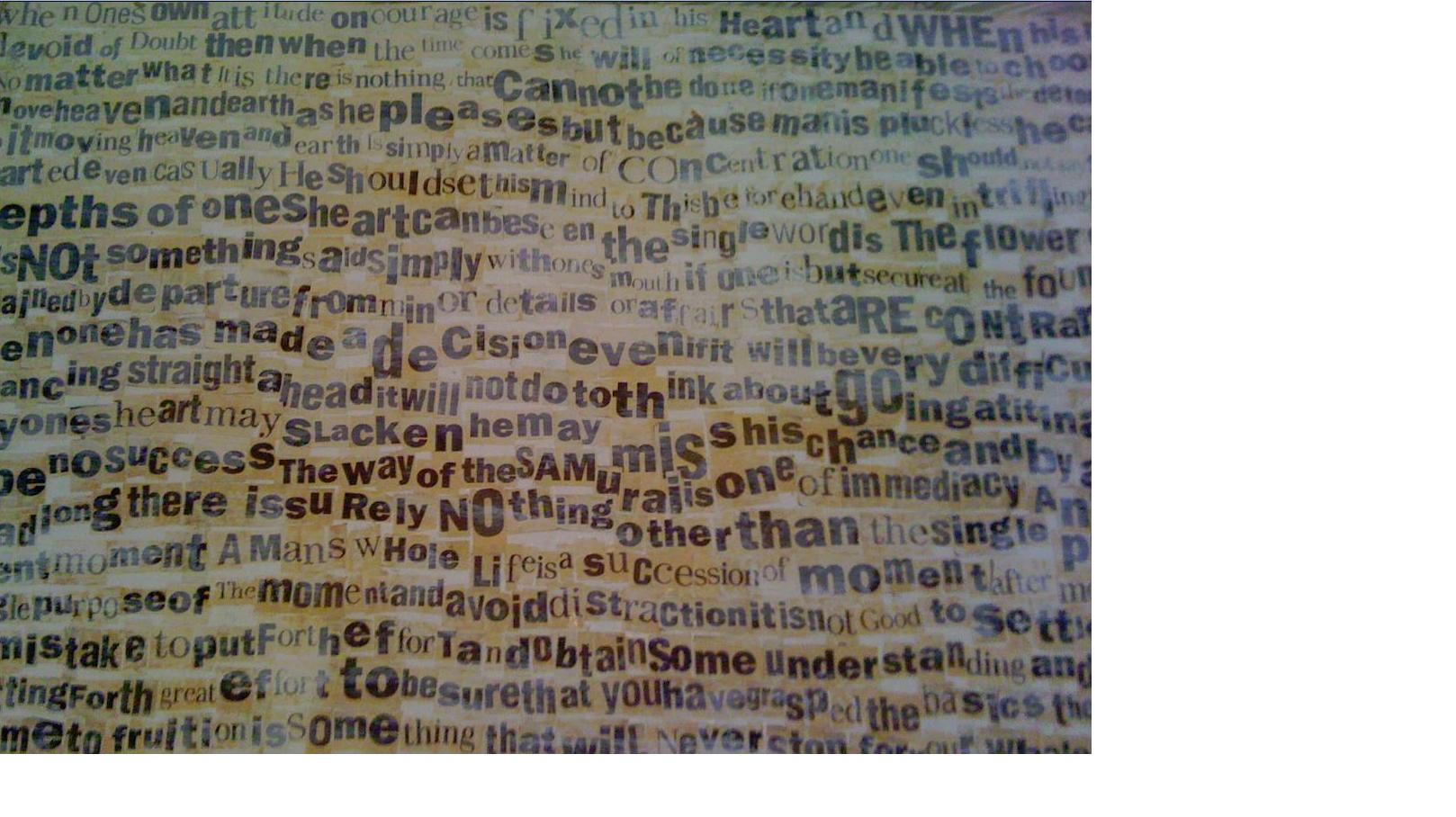
One of the hardest things, for me, is staying creative. That’s why I have to try and write 1000 words a day, to keep my creative mind open, so I can continue to see opporunities in every day life, every day things. It’s easier to ignore that imaginative side, just get on with reality, but when you’re doing something creative, you have to keep it open as best you can. I do this by watching films, reading books, writing as much as I can – sometimes making visual art pieces like the one pictured. I’ve heard that ‘1000 words a day’ target mentioned by many writers over the years, and it is true – the more you push yourself, the more you’ll find the words will come to you. There’s always hard points, times where things just won’t work no matter what you do, but writing every day, keeping that creative part of the brain active, it definitely helps.
Escape
‘As a kid I used to dream about being put in the bins, escaping from things, without my mum knowing she’d put me out in the bins. So I’m in a black plastic bag outside a building, and hearing the rain against it, but feeling alright, and just wanting to sleep, and a truck would take me away.’ – Will Bevan, aka ‘Burial’
 twenty six